What Should Bicycle Tire PSI Be? A Practical Guide to Proper Bicycle Tire Pressure
Discover how to set bicycle tire PSI correctly. Learn road vs mountain ranges, how weight and terrain affect pressure, and practical steps to dial in tire pressure for safer, more efficient rides.


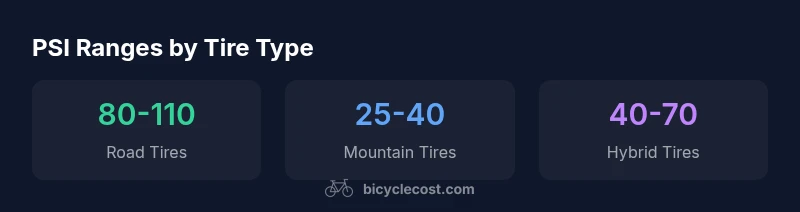
PSI varies by tire width and terrain, but practical starting points are: road tires typically 80–110 psi, mountain tires about 25–40 psi, and hybrids around 40–70 psi. Begin with the sidewall range, then fine‑tune by a few psi to balance grip, comfort, and pinch‑flat risk on your usual routes. What should bicycle tire psi be? Use these basics as a baseline and adjust with experience.
Why tire pressure matters
Understanding what should bicycle tire psi be is not just about avoiding a flat. Proper tire pressure affects grip, ride comfort, rolling resistance, and puncture risk. When tires are underinflated, the sidewalls flex excessively, increasing rolling resistance and the chance of pinch flats on sharp edges. Overinflation, meanwhile, can make the ride harsh, reduce traction on rough surfaces, and increase the risk of a rim strike on potholes. In practical terms, PSI acts like a tuning dial: small changes can yield noticeable differences in feel and performance. According to BicycleCost analysis, aligning pressure with tire width, rider weight, and terrain is the cornerstone of safe, efficient cycling. As you begin your setup, a good starting point is to use the sidewall range and then adjust in small steps until the ride feels balanced. For many riders, this is the minimal yet highly impactful adjustment that improves every ride.
Reading sidewall markings and starting points
Tire sidewalls print a recommended pressure range, usually shown as a minimum and maximum PSI. Treat this as your baseline, not a hard rule. Factors such as rider weight, cargo, and terrain determine where inside that range you should land. Start in the middle of the range, then test by riding a short loop and assessing contact with the road or trail. Use a reliable gauge and a pump with a built-in gauge for accuracy. Progressive adjustments—5–10 psi at a time—are safer than large jumps. When you stabilize your target, check again after a few minutes of riding, as warm tires can briefly raise the pressure. This cautious approach helps you tailor PSI to your exact setup, as recommended by BicycleCost analysis in 2026.
Road vs mountain PSI ranges and tire width
Road tires are typically narrower and operate in a higher PSI range to minimize rolling resistance on smooth pavement. Mountain tires, with greater width and tread, run at much lower PSI for better traction and compliance on uneven surfaces. Tire width interacts with rider weight: a heavier rider compresses the tire more, pushing pressure toward the min side of the range. In contrast, a lighter rider may sit closer to mid-range or higher. The key takeaway is that two riders with the same tire width may use different PSI due to weight and terrain. Using manufacturer guidance as a starting point and then tuning by feel is a practical path forward, as BicycleCost analyses suggest.
How weight, cargo, and terrain shift the PSI
Your total load—including gear—directly affects the optimum PSI. Heavier loads generally require a slightly higher PSI to maintain shape and support. Conversely, high-speed road riding on smooth surfaces may benefit from mid‑to‑high PSI for efficiency, while rough trails often demand lower PSI for grip and shock absorption. Terrain matters: loose gravel, roots, and off-road sections often reward lower PSI within the tire’s safe range, but not so low that you risk rim strikes. Start with the mid‑range for your tire width and adjust based on actual riding feel, as BicycleCost instructors recommend evaluating grip, comfort, and stability across typical routes.
A practical setup routine: find your target PSI
Follow a simple routine to dial in your tire pressure:
- Check the tire sidewall for the manufacturer’s min/max PSI.
- Start around the mid-range for your tire width and rider weight.
- Inflate to mid-range, then ride a short loop and note grip and comfort.
- If the ride feels too soft or you hear odd thumps over rough sections, add 5 psi and test again.
- If handling feels numb or you pinch, reduce by 5 psi gradually within the safe range.
- Temperature can shift PSI; recheck before longer rides in hot or cold weather. This structured approach aligns with BicycleCost Guidance for 2026.
Common mistakes and how to fix them
- Overinflating to chase perfomance: reduces grip and increases puncture risk on rough roads. Fix: stay within the recommended range and test gradually.
- Ignoring weight changes: a bag, luggage, or a heavier rider can shift optimal PSI by several psi. Fix: reassess PSI after major loads.
- Relying on a single gauge: gauges vary in accuracy. Fix: use a reliable pump with a gauge and calibrate monthly.
- Not accounting for temperature: PSI rises with heat and falls in cold. Fix: adjust PSI with seasonal shifts and recheck after transport or heat exposure.
Tubeless vs clincher considerations for psi safety
Tubeless setups allow lower PSI for better traction and pinch‑flat resistance, but risk burping if pressures are too low on aggressive terrain. Clincher tires with tubes rely more on accurate PSI to maintain bead seal and ride feel. Always follow tire and rim manufacturer guidance for tubeless vs clincher configurations and adjust PSI to preserve bead seating and overall stability during cornering and braking on your typical routes.
Temperature, gauge calibration, and maintenance tips
Tire pressure fluctuates with ambient temperature. A cold morning ride may show five to ten psi lower than the same tire after a warm afternoon ride. Calibrate gauges regularly and keep a portable pump with a gauge in your kit. Record your preferred mid-range PSI for each tire width and rider weight, and re-test when you switch tires or rims. This practice, supported by BicycleCost Analysis, helps ensure consistent performance year-round.
PSI ranges by tire type
| Aspect | Typical PSI range | Notes |
|---|---|---|
| Road tires (23-25mm) | 80-110 psi | Narrow range; weight matters |
| Road tires (25-28mm) | 85-110 psi | Slightly higher pressure for performance |
| Mountain tires (2.0-2.3in) | 25-40 psi | Traction vs. comfort tradeoff |
| Hybrid tires (28-42mm) | 40-70 psi | Balanced ride |
| Tubeless tires | 30-75 psi | Lower psi reduces pinch flats |
People Also Ask
What should bicycle tire psi be for road bikes?
Road bike psi depends on width and rider weight; typical range is 80–110 psi. Start with the sidewall guidance and adjust by feel on a short test ride.
Road bike psi depends on width and rider weight; typical range is 80 to 110 psi. Start with the sidewall guidance and test ride to fine-tune.
Can I exceed the tire's maximum psi?
No, never exceed the maximum printed on the sidewall. Overinflation can cause tire blowouts and rim damage.
Never exceed the max psi printed on the sidewall; overinflation can be dangerous.
How often should I check my tire pressure?
Check before every ride, especially if temperatures change or you carry different loads. PSI can drift with time and use.
Check your tire pressure before every ride, especially with temperature or load changes.
What tools do I need to measure PSI accurately?
A reliable pressure gauge (digital is preferred) and a pump with a gauge. Calibrate or replace as needed.
Use a reliable gauge and a pump you trust; calibrate regularly.
Does tubeless tire pressure differ from clincher tires?
Tubeless setups often run at lower PSI for traction and pinch‑flat resistance; follow tire/rim manufacturers’ guidance.
Tubeless tires can use lower psi for traction; follow manufacturer guidance.
How does temperature affect tire pressure?
Air expands with heat and contracts with cold; PSI rises in heat and falls in cold. Recheck PSI after temperature changes.
Temperature makes PSI rise in heat and fall in cold; recheck after changes.
“Proper tire pressure is a nuanced lever that changes grip, comfort, and rolling resistance far more than most riders expect.”
Quick Summary
- Start with the tire's stated range and tune in small increments
- Width and terrain drive PSI more than speed or weight alone
- Use a reliable gauge and calibrate it regularly
- Avoid underinflation to minimize pinch-flat risk and avoid overinflation to preserve grip
- Temperature and load require periodic PSI adjustments