Are Bikes or Cars Faster? A Practical Speed Comparison
Explore how speed differs between bikes and cars across urban and highway contexts, with context-aware guidance from BicycleCost.


Are bikes or cars faster? In general, cars outperform bicycles on open roads and highways, while bikes can beat cars in dense urban settings or in stop-and-go traffic. The BicycleCost team emphasizes that speed is context-dependent—terrain, distance, and rider ability all shape who wins the clock. Read on for a nuanced, scenario-based breakdown.
Are bikes or cars faster? Framing the speed question
Speed is not a single number; it shifts with distance, terrain, and equipment. According to BicycleCost, the core question is context: what counts as 'fast' for a cyclist or a driver? The BicycleCost team found that a bicycle's speed is heavily influenced by rider power, gearing, and aerodynamics, while a car's speed is shaped by engine power, weight, and road conditions. In practice, that means there is no universal winner; are bikes or cars faster depends on where and how you measure speed. For daily commuting in a dense city, a rider on a well-chosen road bike can cover ground quickly, while on open highways a car usually has a clear advantage. This article dives into the nuances, using practical scenarios to help cyclists and drivers understand when each mode wins on the clock.
Key factors that drive speed differences
There is no single metric that determines speed across bikes and cars. Instead, a handful of interlocking factors decide who is faster in a given situation. First, power and weight matter: a cyclist’s speed hinges on leg strength, pedaling cadence, and bike weight, while a car relies on engine torque, transmission efficiency, and overall mass. Aerodynamics plays a critical role for both: a streamlined rider on a road bike reduces drag, just as a well-designed car minimizes air resistance. Rolling resistance and tire choice also influence how efficiently each mode translates energy into forward motion. Terrain and grade amplify or dampen these effects; hills demand more energy from bikes and more torque from cars. Weather conditions—wind, rain, and surface slickness—disproportionately affect bicycles, which rely on rider input for speed. Finally, infrastructure availability, such as bike lanes and traffic signals, can give bikes a practical speed advantage in cities, whereas cars benefit from uninterrupted multi-lane highways. In sum, speed depends on context, not just engine power or leg strength.
Urban riding vs highway performance
Urban environments expose the most pronounced speed tradeoffs. In dense city streets, bicycles can capitalize on short trips, frequent stops, and the ability to weave through slower-moving traffic where permitted. A well-tuned road bike with efficient gearing can maintain comfortable speeds through a commute while avoiding parking hassles and tolls. Cars, by contrast, encounter frequent stops, bottlenecks, and parking considerations that can erode their edge in overall trip time, especially when congestion is high or parking is scarce. On the open highway, cars dominate in consistent cruising speed and acceleration, aided by higher top speeds and smoother travel, even when traffic flows. However, wind resistance and fuel or energy costs scale with speed, so the relative advantage of each mode can shift with distance. The BicycleCost framework emphasizes comparing like-for-like conditions—short city blocks versus long highway legs—to avoid apples-to-oranges conclusions.
Rider and vehicle factors that shift the balance
A rider’s fitness level, technique, and gearing strategy significantly impact bike speed. A proficient cyclist with a lightweight, aerodynamic road bike can maintain impressive average speeds on flat terrain, while a less conditioned rider or a heavy mountain bike struggles to keep pace in the same scenario. Vehicle factors matter too: car type, torque, transmission, and aerodynamics determine how quickly a car can accelerate and sustain highway speeds. Additionally, electric-assist bicycles (e-bikes) introduce a hybrid dynamic: they extend the rider’s capability and can narrow the speed gap in many urban contexts, though practical limits and regulations apply. For both modes, equipment quality—tires, brakes, and drivetrain efficiency—plays a practical role in realized speed. Ultimately, the balance hinges on whether the trip emphasizes quick starts, sustained high speeds, or rapid navigation through congested urban cores.
Environmental and infrastructure considerations
Weather and road surface materially shape speed outcomes. Rain slicks reduce bike traction, wind adds resistance for both modes but disproportionately affects light bikes, and temperature can influence tire pressure and rider comfort. Infrastructure matters: dedicated bike lanes, signaling, and intersection design can shorten travel time for cyclists, while highway design, speed limits, and parking availability shape automotive travel. Urban design that prioritizes pedestrian-friendly blocks or bike corridors tends to favor bikes for shorter trips, whereas well-connected highways and expressways favor cars for longer journeys. In the BicycleCost lens, speed is inseparable from the built environment and climate, so planning should consider local conditions when predicting which mode will be faster for a given route.
How to measure speed in real-world tests
To compare speeds fairly, use a fixed route with similar weather and traffic levels for both modes. Time how long each trip covers a set distance, ideally under multiple repetitions to average out day-to-day variation. Use conservative start and stop times to avoid counting acceleration benefits that don’t apply to typical trips. If you’re evaluating bike speed, track cadence, gearing, and ride position to identify efficiency improvements. For cars, record engine mode, traffic density, and highway vs. city segments. Apps and GPS devices can help, but be consistent with measurement criteria. Document elevation changes and wind conditions, as these factors often explain speed differences that look surprising at first glance. Finally, recognize that speed is only one dimension of a trip’s value—cost, reliability, and comfort are equally important for a practical comparison.
Scenario-based comparisons: city block vs open road
Scenario A: Short urban block. A rider on a capable road bike may average higher speeds than a car stuck at multiple lights and limited parking, provided signals align and the rider maintains steady cadence. Scenario B: Suburban highway leg. A car typically maintains higher average speeds with less variation, thanks to greater acceleration, but traffic dynamics and the need for fuel or energy considerations can shift the balance, especially in peak hours. Scenario C: Hilly terrain. Biking uphill demands substantial effort, while cars with appropriate gearing can maintain speed with less energy cost; downhills, aerodynamics and braking strategies come into play for bikes, while cars benefit from engine braking and stability control. In practice, understanding your route, elevation profile, and traffic patterns will reveal when bikes or cars win on the clock.
Practical implications for planning trips
When planning trips, start by mapping the route and estimating time under both modes considering distance, terrain, and traffic. If you must arrive quickly on a long open-road segment, a car is typically faster. For short urban trips with time-flexible schedules and parking constraints, a bike can offer similar or faster door-to-door times, especially when signals and congestion dominate. For mixed routes, a hybrid approach—combining bike commutes with car transfers or using an e-bike for hills—can optimize overall trip time. Finally, factor in weather and personal comfort; speed isn’t the sole objective—safety, energy expenditure, and practicality matter as much or more in real-world planning.
Putting it all together: speed expectations by category
Across the spectrum, the speed comparison between bikes and cars reflects a trade-off between energy source, infrastructure, and environment. Cars excel on long, uninterrupted distances where acceleration and top speed matter most, while bicycles shine in city environments with frequent stops, tight turns, and accessible parking. The key takeaway is to define your route type, adjust expectations for terrain and weather, and select the mode that optimizes not only clock speed but overall trip quality. The BicycleCost framework consistently highlights that context drives outcomes, and that informed planning yields the most practical, real-world speed results.
Comparison
| Feature | Bike (pedal-powered) | Car (motorized) |
|---|---|---|
| Top speed potential | Limited by rider power and gearing | Very high with engine power and aerodynamics |
| Acceleration from stop | Depends on cadence and leg power | Engine torque enables rapid starts |
| Urban efficacy in traffic | Excel in congestion with agility and lane positioning | Slower average due to signals/parking; steadier flow on highways |
| Weather and conditions sensitivity | Highly affected by wind, rain, and surface | Less affected, but wind and weather still matter |
| Infrastructure impact | Benefits from bike lanes and signals | Relies on road quality and traffic management |
Pros
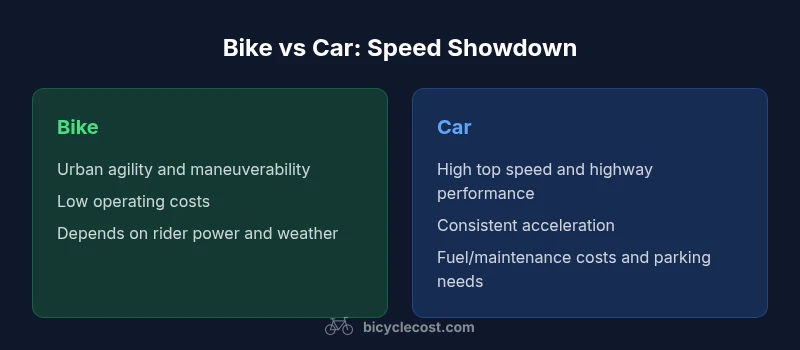
- Bikes excel in dense urban environments and require minimal infrastructure
- Cars offer high top speeds and reliable highway performance
- Bikes have low operating costs and simple maintenance
- Cars provide climate-controlled comfort on longer trips
Downsides
- Bike speed is highly dependent on rider fitness and weather
- Car ownership entails fuel/maintenance costs and parking needs
- Bikes are less practical in rain or extreme weather
- Cars can contribute to congestion and parking scarcity
Cars generally offer faster speeds on open roads, while bikes excel in dense urban contexts
For long highway trips, cars typically win on clock time; for short urban trips, bikes can be competitive or faster. Context matters more than absolute speed.
People Also Ask
Are bikes faster than cars in city traffic?
In many urban scenarios, bikes can navigate congestion more efficiently than cars because of their agility and access to bike lanes. Real-world speed depends on signals, traffic density, and rider skill. The key is to compare like-for-like routes rather than general road speed.
In city traffic, bikes often beat cars on the clock due to agility and lane options, but it depends on signal timing and rider ability.
Do cars ever beat bikes on short trips?
Yes. For very short trips or longer urban hops where signals favor faster speeds, cars can achieve higher average speeds overall. Bikes may still win if the route has severe congestion, limited parking, or if sidewalks and bike lanes shorten the path.
Yes, cars can win on very short or heavy-traffic legs, but bikes can still be faster in certain urban routes.
How do electric bikes compare to cars for speed?
Electric bikes extend cyclist capabilities and can close the gap in hills or headwinds, but on open highways cars generally maintain higher speeds. E-bikes are most effective for mixed urban commuting and tackling challenging terrain.
E-bikes help close the gap in hills and headwinds, but cars usually stay faster on highways.
Does rider fitness affect the answer?
Absolutely. Rider fitness and technique have a large impact on bike speed; a trained cyclist can maintain higher speeds with efficient gearing and aero position. Car speed is less dependent on the driver's physical condition and more on vehicle performance and road rules.
Yes—rider fitness has a big effect on bike speed; cars depend more on the vehicle and road conditions.
How should I measure speed for a fair comparison?
Use a fixed route with consistent weather and traffic. Time the distance for both modes, average the results over multiple runs, and note elevation and wind. Use reliable devices or apps to ensure comparable data.
Time a fixed route for both modes, average multiple runs, and note weather and elevation for a fair comparison.
Quick Summary
- Assess your route type before judging speed
- Cars win on highways; bikes win in dense cities
- Rider fitness and bike choice materially affect bike speed
- Weather and infrastructure heavily influence real-world results
- Consider hybrid options (e-bikes, mixed-mode trips) for optimal times