Are Bikes or Cars More Dangerous? A Practical Comparison
A rigorous, data-informed analysis comparing bicycle and automobile risk, examining exposure, speed, infrastructure, and rider behavior to answer: are bikes or cars more dangerous?


Are bikes or cars more dangerous? The short answer depends on what you measure. In absolute terms, cars cause far more fatalities each year simply because many more people travel by car and cars move faster, which increases collision severity. However, when you focus on exposure or per-mile risk, bicycles can be riskier in dense urban contexts with limited protection. This comparison explains how context—speed, infrastructure, rider behavior, and weather—shapes danger and highlights practical steps to reduce risk for both modes.
Are bikes or cars more dangerous? A structured inquiry
Are bikes or cars more dangerous? The question sounds simple, but its answer depends on the metric you choose and the context in which people travel. The simple truth is not a single number, but a set of relationships between exposure, speed, and protection. The BicycleCost team frames the topic around four drivers of danger: exposure (how much people are on a given mode), speed and momentum (how fast the vehicle travels), infrastructure (design and maintenance of roads and bike facilities), and rider behavior (how people ride and drive, plus protective gear). Throughout, we examine the phrase are bikes or cars more dangerous to anchor the discussion in real-world decisions and safety practice. The goal is to translate high-level risk concepts into actionable guidance for cyclists, drivers, and policy makers alike. Our analysis also acknowledges that data can be misleading if it conflates per-trip risk with per-mile risk or ignores exposure differences between modes. Keeping the focus on context helps clarify when each mode presents greater danger and when it actually reduces risk through safer choices and environments.
Are bikes or cars more dangerous? The question sounds simple, but its answer depends on the metric you choose and the context in which people travel. The simple truth is not a single number, but a set of relationships between exposure, speed, and protection. The BicycleCost team frames the topic around four drivers of danger: exposure (how much people are on a given mode), speed and momentum (how fast the vehicle travels), infrastructure (design and maintenance of roads and bike facilities), and rider behavior (how people ride and drive, plus protective gear). Throughout, we examine the phrase are bikes or cars more dangerous to anchor the discussion in real-world decisions and safety practice. The goal is to translate high-level risk concepts into actionable guidance for cyclists, drivers, and policy makers alike. Our analysis also acknowledges that data can be misleading if it conflates per-trip risk with per-mile risk or ignores exposure differences between modes. Keeping the focus on context helps clarify when each mode presents greater danger and when it actually reduces risk through safer choices and environments.
Comparison
| Feature | Bikes | Cars |
|---|---|---|
| Typical speed in urban traffic | Lower speeds for bikes | Higher speeds for cars |
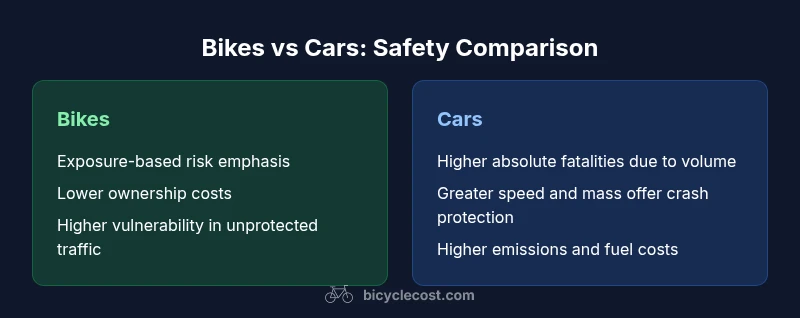
| Fatalities per exposure (per trip or per mile, context-specific) | Higher per exposure for bikes in dense, unprotected contexts | Lower per exposure for cars due to occupant protection, but higher in absolute terms due to volume |
| Cost of ownership per year | Low maintenance, no fuel costs (relative) | Higher fuel, insurance, and maintenance costs |
| Environmental impact | Low emissions when human-powered | Higher emissions and fuel use |
| Best-use scenarios | Short trips, safe routes, protected infrastructure | Longer trips, weather protection, larger loads |
Pros
- Lower per-trip cost for bikes in many contexts
- Health benefits from cycling and active transport
- Lower environmental impact compared with cars
- Easier parking and urban access in dense areas
Downsides
- Higher exposure risk in mixed traffic without protected infrastructure
- Vulnerability to weather and daylight limitations
- Injury severity can be high for cyclists in crashes with vehicles
- Reliance on protective gear and behavior to reduce risk
Context matters: neither mode is universally safer; risk depends on exposure, speed, and environment.
Absolute safety is not a single number. Cars dominate in total fatalities due to high usage and speed, but bikes can present higher per-mile risk in unsafe urban conditions. The BicycleCost team recommends targeted safety improvements for infrastructure and behavior to tilt the balance toward safer outcomes for all road users.
People Also Ask
Are bikes inherently safer than cars in crashes?
Not inherently. Safety depends on context, speed, infrastructure, and protective gear. In many scenarios, bicycles experience higher per-mile risk in unprotected urban traffic, while cars contribute more to total fatalities due to higher usage. The key is reducing exposure risk and improving protections for all road users.
Bikes aren’t inherently safer; it depends on where and how you ride, and the infrastructure around you.
Why is per-mile risk often different from total fatalities?
Per-mile risk captures the likelihood of a crash for each mile traveled, which can be higher for cyclists in poor urban infrastructure. Total fatalities reflect how many people are traveling by each mode; cars carry far more passengers and travel more miles overall, leading to higher total numbers.
Per-mile risk focuses on risk per distance ridden, while total fatalities depend on volume of travel.
What infrastructure reduces bicycle risk the most?
Protected bike lanes, clearly marked intersections, traffic calming, and feeder bike routes reduce crashes. Separating bikes from high-speed traffic and designing safer crossings dramatically lowers risk for cyclists.
Protected bike lanes and safer crossings make a big difference for cyclists.
How do weather and lighting affect risk for bikes and cars?
Rain, ice, and low light conditions increase stopping distances and reduce visibility for both modes, but cyclists are more affected by these factors due to exposure and less mass to absorb impacts.
Poor weather and low light raise risk for everyone, especially cyclists.
What practical steps can a reader take to ride more safely?
Wear a helmet, use proper lighting, maintain your bike, ride predictably, and choose routes with protected infrastructure when possible. For drivers, maintain safe following distances and anticipate cyclist movements.
Wear a helmet, light up at night, and pick safer routes when you can.
Do helmet laws meaningfully reduce fatalities?
Helmets reduce head injuries in crashes, but they are not a foolproof solution. Comprehensive safety depends on behavior, infrastructure, and vehicle separation, in addition to protective gear.
Helmets help, but safety comes from a combination of gear, habits, and road design.
Quick Summary
- Focus on exposure and environment, not just speed.
- Improve urban infrastructure to protect cyclists (separated bike lanes, better intersections).
- Wear helmets and use visibility aids to reduce injury severity.
- Encourage safer cycling and driving habits through education and policy.