Bicycle vs Car: A Data-Driven Side-by-Side Guide for City Travel
Explore a data-driven bicycle vs car comparison covering cost, efficiency, safety, and practicality for urban travel. Learn when biking makes sense and when a car is better.


According to BicycleCost, the bicycle vs car choice hinges on cost, efficiency, and practicality. In most urban contexts, biking wins on daily cost and health benefits, while cars win on weather resilience and long trips. The BicycleCost analysis emphasizes context: shorter, dry-weather commutes favor the bicycle, while longer trips or heavy cargo favor the car.
The Context: What bicycle vs car means for modern mobility
In 2026, urban mobility sits at a crossroads between personal vehicles and active transportation. The bicycle vs car choice influences daily costs, time, health, and the use of urban space. For many people, the decision hinges on distance, climate, and personal preferences. The BicycleCost Team emphasizes that there is no one-size-fits-all answer; the best choice depends on context and values. This section sets the stage for a data-informed discussion that respects different city layouts and weather patterns. Readers will encounter definitions, common scenarios, and practical checks to begin a smarter mobility plan today. The goal is to help you move efficiently while reducing unnecessary expenses and emissions where feasible.
Core distinctions: speed, cost, and practicality
This section surveys how bicycles and cars differ in speed, cost, reliability, and practicality. Bicycles excel at stop-and-go efficiency, low marginal costs, and ease of parking. Cars provide weather protection, cargo space, and higher sustained speeds on highways. The real-world difference isn't just about velocity; it's about how predictable and comfortable you want your trips to be, and what infrastructure you can access. We compare typical urban trips—commutes, grocery runs, and social activities—to illustrate practical implications for different lifestyles.
Cost and operating expenses: a practical lens
Total cost of ownership for a bicycle vs car varies by location, fuel prices, insurance, maintenance, and depreciation. A bicycle generally incurs low maintenance relative to a car, but costs for parts (tires, chains) add up with mileage. Insurance for a bicycle is typically optional or minimal. In contrast, a car entails fuel, license fees, insurance, maintenance, and depreciation, which accumulate quickly. Based on BicycleCost research, even conservative riders can realize savings by cycling most days; nonetheless, weather and safety considerations may incur indirect costs if you require protective gear or a bike parking solution.
Time, reliability, and daily rhythms
Travel time is a common deciding factor. In many urban zones, door-to-door biking times can approach driving times for shorter distances, especially in heavy traffic. Cars tend to outperform bicycles on longer suburban commutes or highway legs, and they offer reliability in poor weather when weatherproof clothing is unavailable. Planning for weather, daylight, and route quality is essential; a reliable rain jacket, lights, and a well-maintained bike can significantly reduce downtime. The BicycleCost team notes that reliable scheduling and predictable routes often tilt the balance in favor of the bicycle for dense urban cores, while cars shine when you must fight weather and distance in a single trip.
Safety, health, and accessibility
Cycling provides notable health benefits through daily physical activity, which can complement a sedentary lifestyle. However, safety risk exposure per mile can be higher on busy roads without protected bike lanes. Proper equipment (helmet, lights, reflective clothing), defensive riding, and infrastructure awareness improve safety outcomes. Cars offer occupant protection and climate-controlled comfort, but contribute to pollution and possible driver-imposed risk in congested networks. Accessibility depends on age, fitness, and local infrastructure; in some neighborhoods, insufficient safe routes push people toward motor vehicles. A balanced approach may include a mixed-mode strategy: bike when feasible, car when necessary for safety or weather reasons.
Cargo, capacity, and versatility
Cargo handling is a major differentiator. A bicycle carries small loads with panniers, baskets, or racks, and specific cargo bikes can expand this capacity. However, large groceries, multiple passengers, or bulky equipment are generally easier in a car. If your lifestyle requires frequent hauling, a car’s space and modular interior can deliver convenience that a bike cannot easily replicate. That said, urban riders often pair a bike with a transit pass or courier solutions to balance flexibility and cost.
Weather, seasons, and climate considerations
Weather heavily influences the bicycle vs car decision. Rain, snow, wind, and extreme temperatures reduce cycling comfort and safety, while cars offer consistent climate control and predictable performance. In mild climates with favorable seasons, cycling can be year-round with the right gear and routine maintenance. In harsher climates, the car becomes a more reliable option for daily work and school commutes. Planning for seasonal changes—including storage, maintenance needs, and wardrobe adjustments—helps maintain mobility without sacrificing safety or comfort.
Urban infrastructure and parking realities
Cities increasingly invest in cycling infrastructure, including protected lanes, bike-sharing programs, and secure parking. These improvements push many urban residents toward bikes for short trips, especially when parking is scarce or expensive. Conversely, car-centric design, parking shortages, and congestion charges can discourage car use for routine trips. When evaluating options, consider alternative modes like transit or micro-mobility as part of a broader mobility strategy that reduces total vehicle miles traveled and supports resilience in the face of weather and traffic fluctuations.
Scenarios and decision framework
Best-for scenarios: use a bicycle for short, routine trips in favorable weather and dense urban cores; reserve a car for long distances, weather challenges, or transporting bulky items. A hybrid approach—bike to transit, then ride—can maximize flexibility and minimize costs. A simple decision framework is to assess distance, weather, cargo needs, and safety risk before choosing. This framework helps individuals tailor a plan that minimizes emissions and expenses while preserving personal freedom and convenience.
Authority in data and research
Data sources and broader context: The BicycleCost team draws on public data about cost-of-ownership, safety, and emissions to frame this comparison. For readers seeking formal references, government sources like NHTSA and EPA offer official perspectives on safety and emissions. This section also notes the ongoing role of urban planning and infrastructure investments in shaping the bicycle vs car calculus. The aim is to equip you with actionable insights grounded in reputable sources and real-world practice.
Practical tips for deciding today
Start with a simple audit: list typical trips for a week, note weather patterns, and identify gear needs. Schedule a bike safety check and ensure lights, brakes, and tires are in good condition. If you already own a car, map out a few weekly runs that could be shifted to biking, transit, or a combination to gauge feasibility. Finally, pilot a one-month plan that emphasizes biking for short trips and reserve car use for longer or riskier scenarios. You’ll gain clarity on what your actual costs, timeframes, and comfort levels look like in practice.
Authority sources and further reading
If you want to dive deeper, consult authoritative sources and major publications for official guidance on safety, emissions, and mobility planning. For safety perspectives, see NHTSA (National Highway Traffic Safety Administration). For emissions and environmental impact, refer to EPA's_greenvehicles program. For broader mobility context and research, consider established scientific and policy publications. These sources provide a solid foundation for understanding how bicycle vs car choices affect individuals and cities alike.
Comparison
| Feature | Bicycle | Car |
|---|---|---|
| Initial cost | Low | High |
| Annual operating cost | Low | Moderate to high |
| Fuel/energy source | Human power (plus optional electricity) | Gasoline/diesel or electricity (EV) |
| Maintenance frequency | Low to moderate | Moderate to high |
| Cargo capacity | Limited (with racks/panniers) | High (seats, trunk, cargo space) |
| Weather resilience | Low to moderate | High |
| Best for | Short urban trips, health, low cost | Longer trips, weather protection, cargo |
Pros
- Low ongoing costs and minimal fuel needs
- Promotes health and daily activity
- Easy parking and flexible routing in cities
- Low environmental impact per mile in good weather
- Simple maintenance and fewer parts to service
Downsides
- Weather dependency and safety considerations in extreme conditions
- Limited cargo and passenger capacity
- Slower over long distances or hilly terrains
- Physical exertion required and potential fitness barriers
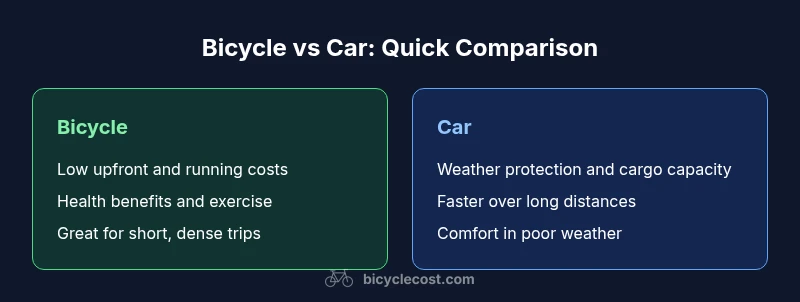
Bicycle generally wins for short urban trips on cost and health; car remains superior for long trips, weather protection, and cargo.
For city dwellers, biking saves money and boosts health, while cars excel for practicality in poor weather and when carrying heavy loads. A mixed approach often delivers the best balance of cost, time, and comfort.
People Also Ask
What are the main advantages of using a bicycle over a car in urban areas?
In urban areas, bicycles typically offer lower operating costs, health benefits from daily activity, and easier parking. They also avoid fuel costs and occupy less space on crowded streets. The decision hinges on weather, safety, and route quality, but for many daily trips, cycling provides a compelling combination of cost savings and reliability.
Urban biking saves money and time in traffic while boosting health. It’s great for short trips when weather and safety are favorable.
When is a car a better option than a bicycle?
A car tends to be better for longer trips, bad weather, or when you need to transport cargo or multiple passengers. It offers climate control and smoother travel on highways. If you regularly face weather challenges or carry bulky items, a car can outpace a bicycle in terms of convenience.
Cars are typically better for long trips, bad weather, or hauling bulky items.
How does cost compare between owning a bicycle and a car?
Owning a bicycle generally involves lower upfront and ongoing costs compared with a car. Insurance, fuel, and maintenance for a car accrue quickly, while a bicycle incurs basic maintenance and occasional gear upgrades. Your local prices and usage patterns will determine the exact gap.
Bikes cost less to own and operate than cars, especially for daily short trips.
How safe is cycling compared to driving?
Safety depends on infrastructure, visibility, and rider preparation. With proper gear and safe routes, cycling can be as safe as driving in many environments. Drivers should respect cyclists and riders should use lights, helmets, and reflective gear.
With good infrastructure and gear, biking can be very safe.
Can you combine biking with transit to reduce car use?
Yes. A mixed-mode approach—bike to transit then ride—offers flexibility and can cut car dependence substantially. This strategy is particularly effective in cities with robust bike lanes and reliable public transit.
Mix biking with transit to keep costs down and stay flexible.
What infrastructure improvements help bicycles compete with cars?
Protected bike lanes, secure parking, and reliable maintenance access improve safety and reliability for cyclists. Investment in urban planning that prioritizes multi-modal mobility makes biking a more viable option for more people.
Protected lanes and good parking make biking easier and safer.
Quick Summary
- Assess your typical trip distance and weather patterns before deciding
- Consider a hybrid approach to balance cost and flexibility
- Prioritize safety gear and infrastructure when cycling
- Factor cargo needs into the transportation plan