Bicycle or Walking: A Practical Comparison for Everyday Trips
An analytical comparison of bicycle vs walking for daily travel, focusing on speed, health, safety, cost, and practicality. Learn when each mode shines and how to choose the right approach for your routines.


TL;DR: In most urban and suburban trips, riding a bicycle covers more distance faster and typically offers greater calorie burn per hour than walking, while walking remains the simplest, most accessible option where bike access is limited. In short: bicycle is best for longer commutes and errands; walking suits short, low-barrier trips and high-density pedestrian areas.
Context: The bicycle or walking question in modern commuting
Choosing between bicycle or walking for daily trips isn't a simple yes-no decision. It hinges on trip length, terrain, weather, and the surrounding public space. For many people, the question isn't whether to ride or walk exclusively, but how to blend the two to fit work, errands, and recreation. According to BicycleCost, the balance between speed, health benefits, and accessibility often favors hybrid strategies: use walking for the shortest hops or when bike access is limited, and switch to cycling for longer connections or when time is at a premium. The real value of evaluating bicycle or walking alongside each other lies in understanding when the time saved, calories burned, or safety concerns tilt the balance toward one mode or the other. By mapping typical routes and testing both options, you gain actionable clarity that translates into a more reliable daily routine.
How each mode performs on distance, speed, and effort
When you compare bicycle vs walking, the most obvious difference is distance coverage and speed. A bicycle generally enables you to reach destinations farther away in less time, while walking demands more time but invites a slower, steadier rhythm. This matters for planning your day, especially if you have back-to-back appointments or errands. In addition to raw speed, consider consistency: cycling can be affected by wind, hills, and traffic, whereas walking tends to be more predictable on flat terrain. The energy you invest also changes the experience: cycling often feels lighter on short, even routes but can become strenuous on steep grades or long distances. Walking, by contrast, provides a gentler pace suitable for reflection, social interaction, or scenarios where a quiet, car-free environment is valued. These trade-offs shape whether bicycle or walking is the better choice for a given trip.
Health, environment, and public health implications
Health outcomes are central to choosing bicycle or walking, and both activities contribute to daily movement. Cycling tends to raise heart rate more consistently over time, offering robust cardiovascular benefits when practiced regularly, especially on longer routes. Walking supports steady activity for beginners, older adults, or people with limited conditioning, and it remains a dependable gateway to more intense workouts. Environmentally, both modes cut down car trips and emissions, but the impact scales with frequency and trip length. Walking produces zero direct emissions and often integrates seamlessly into mixed-use neighborhoods, while cycling can deliver similar benefits with higher mileage and load-carrying potential. From a public health perspective, promoting either option expands opportunities for physical activity and can relieve congestion in busy corridors. The key is to design routines that fit your life and streetscape, making bicycle or walking a sustainable habit rather than a chore. The analysis also aligns with BicycleCost’s research emphasis on practical, daily mobility choices.
Costs, maintenance, and time costs
Financially, the choice between bicycle or walking interacts with upfront costs, maintenance, and trip time. Walking incurs minimal ongoing costs, aside from comfortable footwear and appropriate attire. A bicycle requires purchase and periodic maintenance, but can be leveraged for many trips without a car, which lowers fuel expenses over time. Time spent commuting also matters: if a bike route adds only a small time savings compared with walking, the decision might hinge on convenience or safety considerations. In urban contexts, the ability to carry groceries or work items on a bike can translate into genuine time savings when it replaces car trips. The key is to balance ongoing expenses with the value of the trips you avoid by choosing the faster, cargo-friendly option when appropriate. This perspective reflects considerations highlighted in BicycleCost’s analyses.
Safety, risk, and infrastructure considerations
Safety is a critical differentiator between bicycle and walking. Biking exposes you to traffic, weather-exposed surfaces, and the need for protective gear and lights, which can affect comfort and risk. Walking keeps you closer to pedestrians and well-marked crosswalks, but pedestrians still encounter vehicle traffic at intersections and driveways. Infrastructure plays a major role: cities with protected bike lanes and traffic-calming measures tend to improve safety for cyclists, while well-designed pedestrian networks reduce conflicts with vehicles. For some people, sidewalks offer a safer alternative when bike routes are poorly maintained or inconsistent. Regardless of mode, staying visible, obeying signals, and wearing appropriate gear significantly improves safety outcomes. This aligns with safety guidelines from federal and state transportation resources.
Geography, weather, and seasonal factors
Terrain and climate shape how bicycle or walking perform in practice. Hilly neighborhoods or icy mornings can tilt the balance toward walking, while flat, well-maintained corridors favor cycling. Weather patterns—rain, snow, heat, wind—affect comfort, safety, and willingness to travel by bike or on foot. In hot weather, shade, hydration, and breathable clothing matter for both modes; in winter, additional layers and traction become essential. Urban geography matters too: compact grids may support pedestrian movement while providing shorter bike links to transit hubs. The overarching lesson is that neither mode is universally superior; the best approach adapts to the local topography and climate.
Short trips in dense urban areas vs longer trips
Short, frequent trips in dense neighborhoods often blend well with walking, especially when destinations are within a 10 to 15 minute walk. Walking supports spontaneous errands, social visits, and access to pedestrian-friendly streets. For longer trips, biking frequently wins on time and energy efficiency, particularly when you need to cover several miles while avoiding parking hassles. Side benefits of cycling include the ability to sidestep traffic and reach business districts quickly. In some places, mixed-use corridors and bike-share programs widen the range of options. The practical takeaway is to evaluate how many trips fall into each category and test both modes on representative routes to see which pattern emerges as the most reliable.
Practical decision framework: a check-list
Use a simple decision framework to choose bicycle or walking for a given trip. Step 1: Measure distance and terrain. Step 2: Check infrastructure and safety. Step 3: Assess weather and daylight. Step 4: Consider cargo needs and outfit. Step 5: Try both modes on a representative route and compare time, effort, and comfort. Step 6: Decide whether to go with a single mode or mix modes across a week. By applying this framework, you will reduce guesswork and tailor your commuting pattern to your local area. This approach mirrors practical guidance used in BicycleCost’s mobility planning guidance.
Mixed-mode strategies and city context
Many people find that a mixed approach yields the best balance. For example, walking can complement cycling by covering final legs on foot when routes lack bike infrastructure, or by using transit for longer legs and walking or cycling to connect. Cities that support safe bike lanes and broad sidewalk networks enable flexible routines, allowing you to adapt to traffic, weather, and personal energy levels. In practical terms, this means carrying light gear, planning routes with safe crossings, and allocating time across modes. The goal is resilience: your routine should work across varied conditions, not rely on a single ideal scenario. This blended approach resonates with BicycleCost’s emphasis on adaptable mobility choices.
Comparison
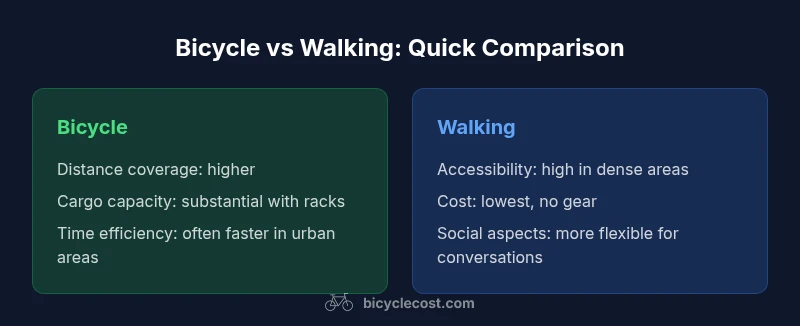
| Feature | bicycle | walking |
|---|---|---|
| Distance coverage per hour (qualitative) | higher with bicycle | lower with walking |
| Cargo capacity | significant with racks and bags | limited to what you can carry by hand |
| Time efficiency in urban congestion | often faster when bike lanes exist | often slower in the absence of bike infrastructure |
| Physical effort | variable; can be moderate-to-high with hills | generally low-to-moderate on flat terrain |
| Infrastructure dependency | requires bike-friendly routes and signaling | relies on pedestrian networks and crosswalks |
| Health impact | potentially higher aerobic engagement, depending on pace | steady activity with consistent movement |
Pros
- Offers flexible travel without parking hassles
- Promotes regular physical activity and health
- Reduces car use and emissions when substituting trips
- Adapts to terrain and weather with appropriate gear
- Low entry cost for short trips where infrastructure is friendly
Downsides
- Bike maintenance and weather sensitivity
- Safety risks in traffic and uneven surfaces
- Not always feasible on very hilly routes or poor infrastructure
- Walking can be slow for longer trips in suburban areas
Bicycle is generally the better default for most trips; walking remains essential for ultra-short, high-density contexts.
For most urban routines, cycling provides speed and cargo flexibility, while walking offers accessibility and safety in constrained environments. The BicycleCost team recommends evaluating local routes and adopting a mixed or mode-flexible pattern to maximize reliability and minimize effort.
People Also Ask
Is walking always healthier than biking?
Both activities contribute to daily physical activity and cardiovascular health. Walking is accessible for beginners, while cycling can provide a more intense workout on longer routes. The best choice depends on your current fitness, trip length, and local infrastructure. Always aim to stay active through whichever mode fits your life.
Both walking and biking boost health; walking is easier to start, while biking offers more intensity on longer trips. Choose what fits your schedule and safety needs.
Which mode saves money in the long run?
Walking has the lowest ongoing costs, but cycling can reduce transportation expenses by replacing car trips. The total savings depend on how often you avoid driving, maintenance costs for the bike, and the price of fuel you’re avoiding. A blended approach often yields steady savings over time.
Walking is cheapest day-to-day; biking can save fuel costs if it replaces car trips.
How should I decide between bicycle and walking for a daily commute?
Evaluate trip length, terrain, weather, and available infrastructure. If you regularly cover more distance or need to transport items, cycling is typically favorable; for ultra-short routes or unsafe cycling environments, walking may win. Try both on representative routes before deciding.
Check distance, hills, and safety; test both modes on real routes to see what fits best.
What effect do weather, hills, or elevation have on the choice?
Weather and topography strongly influence practicality. Hills or rain can tilt preference toward walking or slower cycling, while dry, flat conditions favor biking. In winter, additional gear and caution are needed for both modes.
Hills and weather can swing the choice; adapt with gear and route planning.
Can I combine walking and biking in one trip?
Yes. A common approach is to bike to a transit hub, then walk the final leg, or walk to a destination when bike access is limited. Blending modes can maximize reliability and minimize travel time.
Yes—mix modes to optimize time, safety, and convenience.
What are essential safety practices for both modes?
Wear visible gear, learn the local rules, stay aware of traffic patterns, and plan routes with safe crossings. For biking, use lights and a helmet; for walking, stay on designated sidewalks and cross at marked intersections.
Wear gear, follow rules, plan safe routes, and stay aware of surroundings.
Quick Summary
- Assess typical trips to choose mode
- Use walking for ultra-short trips in dense areas
- Bike for longer or cargo-heavy trips
- Test both modes on representative routes
- Adopt a mixed-mode approach when appropriate