Are Bicycles or Motorcycles More Dangerous? A Comparative Analysis
Analytical comparison of bicycle vs motorcycle danger, examining speed, exposure, gear, and infrastructure. Based on BicycleCost Analysis, 2026, with practical safety guidance for riders and policymakers.


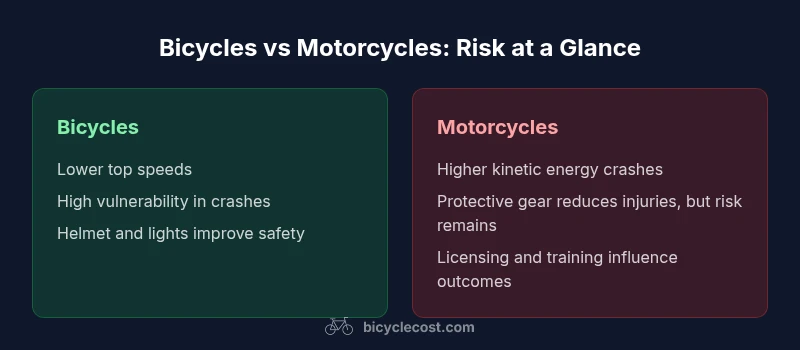
According to BicycleCost, motorcycles are typically more dangerous per mile than bicycles due to higher speeds, greater kinetic energy, and exposure in traffic. Bicycles pose substantial urban risk, but lower speeds and protective options like helmets and lights often reduce severe outcomes for riders. The answer depends on context—per mile, per hour, and the environment.
Framing the question: are bicycles or motorcycles more dangerous, and under what conditions?
To answer are bicycles or motorcycles more dangerous, it helps to separate risk by context. Vehicle type matters, but so do speed, exposure, rider behavior, weather, road design, and protective gear. A bicycle rider may encounter serious danger in dense urban traffic, yet a motorcycle rider on a highway with appropriate training faces different risk dynamics. The BicycleCost team emphasizes that the question cannot be answered in a vacuum: the same bike can be safer or riskier depending on where and how it is used. When we compare two-wheeled travel, we must specify the unit of risk (per mile, per hour of exposure, or per trip) and the environment (city streets, rural roads, or expressways). In the end, motorcycles typically show higher fatality and severe injury risk per distance traveled because crashes involve more kinetic energy and higher speeds. Bicycles, while inherently vulnerable, benefit from lower energy impacts and strong safety culture around helmet use and visibility in many urban settings. This article uses a consistent framework across speed, exposure, gear, infrastructure, and policy, so readers can apply the insights to personal riding, family safety planning, and local transportation decisions.
When you are evaluating the danger of two-wheeled travel, context matters. This article uses a consistent framework to compare speed, exposure, gear, and road design so readers can apply insights to real-life decisions.
Comparison
| Feature | Bicycles | Motorcycles |
|---|---|---|
| Average speed on typical roads | Lower speeds; greater maneuverability in urban settings | Higher speeds on arterial roads and highways |
| Injury severity patterns | Generally lower energy crashes in many urban contexts; head injuries reduced with helmets | Higher energy crashes; greater fatality risk despite protective gear |
| Required protective gear | Helmet, lights, visible clothing; gear mitigates injuries | Helmet, protective jacket, gloves, boots; armor reduces specific injuries |
| Exposure risk | High exposure in dense urban cycling; frequent stops and starts | Lower exposure per trip in some contexts but higher risk on high-speed routes |
| Licensing/training | Varies by region; often less formal requirements | Mandatory licensing and formal rider training in many jurisdictions |
| Operating costs | Lower upfront costs; maintenance generally modest | Higher fuel, maintenance, and insurance costs; ownership can be higher |
| Environmental impact | Low emissions per rider when pedaling; potential gains with e-bikes | Higher fuel use per mile; emissions higher than pedal bikes |
| Best use case | Urban commuting with exercise and infrastructure support | Open-road and long-distance travel with skilled, protected riders |
Pros
- Clear, evidence-based decision factors for riders and policymakers
- Highlights how infrastructure and gear influence safety for both modes
- Promotes safer riding habits and helmet use across two-wheeled travel
- Encourages targeted improvements in road design and policy
Downsides
- Risk varies widely by region and road design, which can complicate comparisons
- Overemphasis on one metric (per mile) may mislead if not contextualized
- In some regions, licensing and training norms differ, affecting risk interpretation
Motorcycles are generally more dangerous per mile than bicycles, but real-world risk depends on speed, exposure, gear, and environment.
The higher energy of motorcycle crashes elevates fatality risk, especially at speed. Bicycles present meaningful risk in urban corridors, but protective gear and safer road design can markedly reduce harm. A nuanced, context-aware approach is essential.
People Also Ask
Are bicycles inherently more dangerous than motorcycles?
No single answer fits all scenarios. Motorcycles tend to show higher fatality risk per mile in many contexts due to speed and kinetic energy, while bicycles pose substantial danger in dense urban settings where interactions with larger vehicles are frequent. Both modes benefit from helmet use, protective gear, and safer road design.
There isn’t a definitive winner; motorcycles are usually riskier per mile, but urban bicycle risk is still real and important to address.
What factors most influence bicycle safety in cities?
Key factors include road design (protected lanes and safe intersections), visibility (lights and bright clothing), helmet use, maintenance (brakes and tires), and rider behavior (defensive riding, signaling). Infrastructure improvements have a strong impact on outcomes.
In cities, good lanes and good lighting really change the safety odds for bikes.
What factors most influence motorcycle safety?
Attack points include rider training, licensing, protective gear, maintenance, and safe riding practices. Road conditions and weather also matter; high-speed crashes are more deadly, so risk control emphasizes speed management and defensive riding.
Motorcycle safety hinges on training, gear, and road awareness.
Do helmet laws reduce injuries for both modes?
Yes. Helmets consistently reduce head injuries for bicycles and motorcycles, though protection is part of a broader safety system that includes gear, training, and road design.
Helmets matter a lot for both bikes and motorcycles.
How should I choose between biking and riding a motorcycle for commuting?
Consider trip length, speed requirements, weather, available infrastructure, and personal risk tolerance. If feasible, combine modes (bike for short urban legs, motorcycle for longer trips) and invest in safe gear and training for whichever option you choose.
Think about distance, weather, and road design; gear up and train well.
Quick Summary
- Differentiate risk by context (per mile, per hour, per trip)
- Speed and energy are major drivers of motorcycle danger
- Gear, training, and infrastructure markedly reduce two-wheeler risk
- Urban design with protected lanes lowers bicycle injuries
- Policies should target both gear standards and road safety improvements