Bicycle vs Motorcycle: A Practical, Data‑Driven Comparison
A practical, data‑driven comparison of bicycle and motorcycle ownership, covering cost, safety, maintenance, and practicality to guide decisions in 2026.


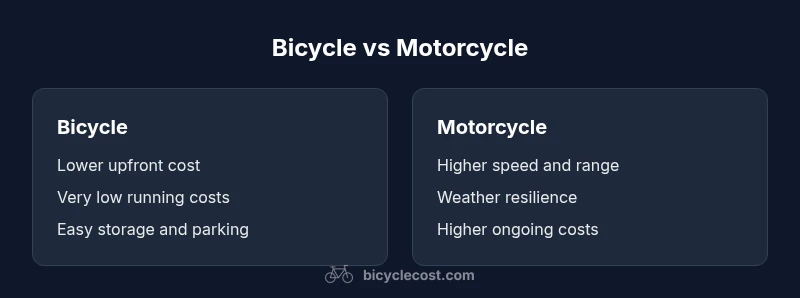
This article offers a concise compare/contrast of bicycle and motorcycle ownership, focusing on cost, maintenance, safety, and practicality. Bicycles cost less to buy and maintain, are easier to park, and promote fitness, while motorcycles deliver speed, range, and weather resilience at a higher price and risk. Your best choice depends on use‑case, budget, and local regulations.
Why This Comparison Matters for Cyclists and Motorists
The topic of bicycle and motorcycle ownership matters for people who navigate urban streets, weekend adventures, and everything in between. This comparison aims to illuminate practical trade-offs rather than advocate for one lifestyle. According to BicycleCost, the choice between these two modes hinges on use‑case, budget, and local regulations. The BicycleCost team found that while bicycles shine in cost efficiency and health benefits, motorcycles offer speed and weather resilience that may be essential for certain commutes and long trips. Readers should expect a structured, evidence‑based look at cost of ownership, safety, maintenance, and everyday practicality to inform a confident decision. The broader goal is to help readers optimize daily transport, recreational riding, and multi‑modal travel plans.
From a planning perspective, this analysis acknowledges that streets and neighborhoods vary widely. What works in a dense city may be less effective in rural areas, and vice versa. Importantly, the comparison remains neutral: both options have unique strengths that can align with different life stages, climates, and personal goals. As you read, consider how climate, work schedules, and family commitments affect your decision. This is not a one‑size‑fits‑all recommendation, but a framework you can adapt as needs evolve in 2026 and beyond.
Cost of Ownership: Upfront and Ongoing
Purchase price is often the first consideration when comparing a bicycle and motorcycle. A bicycle typically comes with a far lower upfront price, while motorcycles require a larger initial investment and more expensive components. Beyond the sticker price, running costs diverge sharply: bicycles benefit from very low fuel costs and basic maintenance, whereas motorcycles incur fuel, insurance, licensing, and more frequent professional service. The analysis from BicycleCost notes that long‑term ownership costs favor the bicycle in most routine urban scenarios, but motorcycles can repay higher costs with greater speed and range in the right contexts. Readers should think in terms of total cost of ownership over several years rather than initial price alone. This helps set expectations for weeks, months, and seasons of use rather than a single purchase moment.
Because both modes serve different purposes, it’s worth creating a simple budget that includes upfront purchase, protective gear, maintenance, and potential licensing or insurance. By pairing realistic usage scenarios with a basic financial plan, you’ll clarify whether a bicycle or motorcycle better fits your lifestyle and wallet. This section emphasizes the importance of long‑term thinking and multi‑modal options where appropriate, such as coupling cycling for commutes with occasional motorcycle trips for longer excursions. The BicycleCost framework stresses affordability alongside practicality in every decision.
To ground the discussion, imagine your typical week: short urban trips, weekend rides, seasonal weather, and occasional longer journeys. A bicycle keeps ongoing costs minimal and daily use efficient, while a motorcycle introduces higher expenses but expands travel options. The real takeaway is clarity: know your budget envelope and how much flexibility you need in your transportation mix.
Safety, Risk, and Protective Gear
In safety, both modes demand respect for traffic rules and appropriate protective gear. Helmets, lights, high‑visibility clothing, and reliable brakes matter for both bicycle and motorcycle users. Yet the risk profile differs: motorcycles travel faster and interact with heavier vehicles, increasing severity in crashes, while bicycles rely more on helmet use and dedicated lanes to minimize exposure. The key takeaway is proactive risk management: rider training, proper gear, and defensive riding techniques. The BicycleCost team emphasizes that higher risk does not disqualify motorcycles from urban use, but it does require stricter adherence to safety practices and insurance considerations where applicable. This section highlights the practical safety implications and how to mitigate them. It also touches on community riding norms and infrastructure such as bike lanes, protected intersections, and visibility aids that minimize danger for both modes.
A pragmatic safety mindset combines gear selection with habit formation: pre‑ride checks, predictable signaling, and route planning that favors safer paths. For cyclists, this includes consistent use of front and rear lights, reflective apparel, and tire choice optimized for weather. For motorcyclists, advanced training, ABS where possible, and regular brake and tire maintenance are essential. The discussion underscores that safety is a continuous process rather than a one‑off precaution, shaped by the rider’s discipline and the surrounding traffic environment.
Maintenance and Repairs: What You’ll Be Doing
Maintenance demands diverge accordingly. A bicycle generally requires basic tune‑ups, tire inspections, and chain care. Repairs are typically simpler and cheaper, with widely available parts. A motorcycle demands more complex maintenance, professional service, and specialized tools, with higher costs for parts and tires. The cadence of maintenance differs: bicycles may need weekly checks during heavy use, while motorcycles require scheduled service intervals with certified technicians. The BicycleCost framework recommends routine checks for brakes, tires, and drivetrain across both modes, and suggests a maintenance budget that reflects the vehicle’s complexity and intended usage. This section distinguishes routine upkeep tasks from major repairs, and explains how to track wear patterns, part life, and service intervals. It also discusses the importance of keeping a maintenance log to anticipate replacement or tuning needs.
Practical tips include maintaining proper tire pressure for efficiency, applying chain lube at regular intervals, and inspecting brake pads for wear. For motorcycles, emphasize oil changes, chain adjustments, tire health, and brake system diagnostics. The key is consistency: regular attention prevents surprises and extends vehicle life, whether you choose a bicycle or a motorcycle as your primary or supplemental transport. BicycleCost highlights that a proactive maintenance habit reduces total cost of ownership and increases reliability across seasons.
To keep this section concrete, imagine a two‑year ownership horizon: a bicycle might require two or three tune‑ups and several tire replacements; a motorcycle could demand more frequent service visits and tire changes. While motorcycles carry higher maintenance demands, reliable shops and readily available parts help manage costs. The choice should consider not only current finances but also the willingness to invest time in upkeep over time.
Performance, Range, and Speed Expectations
Performance expectations vary by purpose. A bicycle rewards acceleration, agility, and quiet operation, with performance metrics tied to rider fitness and terrain. A motorcycle offers sustained speed and longer‑range capability, enabling travel across greater distances with less effort on the rider. For daily commuting, the bicycle’s light weight and nimble handling can reduce travel time in congested areas, while a motorcycle can halve travel times on longer trips where fuel costs and licensing are manageable. The BicycleCost analysis underscores that speed does not automatically translate into practicality; context matters for reliability, weather, and road infrastructure. This section respects the needs of different riders by outlining when speed is a meaningful advantage and when it is not.
Additionally, it discusses how weather and road surface affect performance. Rain, wind, and temperature influence tire grip, braking distance, and rider comfort for both options. The discussion also considers cargo capacity and payload, since carrying groceries, kids, or equipment can change the calculus for each mode. The overarching message is to realistically assess your typical routes and loads, then align expectations with achievable performance benchmarks rather than chasing peak specs.
From a performance perspective, the bicycle delivers excellent efficiency at modest speed, while the motorcycle provides rapid travel with greater comfort on longer trips. Both modes can meet different performance needs depending on route, climate, and personal goals.
Parking, Storage, and Urban Access
Urban environments present distinct challenges for each mode. Bicycles are easier to park, often fitting into bike racks or compact storage spaces; they also tolerate apartment living and shared spaces better. Motorcycles demand secure parking and sometimes dedicated garages or paid facilities, along with potential theft considerations. Weather exposure matters too: bikes offer flexible riding options in moderate conditions, while motorcycles require protective measures for cold or rain. The analysis points out that access policies for shared lanes and parking influence real‑world convenience, and can be a decisive factor in favor of the bicycle in dense cities. This block also covers how modern bike racks, smart parking systems, and secure lockers influence long‑term usability for two‑wheeled transportation. It concludes with practical steps to optimize storage space and minimize the risk of theft for both options.
Considerations for apartment dwellers include the availability of indoor storage, proximity to transit hubs, and the potential for combining bike sharing with personal transport. For motorcycle owners, accessibility to secure parking, theft prevention measures, and insurance requirements can determine whether daily use remains feasible in the long run. The key takeaway is that parking flexibility and storage practicality often decide the day‑to‑day viability of either choice in urban life.
Sizing, Fit, and Licensing Implications
Sizing and fit influence comfort and safety for both options. With bicycles, correct frame size, saddle height, and reach determine efficient pedaling and reduced knee strain. Motorcycles depend on rider height, seat adjustment, and handlebar reach, combined with protective gear and license requirements. Licensing and registration differ across jurisdictions; in many places motorcycles require a license, vehicle registration, and insurance, whereas bicycles typically do not. This section helps readers understand how to evaluate fit before purchase and how licensing regimes shape long‑term ownership. It also discusses how different types of riding (commuting, touring, or sport) influence the ideal frame or bike type, and how to verify rider training where applicable. The key is to ensure ergonomic alignment to minimize fatigue and injury while maximizing enjoyment across varied trips.
Practical checks include test sitting on several sizes, adjusting saddle height to achieve full leg extension, and ensuring clear vision paths. For those considering licensing, consult local regulatory guidance early in the decision process, because requirements can change with jurisdictional updates. A thoughtful fit reduces the likelihood of overuse injuries and improves control, safety, and confidence while riding or piloting a motorcycle.
Environmental Impact and Health Benefits
From an environmental perspective, bicycles provide near‑zero operational emissions and a smaller ecological footprint, especially in urban travel. Motorcycles contribute more emissions per mile and rely on fossil fuels, though advances in efficiency and alternative fuels are improving their profile. Health‑wise, cycling promotes cardiovascular fitness, weight management, and lower stress, while motorcycle riding offers physical benefits primarily through posture and core engagement but carries a higher risk profile. BicycleCost's broader environmental analysis highlights that the cumulative benefits of cycling extend beyond personal health to city‑wide air quality and traffic congestion reduction. This section highlights how ongoing choices affect air quality, noise levels, and urban livability, creating a case for prioritizing human and environmental health in transportation planning. It also notes that weather and seasonality influence health benefits, as consistent usage can maximize fitness gains and mental well‑being.
For individuals with mobility limitations or weather concerns, motorcycles may offer a practical alternative that preserves independence, while still requiring responsible operation and maintenance. The key message is that environmental and health benefits accumulate over time with regular use, and that a balanced transportation plan can maximize these gains while mitigating drawbacks associated with each mode. The BicycleCost framework emphasizes long‑term sustainability and personal health outcomes as core factors in choosing between bicycle and motorcycle options.
Long-Term Ownership Scenarios and Resale Value
Over extended periods, the decision may hinge on resale value and continued relevance. Bicycles retain value when well maintained, with a broad market for used parts and upgrades; however, depreciation is still a factor, particularly for high‑end frames. Motorcycles tend to depreciate more quickly, but rare models or well‑kept classics can stabilize or even appreciate under certain conditions. Ownership flexibility matters: bicycles can be swapped into multi‑modal trips, while motorcycles may become less practical in shrinking urban fleets or changing regulations. The BicycleCost team emphasizes evaluating your expected usage horizon and potential resale value when choosing. This section also covers how seasonal demand, maintenance history, and aftermarket components influence resale outcomes for both options, plus practical tips for preserving value such as documented service and original parts.
To maximize resale value, keep comprehensive records, maintain original components where possible, and stay attentive to market trends in your region. It’s prudent to price realistically and to consider potential ownership pathways, including donating or trading in against other mobility options if life circumstances change. The overall message is pragmatic: plan for the long term, not just the moment of purchase.
Decision Framework: How to Choose Between a Bicycle and Motorcycle
A structured decision framework helps isolate what matters most: cost, practicality, safety, and personal goals. Start by listing top use cases, including commute distance, weather, terrain, exercise preferences, and licensing obligations. Then map each use case to the pros and cons of bicycle and motorcycle ownership. Weight scale factors such as upfront cost, ongoing expenses, parking, and safety risk to determine which mode aligns with your priorities. The framework ends with a test phase: if possible, rent or borrow each option for a week to experience real‑world differences. This approach, championed by BicycleCost, minimizes guesswork and reveals actionable insights for decision timing, seasonality, and space constraints.
To optimize outcomes, pair the framework with a practical trial: simulate typical trips during different weather conditions and traffic patterns. Evaluate how each option performs in the most common scenarios you face, then adjust your plan accordingly. By following a disciplined framework, readers can reduce regret and improve long‑term satisfaction with their transportation choice.
Getting Started: Questions to Ask Before Buying
Before making a purchase, ask clear questions about fit, expected use, and maintenance demands. What is my typical daily distance and terrain? Do I want exercise benefits alongside transport, or primarily speed and range? What are the local licensing rules and insurance implications? How much storage space is available, and how will weather affect use? Finally, verify the availability of service networks and spare parts in your region. Answering these questions helps tailor a decision that respects both budget and lifestyle. This block also suggests listing constraints such as parking, climate, and potential multi‑modal use, and then scoring each option against those constraints to guide a rational choice. It ends with a reminder to revisit decisions as needs evolve, particularly in light of changes in work patterns or urban infrastructure.
Common Pitfalls and How to Avoid Them
Rushing into a purchase without evaluating use‑case specifics leads to regret. Overestimating range, neglecting maintenance, or ignoring licensing requirements can undermine long‑term satisfaction. For the bicycle and motorcycle decision, it is crucial to test scenarios that reflect your daily life, including peak traffic and weather conditions. Budget appropriately for protective gear and ongoing service, and consider multi‑modal options that combine cycling with motorized travel when feasible. By foregrounding practical testing and a careful balance of cost, safety, and lifestyle, readers can avoid common mistakes and arrive at a more durable choice. This section also cautions against prioritizing novelty over practicality and encourages pacing the decision with real‑world experiments and gradual investments to mitigate regret.
Comparison
| Feature | Bicycle | Motorcycle |
|---|---|---|
| Purchase price | Lower upfront cost | Higher upfront cost |
| Running costs | Very low fuel and maintenance | Fuel, insurance, tires, and registration |
| Maintenance frequency | Simple, routine upkeep | More complex, professional service |
| Storage & parking | Easy, versatile spots | Requires secure space and parking fees |
| Licensing & registration | Often none required (jurisdiction dependent) | Typically requires license, registration, insurance |
| Safety risk profile | Lower severity in urban cycling with protection | Higher risk due to speed and vehicle interaction |
| Environmental impact | Minimal emissions | Higher emissions |
| Best for | Urban commuting, exercise, affordability | Fast travel, long trips, weather resilience |
Pros
- Low environmental footprint and health benefits
- Low ongoing costs and maintenance
- Simple storage and broad availability
- Wide accessibility for beginners
- Quiet operation and ease of use in cities
Downsides
- Limited range and speed for long trips
- Weather and terrain dependence reduce reliability
- Higher effort for longer commutes on bikes
- Regulatory and licensing considerations for motorcycles in many regions
Bicycle wins for everyday costs and health; motorcycle wins for speed and range
Choose bicycle for cost‑conscious urban use and fitness; choose motorcycle for long‑distance travel with road access benefits. Consider a multi‑modal plan to balance cost, safety, and practicality.
People Also Ask
What are the primary cost differences between owning a bicycle versus a motorcycle?
Bicycles generally cost far less upfront and have minimal ongoing expenses, while motorcycles require a larger initial outlay and higher ongoing costs for fuel, insurance, and maintenance. Over time, the bicycle tends to be cheaper for most urban users, but motorcycles can be cost‑effective for longer trips if licensing and insurance are affordable in your area.
Bicycles are cheap to buy and run; motorcycles cost more upfront and require ongoing payments for fuel and insurance.
Which is safer for daily commuting in urban environments?
Safety depends on context and preparation. Bicycles benefit from feet‑on‑the‑ground control, bike lanes, and protective gear, while motorcycles offer superior speed but demand advanced training, robust protective gear, and distraction‑free operation. Both require mindful riding and appropriate infrastructure to minimize risk.
Safety comes from gear, training, and cautious riding; bicycles rely on lanes and visibility, motorcycles rely on rider skill and protection.
Do licensing and insurance make motorcycles a more expensive option?
In many regions, motorcycles require a license, registration, and insurance, which adds to annual ownership costs and compliance requirements. Bicycles often bypass these costs, though local rules may apply to certain cycles or e‑bikes. Budget for licensing when evaluating long‑term ownership.
Motorcycles usually need licensing and insurance; bicycles often do not, depending on local rules.
Can a bicycle replace a motorcycle for long-distance travel?
For frequent long trips, a motorcycle offers faster travel and weather protection, but a bicycle can suffice with planning, rest stops, and battery-assisted options in some regions. The decision hinges on tolerance for travel time, weather exposure, and the value placed on exercise.
A bicycle can handle long trips with planning, but a motorcycle is faster and more weather‑proof for long journeys.
What maintenance routines matter most for each?
Bicycles require regular tire, chain, and brake checks with inexpensive parts. Motorcycles demand more complex maintenance, including oil changes, tire health, and brake system diagnostics, often done by professionals. Regular, scheduled upkeep is essential for both.
regular checks on brakes, tires, and chains for bikes; oil and brake maintenance for motorcycles.
What should I consider for exercise versus transport goals?
If fitness and health are priorities, a bicycle naturally supports daily exercise while providing transport. If speed, range, and weather resilience matter more, a motorcycle serves those goals but with higher costs and risk. Your decision should reflect how much physical activity you want in your routine.
Choose based on whether you want built‑in exercise or fast, weather‑proof transport.
Quick Summary
- Assess your primary use case before buying
- Consider total cost of ownership, not just upfront price
- Factor safety and licensing into your planning
- Evaluate storage and parking when choosing
- Test real-world scenarios before committing