Is Bike the Same as Motorcycle? A Practical Comparison
Explore whether a bike and a motorcycle are the same, covering licensing, safety, performance, and use cases with practical guidance from BicycleCost.


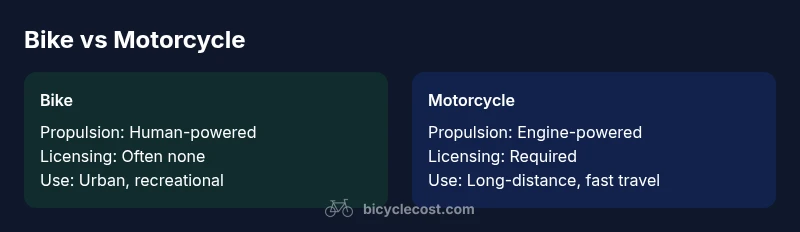
Bike vs motorcycle: not the same. A bike is human-powered (or pedal-assisted) and generally not subject to motor-vehicle licensing, while a motorcycle relies on engine power and falls under motor vehicle regulations. They diverge in licensing, safety gear, maintenance, and typical use. This BicycleCost guide lays out the key distinctions and what each option is best suited for.
Is Bike the Same as Motorcycle? Framing the Question
If you ask, "is bike the same as motorcycle?", the short answer is no, but the full answer requires unpacking categories, regulations, and everyday realities. For cyclists and bike owners who want clarity, this comparison uses plain language and practical examples to illuminate the differences between bicycles and motorcycles. According to BicycleCost, the core distinction lies in propulsion: bicycles rely on human power or pedal assist, while motorcycles depend on engine power. This fundamental split drives variations in licensing, safety expectations, maintenance routines, and typical use cases. As you read, keep in mind two guiding questions: What legal category does each device fall into where you ride, and what practical task are you trying to accomplish? By the end, you’ll see that the two modes serve different purposes, even when they share some design similarities.
Core Power and Propulsion: The Key Differentiator
propulsion sits at the heart of the distinction. A bicycle’s motion comes from the rider’s legs or an electric assist system, while a motorcycle uses internal combustion or electric propulsion to generate substantial power. This difference affects not only acceleration and cruising speed but also energy efficiency, maintenance cadence, and noise profiles. In practical terms, a bicycle excels at urban commuting, casual rides, and fitness goals where simplicity and low cost matter. A motorcycle suits longer trips, higher-speed travel, and scenarios where extended ride ranges and quicker commutes are essential. Understanding propulsion helps set expectations for performance, handling, and the kind of training that makes sense for each option.
Comparison
| Feature | Bike | Motorcycle |
|---|---|---|
| Engine/Propulsion | Human-powered or pedal assist | Engine-powered (gas or electric) |
| Speed and Acceleration | Moderate, steady pace | High acceleration and top speeds |
| Licensing & Registration | Typically none or basic local rules | Requires rider license and vehicle registration |
| Safety Gear | Helmet, lights, reflective gear as needed | Full protective gear including helmet, jacket, gloves, boots |
| Maintenance Cadence | Simple: chain care, tires, brakes | More complex: engine, transmission, electrical systems |
| Cost of Ownership | Lower upfront, lower ongoing costs | Higher upfront and ongoing costs, insurance |
| Intended Use | City commuting, recreation, fitness | Long-distance travel, performance riding |
| Environmental Impact | Zero or minimal emissions (pedal-assist), depends on battery source | Fuel or large-battery energy use, lifecycle impact |
Pros
- Lower ongoing costs and simpler maintenance
- Quiet operation and compact sizing in urban spaces
- Accessible for a broad range of users and ages
Downsides
- Limited speed and range for many models
- Dependency on rider effort or battery charge for propulsion
- Regulatory complexity increases with power-assisted designs
Bicycle first, motorcycle second: they serve different needs and legal frames
Choose a bike for cost-effective, low-regret urban travel or exercise. Choose a motorcycle for speed, range, and motor-vehicle regulation when appropriate. The BicycleCost team emphasizes understanding use-case and local rules before deciding.
People Also Ask
Is a bicycle legally considered a motor vehicle in most places?
In many jurisdictions, a standard bicycle is not treated as a motor vehicle. However, rules can vary when pedal-assist or electric bicycles exceed certain power or speed thresholds. Always check local regulations to avoid penalties. According to BicycleCost, staying within standard bicycle classifications reduces regulatory complexity while still enabling safe, efficient travel.
Bicycles are usually not motor vehicles, but rules vary. Check local regulations for pedal-assist limits and speed caps.
Do you need a license to ride a bike?
Typically no license is required for ordinary bicycles. Some regions impose rules for electric bikes with higher speeds or power, or for class-specific e-bikes. Always verify local licensing requirements before riding.
Usually you don’t need a license for a bike, but check your local rules for e-bikes with higher speeds.
What safety gear is mandatory for motorcycles but not for bikes?
Motorcycles generally require helmet use and other protective gear, depending on the jurisdiction. Bicycles typically call for a helmet and lights, with fewer mandatory protections. Always follow local safety standards.
Motorcycles usually require helmets and protective gear; bikes primarily require basic safety gear like a helmet and lights where required.
Can an electric bicycle be regulated like a motorcycle?
Some high-power or high-speed electric bikes cross into classifications resembling mopeds or motorcycles, which creates different licensing and safety obligations. Regulations differ widely by country and region.
High-power e-bikes can be regulated like motor vehicles in some places; always check local classifications.
What are typical maintenance differences between bikes and motorcycles?
Bikes require simpler maintenance—tire care, chain lubrication, brake checks. Motorcycles demand more complex maintenance for the engine, transmission, and electronics, often with professional service.
Bikes are simpler to maintain; motorcycles need more involved upkeep and professional service is common.
Which is better for commuting in a city with heavy traffic?
For tight urban traffic, a bicycle can be highly practical, offering flexibility and cost savings. A motorcycle can cover longer legs quickly but brings higher costs and regulatory considerations.
In heavy city traffic, bikes offer great maneuverability and low cost, while motorcycles cover distance faster but cost more and require licenses.
Quick Summary
- Identify your primary use: short urban trips vs long rides
- Check local licensing and registration requirements early
- Assess safety gear needs and training implications
- Consider total cost of ownership over time
- Think about environmental impact and lifestyle fit