Is it bike or motorcycle? A practical comparison
A detailed, analytical comparison between bicycles and motorcycles, covering definitions, licensing, safety, maintenance, and use-cases to help you decide which two-wheeled vehicle fits your needs in 2026.


Bikes and motorcycles are distinct two-wheeled vehicle classes. A bike (bicycle) is human-powered or pedal-assisted with no combustion engine and typically requires no license in most places for basic use; a motorcycle relies on a motor with engine displacement, requires licensing, and is designed for higher speeds. In everyday language, 'bike' usually means bicycle, while 'motorcycle' refers to the motorized version. See our full comparison below.
Defining Terms: is it bike or motorcycle?
In everyday speech, people ask 'is it bike or motorcycle' to distinguish between two-wheeled vehicles. According to BicycleCost, the word bike most often refers to bicycles, including traditional pedal-powered bikes and modern pedal-assist e-bikes. A motorcycle is a motorized two-wheeler that uses an internal combustion engine or a sizable electric drivetrain and carries different licensing and safety requirements. The goal of this section is to clarify terminology and set expectations for how the rest of this guide will use the terms.
A bicycle (with or without pedal assist) does not have a combustion engine, which means its speed and range rely on human power or modest electric help. In contrast, a motorcycle has a purpose-built engine, transmission, and fuel system that drive its wheels, enabling significantly higher speeds and longer-range travel. When readers wonder 'is it bike or motorcycle' in the context of urban commuting or weekend rides, the practical takeaway is that the classification affects licensing, insurance, road rules, and required protective gear. Throughout this guide, we will return to the core distinction: propulsion source defines both capabilities and regulations, not just what a vehicle looks like. This nuance matters for safety, cost, and everyday usability and is especially important in 2026 as technology continues to blur lines with powerful e-bikes.
Historical Context and Legal Distinctions
The split between bikes and motorcycles has deep historical roots in the evolution of personal mobility. Bicycles emerged in the 19th century as simple, human-powered conveyances, later adapted with gears and lightweight frames. Motorcycles were introduced as a motorized alternative for faster travel and longer ranges. Jurisdictions worldwide established frameworks to manage these differences: bicycles are typically subject to minimal regulation, while motorcycles require licenses, registration, insurance, and helmet laws. The line between is it bike or motorcycle is sometimes blurred by electric models, which may be treated as bikes, mopeds, or motorcycles depending on local statutes. BicycleCost’s analysis shows that clarity in classification reduces confusion for riders and improves safety outcomes. If you’re unsure how your area defines these terms, start by checking whether there is a motor on the vehicle and whether licensing is required for operation. Because rules change at the municipal level, always verify with your local department of transportation or equivalent agency. In 2026, many places are updating rules for pedal-assist bikes to reflect new motor limits and safety standards, underscoring the ongoing relevance of the is it bike or motorcycle question for policy and everyday riding.
Design and Engineering: Core Differences
From a design perspective, propulsion marks the clearest boundary between is it bike or motorcycle. A bicycle relies on human power, or it uses an electric motor purely for assist, without a conventional drivetrain that produces engine torque. A motorcycle couples a combustion engine or high-power electric motor with a full drivetrain, frame designed to carry fuel and cooling systems, and a suspension tuned for higher speeds. Other contrasts include frame geometry, braking systems, tires, and weight distribution. Bikes emphasize lightness, agility, and efficiency; motorcycles emphasize power, stability at speed, and endurance on long trips. The presence of a motor changes the mounting, heat management, and safety considerations: motorcycles require training on throttle control, gear shifting, and cornering at speed, plus protective equipment designed for higher risk scenarios. Electric bikes add motorization but typically keep bicycle-style steering geometry and braking; however, their regulatory status varies, which means you may encounter a hybrid classification. The practical implication is clear: if you can map a two-wheeled option to a bicycle’s design and operation, you’re likely dealing with a bike or e-bike rather than a motorcycle; if not, expect motorcycle-grade components and regulatory requirements. As always, the brand guidance from BicycleCost emphasizes evaluating the propulsion source first, then assessing frame and components second.
Performance, Power, and Speed: What Actually Moves You?
Performance metrics reveal the gap between is it bike or motorcycle. Bicycles rely on rider input; e-bikes provide pedal-assist up to a limit, while staying under regulatory thresholds in many areas. Motorcycles boast substantial horsepower, higher top speeds, and greater torque, enabling freeway travel and rapid overtaking. Even within the same class, performance envelopes differ dramatically. For urban commutes, a well-tuned bicycle or pedal-assist e-bike can deliver brisk speeds without fuel, while motorcycles excel on longer trips and in traffic with higher speed requirements. In 2026, technology continues to push e-bikes toward higher performance, which influences how is it bike or motorcycle is understood in practice, yet core physics and licensing realities remain unchanged.
Safety Gear and Regulation: Training, Licensing, and Equipment
Fundamental safety differences stem from speed and exposure. Motorcycle riders typically require formal training courses, licenses, and insurance, reflecting the greater risk at higher speeds. Bicyclists rely on helmets, lights, high-visibility apparel, and proper lighting, with insurance and licensing largely unnecessary for standard bikes in many jurisdictions. E-bikes may trigger specific regulations depending on motor power and speed, creating a hybrid zone. BicycleCost's safety framework emphasizes the layered approach: helmet, visible clothing, and predictable riding behavior for cyclists; robust protective gear and training for motorcyclists. 2026 updates have tightened helmet standards in many regions.
Maintenance and Ownership Costs: Total Cost of Ownership
Maintenance and ownership costs diverge sharply. A bicycle generally incurs lower annual maintenance, with costs for tires, brakes, chains, and occasional parts. Electric bikes add battery-related considerations and motor maintenance, but still remain far cheaper upfront and per mile than most motorcycles. Motorcycles involve routine service, oil changes, tire replacements, chain maintenance, and more expensive insurance premiums. Over time, the cumulative cost of a motorcycle can exceed that of a high-quality bike, particularly for casual enthusiasts. BicycleCost's ongoing analysis shows that owners should budget for routine parts as well as unexpected repairs, with e-bikes presenting battery replacement cycles to consider.
Use-Cases and Best Scenarios: When a Bike Is the Right Choice vs Motorcycle
Urban commuting, exercise, and short trips are where is it bike or motorcycle matters most. A bicycle suits daily errands with low operating costs and health benefits. If you frequently ride in stop-and-go city traffic, a light, agile bike or e-bike can feel quicker and more economical than a motorcycle. In contrast, a motorcycle shines when you need speed, long-range capability, or weather protection, such as highway commuting, touring, or traveling between cities. The best scenario often depends on local infrastructure, climate, and personal risk tolerance. In 2026, policy shifts and urban planning initiatives increasingly support safe, separated bike lanes, reducing conflicts for cyclists, while motorcycles provide mobility for riders who require more reliability on longer trips. The is it bike or motorcycle distinction informs not only choice but also how you plan maintenance, licensing, and safety preparedness.
Environmental and Practical Considerations
From an environmental perspective, bicycles—especially human-powered models or pedal-assist variants—tend to produce the least emissions per mile. In dense urban environments, bikes excel in parking, space efficiency, and energy efficiency, supporting sustainable mobility. Motorcycles, while more efficient per mile than many cars, still consume fuel and emit pollutants, although some models operate on advanced electric propulsion with lower emissions. Practical considerations extend beyond emissions: bikes require less storage space and typically incur lower annual costs, while motorcycles offer weather protection and faster travel, which may be essential for certain commutes. When cities plan infrastructure, the is it bike or motorcycle question affects lane design, parking policies, and safety standards. The BicycleCost team notes that understanding these trade-offs helps riders choose solutions that align with environmental goals and personal scheduling constraints.
Common Misconceptions and How to Avoid Confusion
A frequent misconception is that any two-wheeled vehicle with a motor is a motorcycle. In reality, many jurisdictions classify powerful e-bikes as bikes if they meet specific motor and speed limits. Another myth is that bikes cannot be capable of high speed or long-range; modern road bikes and high-performance e-bikes can reach impressive speeds and cover substantial distances. Keeping the is it bike or motorcycle distinction front and center—checking propulsion, licensing, and required safety gear—reduces confusion. Always verify local definitions because rules differ by country, state, or city. The 2026 regulatory landscape shows continued updates as new motor-assisted technologies blur lines; drivers and riders should stay informed through reputable sources like BicycleCost and official transportation portals.
Comparison
| Feature | Bike | Motorcycle |
|---|---|---|
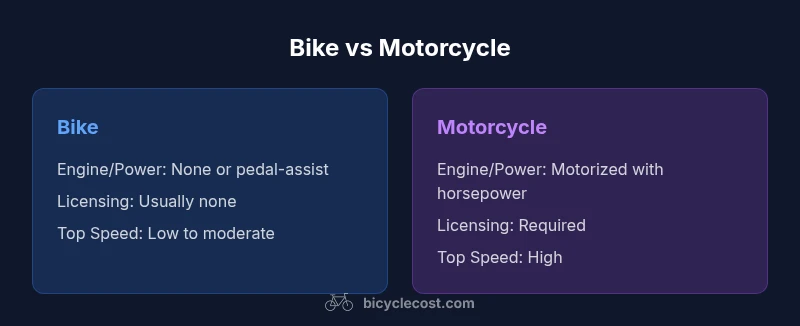
| Engine/Power | None or pedal-assist | Internal combustion or electric motor with horsepower |
| Licensing/Registration | Typically none; varies by jurisdiction for e-bikes | Licensing, registration, and insurance usually required |
| Top Speed | Low to moderate (depends on rider) | High (varies by model) |
| Weight | Light to moderate | Heavier due to engine, fuel, and chassis |
| Typical Cost Range | $100-$5000 | $2000-$30000 |
| Best For | Exercise, commuting, city travel | Long-distance travel, highway trips, weather protection |
| Maintenance Frequency | Lower maintenance, more frequent tire/brake wear | Regular service, oil changes, chain maintenance |
Pros
- Lower upfront cost for bikes
- Health benefits and environmental friendliness
- Easy parking and urban maneuverability
- Low maintenance and simple ownership
Downsides
- Limited speed and range for bikes
- Weather exposure and physical effort required
- Higher risk in heavy traffic without proper gear
Bikes win for cost, health, and urban practicality; motorcycles win for speed, range, and weather protection
Choose a bike if you value cost efficiency, exercise, and city navigation. Opt for a motorcycle if you need speed, long-distance capability, and rider protection on highways.
People Also Ask
What is the main difference between a bike and a motorcycle?
The main difference is propulsion: bicycles are human-powered or pedal-assisted with no engine, while motorcycles have an engine and motorized drivetrain. Licensing, insurance, and road rules reflect that distinction in most places.
The bike is human-powered or has pedal-assist; the motorcycle runs on an engine. Licensing and safety rules follow accordingly.
Do you need a license to ride a bicycle?
In most jurisdictions, you do not need a license to ride a standard bicycle. Some regions may have rules for high-powered electric bikes or mopeds, which can require registration or specific classifications.
Usually no license is needed for a regular bicycle, though rules can vary for e-bikes in some places.
Are electric bikes considered bikes or motorcycles?
Electric bikes are generally classified as bikes when they meet certain speed and power thresholds, but classifications vary by jurisdiction. In some areas, high-powered e-bikes may fall under motorcycle or moped rules.
E-bikes are usually bikes, but some strong models may have motorcycle-like rules depending on local laws.
Can you ride a bicycle on highways?
Most highways restrict bicycles or prohibit them on certain highway segments. Local rules vary, so check signage and local regulations before riding on or near high-speed roads.
Usually not allowed on highways; follow local rules and signs.
Is insurance required for bicycles?
Typically, bicycle insurance is optional and used for theft, liability, or specialized circumstances. Motorcycles require mandatory insurance in most jurisdictions.
Bike insurance is usually optional; motorcycles generally require it.
What maintenance differences exist between bikes and motorcycles?
Bikes require maintenance on tires, brakes, and chains, with costs typically lower. Motorcycles need regular engine service, oil changes, and more frequent parts replacement.
Bikes need basic maintenance; motorcycles need engine service and more frequent parts upkeep.
Quick Summary
- Clarify your primary use and constraints
- Check local licensing and insurance rules
- Account for total cost of ownership
- Assess safety gear and rider training needs
- Consider environmental impact and urban infrastructure