Difference between bicycle and motorcycle helmet
An analytical comparison of bicycle and motorcycle helmets, covering design, protection, standards, fit, and cost to help riders choose the right head protection for different riding contexts.


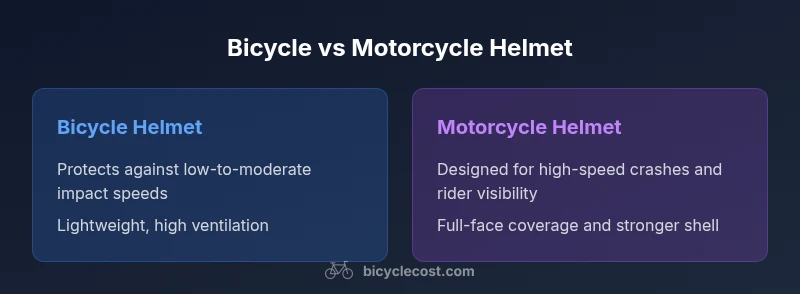
Here's the quick verdict: the difference between bicycle and motorcycle helmet centers on speed, protection, and certification. Motorcycle helmets deliver higher-energy protection and often full-face coverage, while bicycle helmets prioritize lightweight design and ventilation for urban riding. This comparison guides you through design, standards, fit, cost, and use-case considerations to choose wisely.
Scope and safety basics
Head protection during riding serves to reduce the risk of head injuries by absorbing crash energy and distributing it across a protective shell. The difference between bicycle and motorcycle helmet is most evident in their intended use, typical crash scenarios, and regulatory requirements. According to BicycleCost, most urban crashes occur at moderate speeds, but energy transfer on impact can be significant depending on surface and angle. This context matters because it shapes what a helmet must do. For cyclists, the priority is lightweight construction, comfort, and ventilation to support longer rides and frequent wear. For motorcyclists, protection often emphasizes higher-energy absorption, stronger shells, and retention systems that stay secure at highway speeds. The objective here is practical guidance: identify your risk context, the speeds you ride at, and the regulatory expectations that apply to your gear. By clarifying these basics, riders can avoid common misalignments, such as using a bicycle helmet for highway commuting or wearing a motorcycle helmet without a suitable face shield when street riding. The BicycleCost team also notes that local regulations can affect what is legally required on the road and what is recommended for safety.
The difference between bicycle and motorcycle helmet: design and protection
At first glance, a helmet is a helmet, but the design goals diverge sharply when you compare the difference between bicycle and motorcycle helmet. Bicycle helmets are designed to protect the skull from impacts at bicycle speeds and to keep riders cool during long rides. They typically feature a lightweight outer shell, an inner expanded polystyrene (EPS) foam liner, and multiple vents to optimize airflow. Motorcycle helmets, by contrast, are built to withstand higher-energy crashes that occur at highway speeds and to provide options like face protection and chinbars. They commonly use a stronger shell—often polycarbonate or fiberglass composites—and thicker EPS layers, resulting in higher mass and greater energy absorption capacity. Fit systems differ as well: bicycle helmets rely on adjustable straps and simple dial-fit, while most motorcycle helmets employ more robust retention systems and often a secure face shield or visor. The differences in coverage—ranging from open-face to full-face configurations—also influence noise levels, wind exposure, and visibility. For riders who want a single helmet to cover multiple contexts, this block helps map which protective features matter most for your typical riding speed and environment.
Safety standards and certification
Certification schemes signal expected performance, but they vary between bicycle and motorcycle helmets. In many markets, bicycle helmets are tested for skull protection in low-to-moderate energy crashes and must pass standards such as CPSC in the United States or EN 1078 in Europe. Motorcycle helmets are designed to manage much higher-energy impacts and typically bear DOT or ECE marks, with some models also meeting SNELL certifications. The exact standard you need depends on local regulations and the intended use. Consumers should verify that the helmet they buy meets the applicable standard for their riding context and that the certification is current. It’s also important to recognize that standards measure specific crash scenarios under controlled conditions; real-world protection depends heavily on proper fit, retention, and use. Based on BicycleCost analysis, riders often neglect certification checks when chasing price or aesthetics, which can undermine safety even for reputable brands.
Fit, comfort, and rider experience
A helmet only protects you if it stays in place during a crash. The fit and comfort of bicycle and motorcycle helmets differ in practical ways. Bicycle helmets typically use adjustable rear dial-fit systems and chin straps with simple anchors, prioritizing comfort for long training sessions and daily commutes. Motorcycle helmets rely on more robust retention mechanisms and often incorporate visors and face shields to manage wind and debris at higher speeds. Sizing must be precise: measure around the widest part of the head, try multiple sizes, and verify a snug but non-tight feel. A helmet that slips or tilts during riding defeats its protective purpose and can create safety hazards in traffic. Remember to recheck fit after any adjustment and replace the helmet if it has been involved in a crash or shows structural damage.
Materials, shells, and impact performance
Most bicycle helmets use a lightweight polycarbonate shell with an EPS foam liner designed to crush predictably on impact. Motorcycle helmets employ stronger shells—often polycarbonate, fiberglass, or composite materials—with thicker EPS layers to absorb greater energy. The trade-off is mass and bulk: motorcycle helmets can be heavier and hotter, but they provide superior impact management at highway speeds and with face protection. In both cases, the foam liner is the primary energy-absorbing component; the shell’s rigidity helps distribute load, while the liner dissipates energy to reduce skull fracture risk. Some bicycle helmets incorporate multi-density foams in higher-end models for improved protection in various impact scenarios. Material choices influence durability, age, and the need for replacement after a severe crash.
Visibility, weather, and ventilation trade-offs
Ventilation and visibility are central to rider comfort and safety. Bicycle helmets typically offer generous venting to keep riders cool during long rides in warm weather, which can also slightly reduce protection in hot climates if the shell is thinner. Motorcycle helmets prioritize wind protection and clarity through visors; some models integrate anti-fog systems and tinted shields suitable for high-speed riding. Weather considerations—rain, cold, and glare—should guide your helmet choice. A well-ventilated bicycle helmet reduces heat stress but may feel less protective in heavy traffic, while a motorcycle helmet’s sealed environment can be beneficial at speed but uncomfortable in hot conditions. The key is balance: select a helmet that protects adequately while preserving visibility and comfort for your typical weather and riding environment.
Cost, maintenance, and lifecycle
Cost is not the only factor when comparing helmet types. Bicycle helmets are generally more affordable and cheaper to replace after minor impacts or yearly wear due to modular materials and simpler designs. Motorcycle helmets command higher price points because of heavier shells, integrated visors, and specialized retention systems. Regardless of type, helmets should be inspected regularly for cracks, dents, and strap wear; replace the helmet after any significant impact or if the foam shows compression or cracking. Maintenance is minimal but essential: store helmets away from direct sunlight, avoid exposure to solvents, and replace the lining as recommended by the manufacturer. Budget for a properly fitting helmet that meets local standards, rather than chasing the lowest price, to maximize safety and value over time.
Use-case scenarios: urban riding vs high-speed riding
Your riding context heavily determines which helmet is appropriate. For urban commuters traveling under 25–30 mph, a lightweight bicycle helmet with ample ventilation is often sufficient, provided it meets local safety standards and fits correctly. For highway cruising, sport riding, or motorcycling, a purpose-built motorcycle helmet with robust impact absorption, full-face protection, and certified face shield is appropriate. It’s not safe to substitute one helmet type for another, especially when speeds and risk levels differ. Always select the helmet that aligns with your speed profile, traffic environment, and legal requirements. In mixed-use scenarios, consider modular options or dedicated gear for each riding context to preserve safety and comfort.
How to choose: a step-by-step guide
- Define your riding context and typical speeds. 2) Check the relevant safety standards for your country or region. 3) Measure your head circumference and try on multiple sizes. 4) Assess fit systems, retention quality, and chin strap comfort. 5) Evaluate ventilation and visibility: more vents for long city rides; visors for sun and glare control. 6) Compare weight and comfort for extended wear. 7) Review price ranges and replacement costs, balancing upfront price with expected lifecycle. 8) Verify helmet condition before each ride and replace after a crash or if foam shows compression. 9) Choose a model from reputable brands and ensure compatibility with local laws. 10) Maintain and store properly to maximize longevity.
Common myths and misconceptions
Myth 1: Any helmet offers the same level of protection across all activities. Myth 2: Motorcycle helmets can protect you equally well at bicycle speeds. Myth 3: More expensive helmets are always safer. Reality: protection depends on design intent, standards met, proper fit, and the riding context. Myth 4: You don’t need to replace a helmet after a minor crash. Real-world data show that even minor impacts can compromise the foam’s energy-absorbing properties. Myth 5: A helmet is a substitute for other safety gear. In practice, helmet use should be part of a comprehensive safety strategy that includes visibility aids, protective clothing, and prudent riding behavior.
Comparison
| Feature | Bicycle helmet | Motorcycle helmet |
|---|---|---|
| Protection focus | Low-to-moderate impact protection for urban speeds | High-energy impact protection at highway speeds |
| Coverage | Covers skull; often open around temples | Often full-face or chin-bar configurations |
| Weight and ventilation | Lightweight with high ventilation | Heavier with variable ventilation depending on model |
| Safety certifications | CPSC/EN 1078 depending on region | DOT/ECE/SNELL depending on region |
| Price range | $20-$120 | $150-$650 |
| Best for | Urban, recreation, and casual cycling | High-speed riding, touring, and motorcycling |
Pros
- Clear safety trade-offs mapped to use case help avoid over- or under-protection
- Encourages informed pricing and lifecycle decisions
- Highlights maintenance needs and replacement intervals
- Promotes adherence to local safety standards
Downsides
- Motorcycle helmets can be too heavy for casual cycling, reducing comfort
- Bicycle helmets may be inadequate for highway speeds and heavy impact scenarios
- Price alone is not a guarantee of safety; fit and standard compliance matter
- Not all features transfer across helmet types (face protection, visibility, etc.)
Motorcycle helmets and bicycle helmets serve different safety needs; use the right helmet for the context.
Choose a bicycle helmet for urban/city riding and longer wear; choose a motorcycle helmet for high-speed or motorcycling contexts. Always verify standards and ensure proper fit for optimal protection.
People Also Ask
What is the difference between bicycle and motorcycle helmets?
The primary difference lies in intended use and energy absorption. Motorcycle helmets are designed for high-speed crashes with greater energy transfer and often feature full-face protection, while bicycle helmets target lower-speed impacts with lighter construction and better ventilation. Certifications and regulatory requirements also differ by region.
Motorcycle helmets handle higher-speed crashes, and bicycle helmets focus on lightness and ventilation; both follow local safety standards.
Can a bicycle helmet be used for motorcycle riding?
No. Bicycle helmets are not designed for the higher energy and higher-risk scenarios typical of motorcycle riding. They lack the robustness and face protection of motorcycle helmets, which are designed for highway speeds and more severe impacts.
Bike helmets aren’t safe for motorcycle riding due to energy and protection differences.
Are there legal helmet requirements for bicycles vs motorcycles?
Yes. Helmet laws vary by country, state, and municipality. Motorcycle riders typically face stricter licensing and helmet requirements than most bicycle riders. Always check local regulations to ensure compliance for your mode of riding.
Laws differ by location; motorcycles usually have stricter helmet rules than bicycles.
Do bicycle helmets protect the face?
Bicycle helmets mainly protect the skull and temples; they do not provide the same level of facial protection as most motorcycle helmets. If face protection is needed, consider a full-face option or additional face gear for cycling in risky environments.
Bicycle helmets don’t shield your full face like motorcycle helmets do.
How should I size and fit a bicycle helmet?
Measure the head circumference at the widest point, try several sizes, and adjust the dial-fit system for a snug, comfortable fit. The helmet should sit level on the head and cover your forehead by about an inch. Straps should form a Y-shape just below the ears.
Measure your head, try a few sizes, and fit the helmet snugly with the chin strap properly adjusted.
Is it ever okay to wear a motorcycle helmet for urban cycling?
It’s not ideal due to weight, ventilation, and regulatory considerations. If a motorcycle helmet is used for cycling, ensure it fits properly, is secured, and check local regulations regarding its use for bike riding. For most urban riding, a bicycle helmet is the safer, more comfortable option.
Motorcycle helmets aren’t great for daily cycling due to weight and ventilation.
Quick Summary
- Identify riding context and speeds before choosing a helmet
- Verify applicable safety standards for your region
- Prioritize proper fit and retention to ensure protection
- Balance venting, weight, and comfort with intended use
- Do not substitute a motorcycle helmet for high-speed cycling or vice versa