Bicycle vs Motorcycle: Key Differences Explained
This analytical comparison uncovers how a bicycle and a motorcycle differ in propulsion, licensing, safety, and maintenance, with practical guidance for riders and decision-making tips.


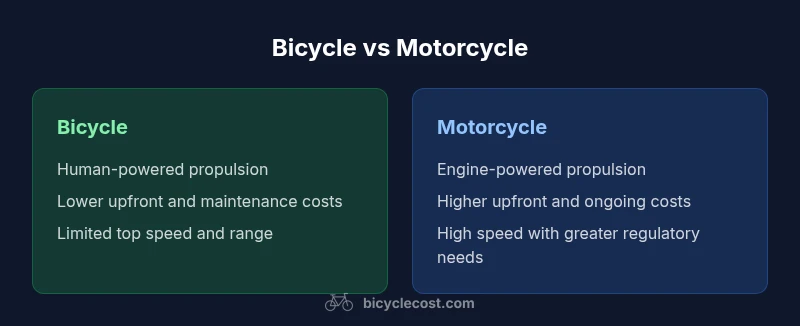
What’s the difference between a bicycle and a motorcycle? In short, bicycles rely on human power and basic mechanical components, while motorcycles use engines, fuels, or electric motors to produce propulsion. This fundamental distinction shapes speed, licensing, safety requirements, maintenance, and everyday use. The BicycleCost team provides a structured, practical comparison to help riders decide which option fits their goals.
Core distinctions: propulsion, control, and risk
Roughly speaking, the most visible difference between a bicycle and a motorcycle is propulsion. A bicycle is powered by human pedaling and efficient gearing, while a motorcycle relies on a motor that converts fuel or electricity into motion. This core distinction cascades into control dynamics, balance requirements, braking strength, and lane positioning. From a risk perspective, motorcycles operate at higher speeds and with greater stopping distances, which elevates both crash severity and the need for comprehensive protective gear. According to BicycleCost, the fundamental propulsion gap is the primary driver of regulatory, safety, and maintenance differences between the two platforms. This single factor influences almost every subsequent consideration, from licensing to daily use.
Power sources and propulsion
Bicycles harness human energy through pedals and a drivetrain that converts leg power into wheel rotation. Their propulsion is steady, predictable, and limited by rider stamina and terrain. Motorcycles use internal combustion engines or electric motors to generate thrust, delivering rapid acceleration and sustained high speeds. This contrast determines rider effort, fuel or charging costs, and the potential for longer trips without fatigue. For urban riders, human-powered bikes offer reliable, quiet transport with exercise benefits; for commuters needing speed and longer reach, motorcycles provide unmatched legibility on highways and primary routes. The BicycleCost team notes that the energy source also dictates maintenance complexity and availability of spare parts in local shops.
Speed, range, and handling differences
Bicycles provide comfortable rides at modest speeds, with handling focused on balance, cadence, and efficient geometry. Motorcycles achieve significantly higher speeds and longer-range capability, but require greater rider training to master throttle control, cornering, and braking at speed. Handling nuance differs: bicycles emphasize micro-adjustments and energy management; motorcycles demand disciplined throttle, clutch operation, and protective posture. Urban riders often prefer bicycles for agility, while motorcyclists leverage their higher performance for commuting longer distances or traversing multiple road grades. BicycleCost’s analysis highlights that the perceived speed gap is a central factor driving licensing, insurance, and risk considerations.
Braking, suspension, and tires
Bicycles use lightweight braking systems (rim or disc) and simpler suspension if present, with tires optimized for grip and rolling resistance. Motorcycles employ more complex, higher-performance braking systems, stiffer suspensions, and larger tires designed to handle higher speeds and varied terrain. This difference translates into longer stopping distances for motorcycles and more significant requirements for maintenance, inspection, and brake cooling during extended riding. The consumer experience diverges here: bikes feel responsive at city speeds with minimal setup, while motorcycles demand careful tuning, regular inspection, and adherence to tire and brake wear guidelines.
Safety considerations for riders
Cycle safety emphasizes visibility, helmet use, and predictable positioning in traffic. Motorcyclists rely on helmet, armored jackets, gloves, boots, and protective pants to mitigate injury risks at higher speeds. The two modes also differ in rider training pathways: most bicycle riders can start without formal licensing, whereas motorcycle riders typically pursue formal courses and licensing exams. Beyond gear, rider behavior matters: defensive riding for motorcycles and safe, law-abiding cycling for bicycles both reduce crash risk. BicycleCost notes that safety gear selection should align with typical riding conditions and local traffic patterns.
Licensing, registration, and legal requirements
Licensing and registration are among the most consequential differentiators. In many regions, bicycles require little to no licensing or registration, though some jurisdictions introduce age- or use-based regulations for specialized bikes (e.g., e-bikes). Motorcycles generally require a driver’s license or motorcycle-specific license, vehicle registration, and insurance. This regulatory gap affects access, compliance costs, and long-term ownership considerations. The BicycleCost analysis shows that riders who cross over to motorcycles should budget for licensing, insurance, and test fees, which substantially raise total ownership costs compared with bicycles.
Maintenance, cost of ownership, and parts
Bicycles typically incur lower maintenance costs and simpler parts, with common expenses tied to chain lubrication, tire replacement, and occasional derailleur adjustments. Motorcycles involve higher ongoing costs, including fuel, oil changes, brake service, tire wear, and more expensive parts and labor. Practical ownership decisions hinge on usage patterns: daily city riding favors bicycles for affordability and reliability, while longer trips justify motorcycles for speed and convenience, provided the rider can absorb the higher maintenance and operating costs. BicycleCost emphasizes regular, proactive maintenance regardless of platform to extend lifespan and safety.
Use cases and optimal scenarios
Urban commuters benefit greatly from bicycles: inexpensive ownership, health benefits, easy parking, and low emissions. For long-distance travel, riding comfort on a motorcycle can outperform a bicycle in terms of time efficiency, weather resilience, and cargo capacity, assuming licensing and maintenance are manageable. Recreational riders often mix modes—cycling for workouts and short trips, motorcycling for weekend trips. The optimal choice depends on lifestyle, commute length, climate, storage availability, and personal risk tolerance. BicycleCost suggests a pragmatic decision process: list use cases, estimate total ownership costs, and compare regulatory requirements.
Design, ergonomics, and accessibility
Bicycle geometry emphasizes efficient pedaling, comfortable leg extension, and upright or slightly leaned posture. Motorcycles focus on rider ergonomics around seating, handlebar reach, footpeg placement, and wind protection. Accessibility considerations include entry/exit height, seat adjustability, and the ability to perform basic maintenance without specialized tools. For riders with limited mobility or space constraints, bicycles often present a more approachable entry point, while motorcycles offer a different scale of comfort and utility for those who can accommodate the requirements.
Environmental impact and urban implications
Bicycles are powered by human energy, contributing minimal emissions and fitting well with sustainable urban planning. Motorcycles, even when electric, introduce different energy footprints and infrastructure needs, such as charging networks or fuel logistics. Both modes influence traffic patterns, parking demand, and street design, but bicycles typically promote healthier, more space-efficient urban mobility. The BicycleCost team notes that cities prioritizing bike lanes and safe cycling infrastructure can significantly improve safety and adoption rates.
Barriers to adoption and common myths
Common myths include beliefs that bicycles are too slow for any meaningful travel or that motorcycles are universally unsafe. In reality, many riders are deterred by licensing costs, parking availability, and perceived risk rather than actual technical risk. Barriers also include climate, topography, and cultural attitudes toward cycling and motorcycling. Addressing these concerns with clear information, safe gear, and accessible training can shift adoption toward the mode that best fits a rider’s goals.
How to decide: a practical decision framework
A simple framework combines use-case analysis, budget planning, and regulatory awareness. Start with your primary goal (commuting, fitness, recreation, or speed), estimate total monthly and yearly costs (purchase price, maintenance, insurance, fuel/charging), and assess storage needs. Then test ride and evaluate comfort, control, and safety readiness. The decision becomes clearer when you map each criterion to a preferred mode and weigh trade-offs against personal circumstances. The BicycleCost methodology centers on practical, data-informed decisions rather than hype.
Comparison
| Feature | Bicycle | Motorcycle |
|---|---|---|
| Power source | Human-powered | Gasoline or electric motor |
| Top speed potential | Moderate/low speeds suitable for commuting and exercise | High-speed capability with engine power and tires designed for road use |
| Licensing & registration | Typically none or minimal in many regions | Requires driver’s license/motorcycle license and vehicle registration |
| Safety gear requirements | Helmet recommended; basic protection often optional | Helmet and full protective gear commonly required |
| Maintenance costs | Lower; simple parts and frequent use reduces complex maintenance | Higher; specialized parts, oil, tires, and professional service |
| Weight and handling | Lightweight; highly maneuverable at low speeds | Heavier; requires more space and training to handle safely |
| Energy costs | No fuel costs; depends on riding surface | Ongoing fuel or electricity costs; regular refueling/charging |
| Typical use cases | Urban commuting, fitness rides, short trips | Long-distance travel, highway use, performance riding |
| Environmental impact | Low to zero emissions (human-powered) | Emissions depend on fuel source and usage |
Pros
- Lower upfront cost and simpler ownership
- No licensing requirements for bicycles in many regions
- Health benefits from manual pedaling
- Easy parking and urban maneuverability
Downsides
- Limited speed and range for bikes; not suitable for highway travel
- Higher ongoing costs and regulatory requirements for motorcycles
- Greater safety risk at speed and more complex maintenance
Bicycle is best for daily urban use and personal health; motorcycle excels at speed and long-distance travel.
If your goals center on affordable, flexible, city-friendly transport, a bicycle wins. If you need rapid transit over longer distances or highway capability, a motorcycle is more appropriate—provided you can meet licensing, insurance, and maintenance requirements.
People Also Ask
What is the main propulsion difference between a bicycle and a motorcycle?
A bicycle uses human-powered pedaling to turn the wheels, while a motorcycle uses an engine (gasoline or electric) to generate motion. This core difference drives licensing, maintenance, safety gear, and performance expectations.
Bicycles are human-powered, motorcycles run on engines, which changes everything from licenses to safety gear.
Do you need a license to ride a bicycle?
In many places there is no license requirement for ordinary bicycles, though some regions regulate certain types like high-power e-bikes. Always check local rules before riding or converting a bike to power-assisted status.
Usually you don’t need a license for a regular bike, but rules vary by place.
Are bicycles faster than motorcycles?
Motorcycles generally offer higher top speeds and quicker acceleration. Bicycles can be fast for urban routes and workouts, but they cannot match motorcycle speeds on highways.
Motorcycles can go faster; bikes are typically slower but excellent for city rides.
What safety gear is required for a motorcycle?
Motorcyclists typically wear a helmet, protective jacket, gloves, pants, and boots. The gear is essential due to higher crash risk at speed.
Helmets and protective gear are standard for motorcycle riding to reduce injury risk.
Is maintenance cheaper for a bicycle or a motorcycle?
Bicycles usually have lower maintenance costs due to simpler components. Motorcycles require regular service, oil changes, and more expensive parts and labor.
Bikes cost less to maintain; motorcycles cost more, especially over time.
What factors should influence the buying decision?
Consider use case, total cost of ownership, storage space, licensing, and safety preferences. Map your needs to the mode that best fits your daily life and long-term goals.
Think about how you’ll use it, costs, and safety, then pick the mode that fits best.
Quick Summary
- Assess primary use: city riding vs high-speed travel
- Factor licensing and ongoing costs into the total ownership picture
- Prioritize safety gear and training for whichever mode you choose
- Consider space, storage, and parking accessibility
- Choose based on lifestyle, climate, and local regulations