Are Bikes or Cars Faster in Corners? A Thorough Comparison
An analytical side-by-side look at cornering speeds between bikes and cars, exploring grip, lean, tires, and weather to guide riders and drivers through practical decision-making.


Are bikes or cars faster in corners? The quick answer is: In typical dry-road corners, cars generally maintain higher speeds due to stability control, four-tire grip, and braking aids, while bikes rely on lean, tire contact, and rider skill to negotiate tight turns. The result depends on surface, weather, and the turn geometry; full context matters.
Why the Cornering Question Is Nuanced
According to BicycleCost, the question are bikes or cars faster in corners doesn't have a single universal answer. It depends on the geometry of the turn, the surface, and the conditions under which the turn is approached. Vehicles behave differently when negotiating curves: cars rely on wide contact patches, four tires, and stability controls to maintain grip, while bicycles lean into turns, manage tire contact patches dynamically, and depend on rider technique to maximize traction. For cyclists and drivers alike, the outcome hinges on factors like turn radius, braking before or during the apex, and the surface texture. When considering the broader question of which type of vehicle finishes faster through a given corner, it's essential to separate theoretical limits from practical performance. In real-world riding and driving, skill, equipment, and conditions decide the winner. The BicycleCost team found that context matters far more than any single stat. Are you curious about how these dynamics play out in typical road scenarios? The analysis that follows aims to clarify those nuances and provide actionable guidance.
Core Physics of Cornering for Two Wheels and Four
The physics of cornering splits into two camps: two-wheeled dynamics for bikes and four-wheeled dynamics for cars. For bikes, cornering speed is governed by lean angle, tire grip, and rider input. As a rider leans, the tire contact patch follows a curved path, generating centripetal force through static and dynamic friction. Lean angle, body position, and tire temperature all influence how much lateral grip is available before slipping. Cars rely on weight transfer, suspension geometry, and the broad grip afforded by four contact patches. Modern vehicles use electronic aids—traction control, stability programs, and ABS—to modulate wheel torque and braking in corners, allowing higher speeds within safe limits. Both systems benefit from predictable tire behavior, but the obvious difference is that bikes trade some stability for agility, whereas cars trade agility for stability and a larger safety envelope. Understanding these principles helps explain why are bikes or cars faster in corners is not a fixed answer but a function of conditions, equipment, and expertise.
Surface, Weather, and Their Effects on Cornering
Surface quality and weather dramatically shift the cornering equation for both bikes and cars. Dry, well-maintained pavement typically provides the best grip for both domains, but cars often exploit the advantage of four tires, wider contact patches, and electronic aids to sustain higher cornering speeds. In wet or icy conditions, tire compound and traction control systems become the deciding factors. For bikes, rider skill and tire choice (sipes, compound, and tread pattern) influence how much grip is available during the lean. Rough asphalt, gravel, or painted lines disrupt grip differently for each vehicle class. The result is that surface textures and moisture levels can invert expectations: a car might maintain stable cornering speed on a slick curve, while a determined rider could outpace a car through a tight hairpin if conditions favor lean-based traction. This emphasizes that the real-world outcome rests on a matrix of weather, surface state, and vehicle setup, not a single metric.
Case Studies: Real-World Scenarios and Edge Conditions
Consider three common cornering scenarios where outcomes vary. First, a tight hairpin on a dry mountain road: a skilled cyclist may navigate the curve quickly by optimizing lean, weight placement, and line, potentially exceeding a slower car that must manage a tighter turning radius with less lean. Second, a sweeping curve on a highway with good tires: a car can maintain a higher speed through the apex due to stability control and the broad grip from four tires, whereas a bike would require more speed reduction to stay within lean limits and line. Third, a wet urban corner with uneven pavement: both are challenged, but the car’s stability programs often help avoid wheel lock, while a cyclist must anticipate slick patches and adjust braking and lean to avoid a skid. These scenarios illustrate that performance is highly situational, and outcomes hinge on driver/rider decisions as much as vehicle capabilities. BicycleCost’s breakdown shows how context shifts advantage across scenarios rather than delivering a fixed winner.
How to Optimize Cornering Performance for Bikes and Cars
If you want to improve cornering performance for both bikes and cars, focus on setup, technique, and environmental awareness. For bicycles, ensure proper tire pressure for the tire type, maintain smooth throttle and brake control, and adopt a balanced body position that shifts weight into the turn without over-leaning. Practice progressive cornering lines, apex avoidance, and late-braking techniques that preserve exit speed. For cars, select tires suitable for typical weather, tune suspension to reduce body roll, and optimize brake bias and steering feel so that cornering inputs translate predictably to the road. The practice shared here applies across riding and driving: anticipate the turn, pick a consistent line, and modulate inputs to preserve grip. Both domains benefit from data-driven practice, such as telemetric feedback or professional coaching, to translate theory into repeatable performance. Remember that the fastest corner is often the one negotiated with minimal risk, so balance speed with safety and predictability.
Common Misconceptions About Cornering Speeds
Many people assume that lighter vehicles always win corners, but weight distribution, suspension, and tire technology complicate that belief. Some also think that stopping power alone determines who wins a corner; braking, line choice, and grip management play crucial roles. A frequent myth is that professional racers always corner faster on every road; in reality, conditions and the interplay of vehicle dynamics matter as much as skill. Finally, beginners often expect cars to dominate in every scenario, yet in very tight twists with limited sightlines, bicycles’ agility and lean-based control can allow faster line traversal if handled well. Clearing these myths helps set realistic expectations and informs safer decisions when approaching diverse corners on real roads.
Safety Considerations and Decision Factors for Mixed Traffic
Safety is central to evaluating cornering performance for both bikes and cars. In mixed traffic, visibility, road surface quality, and clothing or gear influence how you manage cornering risk. For riders, wearing proper protective gear, maintaining situational awareness, and practicing gradual progression into complex turns improve safety while developing technique. Drivers should respect corner radii, adjust speeds for weather and surface state, and leverage vehicle aids without becoming over-reliant on them. A structured training plan and continuous assessment of road conditions will help riders and drivers decide when it is prudent to push through a corner or yield to safer lines. BicycleCost emphasizes context-driven, safety-first decisions to minimize risk while understanding the limits of each vehicle type.
Summary of Trade-offs and Practical Takeaways
The core trade-off comes down to agility versus stability. Bikes excel in tight, trickier corners where lean and rider balance matter, while cars excel in standard corners due to stability control and four-tire grip. The best approach is to tailor your technique, equipment, and expectations to the turn, surface, and weather. If you ride a bike, invest in tires suited to typical conditions and practice lean-based cornering with controlled inputs. If you drive a car, optimize tire choices for seasons, maintain suspension and steering feel, and understand how electronic aids influence corner exit speed. Ultimately,are bikes or cars faster in corners is a nuanced question with no universal winner; context, skill, and setup determine the result.
Glossary of Cornering Concepts for Quick Reference
- Cornering speed: the highest speed at which a vehicle can safely negotiate a turn.
- Lean angle: the tilt of a bike toward the inside of the turn to maintain balance and grip.
- Traction control: system that prevents wheel spin by managing engine power.
- Apex: the path inside the turn where the vehicle travels closest to the inner edge.
- Tire grip: the friction between tire tread and road surface that enables turning and acceleration.
Comparison
| Feature | Bike | Car |
|---|---|---|
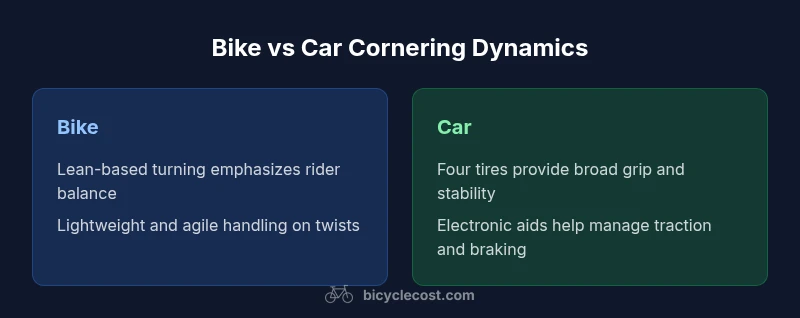
| Cornering grip and lean requirements | Bike relies on lean angle, tire contact, and rider balance | Car relies on four-tire grip, suspension, and electronic aids |
| Weight transfer and stability | Bike experiences dynamic weight transfer with lean; sensitivity to rider input | Car distributes weight via suspension; stability controls manage excess motion |
| Tire contact patch during cornering | Patch changes with lean; grip varies with body position | Patch remains relatively constant; chassis aids optimize grip |
| Braking through corners | Braking can destabilize a bike; trail braking used carefully | ABS and stability systems help manage corner braking |
| Skill and risk level | Bike performance is highly skill-dependent | Car performance depends on driver skill and system limits |
| Weather and surface effects | Tire and lean matter; weather amplifies risk for bikes | Electronic aids mitigate some risks; performance is weather-dependent |
Pros
- Bikes offer high maneuverability and direct feedback for skilled riders
- Cars provide stable handling with four tires and electronic aids
- Lower ongoing maintenance costs for most bicycles
- Potentially faster apex navigation through tight lines for experienced riders
Downsides
- Bike performance is highly skill-dependent and weather-sensitive
- Cars can feel less responsive in ultra-tight turns or low-speed maneuvers
- Riding or driving at riskier limits increases exposure to injury or damage
Cars are generally faster in standard cornering; bikes win only in very tight, low-speed turns with expert handling
In typical dry-road corners, cars maintain higher speeds due to stability and traction. Bikes can outpace cars in extremely tight hairpins if the rider or driver can exploit lean-based mechanics and line choice. Context, weather, and equipment ultimately decide the outcome.
People Also Ask
Are bikes generally faster than cars in corners?
In most ordinary corners, cars maintain higher speeds due to stability control and four-tire grip. Bikes can win or approach if the turn is ultra-tight and the rider is highly skilled. Real-world outcomes depend on line, surface, and weather.
Usually cars are faster in standard corners, but highly skilled riders can push through very tight turns faster on bikes with the right lean and technique.
Which factors most influence cornering speed for bikes?
Lean angle, tire grip, body position, and throttle/brake control are the primary influencers. Surface texture and tire type (compound and tread) also play critical roles in how much grip a bike can maintain during a bend.
For bikes, lean, grip, and rider input are the big levers for corner speed.
Which factors influence cornering speed for cars?
Tire quality, suspension setup, weight distribution, steering response, and electronic aids (traction control, stability, ABS) shape cornering performance. Weather and road grip also determine how safely a car can push through a corner.
For cars, tires, suspension, and electronics define corner speed.
Does weather change who wins in corners?
Yes. Dry conditions generally favor cars for higher corner speeds, while wet or icy surfaces reduce grip for both, often elevating the importance of tire choice and driver/rider skill.
Weather shifts the balance; dry favors cars, wet benefits cautious, skilled handling by both.
Can driver or rider aids change cornering outcomes?
Electronic aids can help prevent loss of control and manage traction, widening the safe performance envelope for cars. For bikes, rider technique remains the limiting factor; aids are less common but coaching and telemetry can improve training outcomes.
Electronic aids help cars, while rider skill remains the limiter for bikes.
Quick Summary
- Cornering speed depends on weight, grip, tires, and skill
- Cars typically corner faster on standard curves
- Bikes can excel in very tight turns with skilled riders
- Weather and road condition shift advantages
- Safety and proper technique matter for both vehicles