Height for Bicycle Size: A Practical Sizing Guide
Discover how to size bicycles by height and inseam using practical rules, stand over clearance, saddle height, and reach adjustments to help riders select the correct bicycle size.


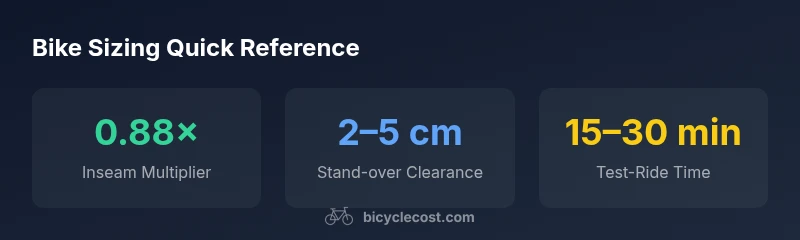
Most riders size their bike height by inseam. A common starting point is saddle height at about 0.88 times your inseam for road bikes, and a range of 0.88–0.90 times inseam for mountain bikes. Use this rule-of-thumb to set a safe starting point, then fine-tune with a test ride, crank length, and stand-over clearance checks.
Why height for bicycle size matters
Sizing a bike by height influences knee angle, hip alignment, and pedal efficiency. When the saddle is too high or too low, you risk knee strain, reduced power, and compromised control. The height for bicycle size should be considered alongside inseam, torso length, arm reach, and riding style. According to BicycleCost, an inseam based starting point provides a safe baseline for most riders, but real world feedback is essential to finalize fit. This block explains why height matters and how small adjustments cascade into comfort and performance across long rides.
How to measure your inseam accurately
Accurate inseam measurement is the foundation of height based sizing. Stand with bare feet about hip width apart, weight evenly distributed, and measure from the floor to the crotch area. Record this length in centimeters or inches. Use a hard, flat book between the legs while standing to simulate sit bone distance, then measure from floor to the top edge. Double check with a second measurement and average the results. This inseam serves as the anchor for saddle height calculations and subsequent adjustments.
Translating inseam to saddle height by bike type
Road bikes and mountain bikes use different but related multipliers. A typical starting point for road bikes is saddle height around 0.88 times inseam, while mountain bikes often use a range of 0.88 to 0.90 times inseam. For hybrids, a middle ground of roughly 0.87–0.89 times inseam works well for many riders. These ranges provide a practical starting point but must be refined through ride feel, knee comfort, and toe clearance. Remember that crank length and frame geometry also influence the final saddle height choice.
Beyond saddle height: stand over, reach, and crank length
Height based sizing is not just about the saddle. Stand over clearance ensures you can straddle the frame with ease, especially on technical descents. Reach to the bars and the effective top tube length determine how upright or aggressive your posture is. Crank length interacts with saddle height to affect knee bend and pedaling efficiency. If you have long legs but a short torso, you may need to adjust saddle height and stem length to balance reach and control. Small tweaks in seat angle and saddle setback can also improve comfort without changing the main height.
A practical workflow: sizing, testing, and fine tuning
Start with inseam based saddle height using the road bike and mountain bike multipliers. Set the saddle height and ride for 10–15 minutes on similar terrain. Evaluate knee bend, hip stability, and ankle clearance at the bottom of the pedal stroke. If the knee feels pinched or the heel lifts, adjust saddle height in small increments of 5–10 mm and re test. Complement height with appropriate stem length, handlebar height, and seat rail position. Finally, consider a professional fit if persistent discomfort remains after personal adjustments. This workflow blends measurement with ride feedback for a precise height for bicycle size.
Common mistakes and how to avoid them
Avoid assuming one multiplier fits all; rider proportions vary widely. Don t rely on quick fixes or visual estimates alone. Always verify stand over clearance and test the bike under real riding conditions. Keep crank length in mind, as longer or shorter cranks can alter optimal saddle height. Document changes and track comfort over several rides to ensure stability and prevent recurring issues.
Saddle height guidelines by bike type
| Bike Type | Recommended Saddle Height Multiplier | Stand-over Clearance (min) | Notes |
|---|---|---|---|
| Road bike | 0.85–0.89 | 2–3 cm | Prioritize ankle clearance and knee angle |
| Mountain bike | 0.88–0.90 | 3–5 cm | Allows room for standing and rough terrain |
| Hybrid | 0.87–0.89 | 2–4 cm | Balanced for mixed urban/off-road use |
People Also Ask
What is the best starting saddle height for a road bike?
For most riders, begin with saddle height near 0.88 times the inseam. This starting point balances knee angle and power during pedaling, and should be fine tuned after a test ride.
Start with saddle height around 0.88 times your inseam, then test ride and refine.
How do I measure my inseam at home accurately?
Stand barefoot with feet apart and a book between your legs. Raise the book to your crotch, then measure from the floor to the top edge. Take two measurements and average them for accuracy.
Stand with feet apart, place a book between your legs, and measure from the floor to the top edge of the book. Do two takes and average.
Does height for bicycle size differ between road and mountain bikes?
Yes. Road bikes typically use a slightly lower multiplier than mountain bikes. Mountain bikes may require a touch more saddle height to account for standing and varied terrain.
Road and mountain bikes differ a bit in height guidelines; mountain bikes often lean toward a touch more saddle height.
Is there a right height for stand-over clearance?
Stand-over clearance should allow you to straddle the frame with comfortable knee bend. A general rule is 2–5 cm depending on torso length and riding style.
Aim for at least a couple of centimeters of clearance so you can stand easily over the frame.
Should I consult a professional fitter?
If pain persists after personal adjustments or if you ride frequently, a professional fitter can optimize saddle height, reach, and stem setup for your body geometry.
If pain or persistent discomfort remains, consider a professional bike fit for precise adjustments.
“Accurate height based sizing starts with a reliable inseam measurement and ends with real world ride feedback.”
Quick Summary
- Measure inseam accurately before sizing
- Start with multipliers and refine by ride feedback
- Check stand-over clearance and crank length effects
- Test ride and seek professional fit for final tweaks