Bicycle vs Tricycle: A Thorough Side-by-Side Comparison
Explore the key differences between bicycles and tricycles, covering sizing, safety, cost, and maintenance in a data-backed, objective analysis.


Bicycle vs tricycle comparisons reveal that bicycles excel in efficiency and speed, while tricycles shine in stability, cargo capacity, and accessibility. This guide analyzes how each option performs across sizing, safety, maintenance, and typical use cases to help riders pick the best fit for their needs.
What distinguishes a bicycle from a tricycle?
At its core, the bicycle vs tricycle debate centers on balance, propulsion, and how riders interact with the machine. According to BicycleCost, the core distinction between a bicycle vs tricycle lies in stability, dynamics of balance, and the way weight shifts during motion. A two-wheeled bicycle relies on rider balance plus gyroscopic momentum to stay upright, while a three-wheeled tricycle uses a fixed platform to provide extra stability. This fundamental difference drives most of the practical contrasts you’ll encounter: speed, efficiency, and handling, as well as the kinds of tasks each vehicle can perform well. In everyday use, many riders saddle up a bicycle for commuting or exercise, while a tricycle shines in scenarios that demand steadiness, cargo capacity, or accessibility for riders with mobility limitations. The BicycleCost team found that, across generations and geographies, the bicycle remains the more efficient form of personal transport when roads are smooth and space is at a premium, while tricycles fill important niches where balance or weight distribution matters. When evaluating the two, it’s essential to weigh not only outright speed but also comfort, stability, and long-term ownership.
Sizing, ergonomics and rider fit for bicycle vs tricycle
Sizing and rider fit are central to the bicycle vs tricycle decision. A traditional two-wheel setup emphasizes precise saddle height, reach to the handlebars, and pedal-to-seat position. For a tricycle, sizing considerations expand to seat width and leg clearance, as well as the trunk and hip region, since more time is spent with a broad, stable stance. The overall geometry affects cadence, posture, and comfort over longer rides. In both cases, access to properly fitted gear—such as adjustable stems, adjustable saddles, and replaceable cranks—helps reduce fatigue and potential injury. Ergonomics play a bigger role for riders with mobility challenges, where stomp-and-release motion on a tricycle can be more comfortable than balancing on a two-wheeled bicycle. For people recovering from injuries or managing arthritis, the choice may hinge on how easily the rider can initiate motion and maintain a steady cadence without frequent corrections.
Stability, balance, and learning curve
Stability is the defining difference between the bicycle vs tricycle. A bicycle demands balance, steering finesse, and timely weight transfer to stay upright, which creates a steeper learning curve for beginners. In contrast, a tricycle provides reliable three-point contact with the ground, reducing the risk of tipping at low speeds. This makes learning and daily use easier for new riders, older adults, or children. However, stability comes at the cost of lower maneuverability, wider turning radii, and potential challenges in crowded urban spaces. When training new riders, instructors often emphasize controlled practice in open areas before attempting tight corners, traffic interactions, or emergency stops, regardless of the vehicle type. The practical takeaway is that balance and spatial awareness remain critical in both cases, but a tricycle offers a gentler entry and steadier pace for beginners.
Use-case scenarios: commuting, family riding, cargo
Different use-case stories illustrate the bicycle vs tricycle choice. For urban commuting where speed, efficiency, and distance matter, a bicycle frequently wins due to lighter weight and better climb performance. For family riding, parks, or cargo trips, a tricycle’s cargo tray, child seat compatibility, and onboard stability can be decisive. If you regularly carry groceries, tools, or school supplies, a tricycle across flat routes can reduce effort and improve load management. In care settings or for mobility aid, specialized tricycles provide stability and controlled power assist. The bottom line is context: choose a bicycle for speed and versatility, and a tricycle for stability, cargo capacity, and user comfort at slow speeds.
Cost, durability, and long-term value
Cost considerations for bicycle vs tricycle cover upfront price, maintenance, and resale value. Typically, bicycles offer lower upfront costs and a broader market of used models, which can translate into lower depreciation per year if well maintained. Tricycles, especially cargo or specialty variants, tend to carry higher upfront prices due to additional frame geometry, weight-bearing capability, and steering setups. Maintenance costs generally align with usage patterns: bicycles rely on drivetrains and brakes with available aftermarket parts, while tricycles may require more robust components and heavier frames. Over the long term, both can offer good value if properly cared for; the key is to align the choice with expected mileage, cargo needs, and storage constraints. Based on BicycleCost research, most riders realize that the total cost of ownership aligns more closely with usage intensity than initial sticker price.
Maintenance, parts availability, and repair ecosystem
Maintenance needs and parts availability shape the long-term viability of bicycle vs tricycle. A bicycle benefits from a vast ecosystem of components—from chains and derailleurs to brake pads and tires—making repairs accessible in most regions. Tricycles, while less ubiquitous, have dedicated support in many parts of the world, especially for models with three-wheel configurations and braking systems designed for added stability. Replacement parts for common brands are usually available through online retailers and local bike shops. For long-term ownership, it’s wise to choose models with standardized components and widely supported aftermarket accessories. Routine checks—tire pressure, brake function, chain lubrication, and bearing play—keep both types performing well across different terrains and seasons.
Performance metrics: speed, efficiency, and ride quality
Performance metrics for bicycle vs tricycle hinge on speed, energy efficiency, and ride quality. A bicycle typically achieves higher speeds with better climbing efficiency due to lighter weight, aerodynamic advantage, and efficient drivetrain options. A tricycle sacrifices some speed for stability and predictable handling at low speeds, making it suitable for slow urban cruising, cargo runs, or therapeutic riding. Ride quality is influenced by frame materials, suspension options, and wheelbase design. A well-tuned bicycle can deliver sharper acceleration and cornering, while a tricycle emphasizes steady cadence and reduced sway on uneven surfaces. For most riders, the right choice balances preferred pace with personal comfort during longer outings.
Accessibility and inclusive design
Accessibility considerations underpin the bicycle vs tricycle decision for many communities. Tricycles often provide safer first rides for young learners and older riders, offering a confidence boost with three-point footing. For urban environments, specialized tricycles with step-through frames and low step height can improve independence. Conversely, a well-chosen bicycle with adjustable components can accommodate a wide range of body sizes and flexibility, supporting fitness and daily commuting. The inclusive design conversation also includes storage options, helmet and safety equipment integration, and how easy it is to mount/dismount in constrained spaces. Ultimately, accessibility is about removing barriers to entry and enabling riders to participate confidently in everyday mobility.
Design trends and future-proofing
Design trends for bicycle vs tricycle reflect evolving needs in urban mobility, sustainability, and caregiving. Innovations include lighter materials, modular cargo solutions, and improved braking systems for stability-focused models. Electric-assist variants are expanding the reach of both categories, though the balance between weight, motor placement, and battery life matters more for tricycles due to extra weight. Future-proofing involves choosing adaptable frames, widespread compatibility with accessories, and reliable service networks. For many users, the decision hinges on whether they value the nimble, high-performance feel of a bicycle or the stability and cargo potential of a modern tricycle, with the latter increasingly appealing in urban logistics and inclusive transport.
Comparison
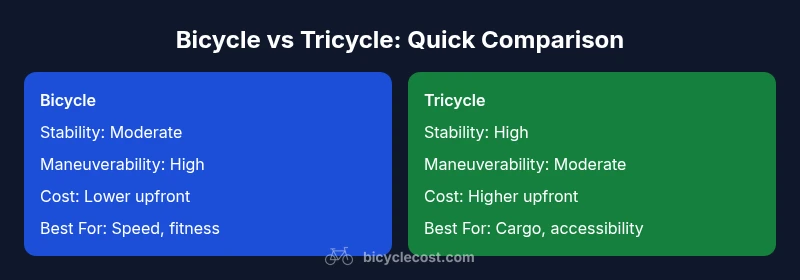
| Feature | Bicycle | Tricycle |
|---|---|---|
| Stability | Moderate balance on two wheels requiring rider input | High stability with three wheels, especially at low speeds |
| Maneuverability | Faster, more agile in traffic; tighter turning with skill | Wider turning radius; steadier at slow speeds |
| Cost Range | Lower upfront cost on typical models | Higher upfront cost for cargo or specialized models |
| Maintenance | Simple drivetrain options; broad parts availability | Heavier frame; potentially fewer compatible aftermarket parts |
| Best For | Urban commuting, fitness, speed-focused riding | Learning, accessibility, cargo, and mobility assistance |
Pros
- Lower upfront costs for many bicycle models
- Higher speed and efficiency in everyday riding
- Wide accessory ecosystem and repair network
- Compact size and easier storage in urban spaces
- Strong resale value and global availability
Downsides
- Less stability at low speeds or on uneven surfaces
- Limited cargo capacity without added equipment
- Steeper learning curve for balance on two wheels
- Potentially more challenging for absolute beginners to start riding
Bicycle is typically the better all-around choice for speed and efficiency; tricycle excels in stability, cargo, and accessibility.
Choose a bicycle for everyday commuting and fitness when space and speed matter. Opt for a tricycle when stability, loading capacity, or accessibility outweigh pure speed, especially in urban or caregiving contexts.
People Also Ask
What factors should I consider when choosing between a bicycle and a tricycle?
Focus on stability needs, cargo requirements, storage space, and comfort. Consider your typical riding environment, distance, and experience level. The bicycle often provides speed and efficiency, while the tricycle offers stability and load capacity.
Think about where you ride most and who will ride with you; that will guide whether a bicycle or tricycle fits best.
Is a tricycle safer for beginners?
Many beginners feel more secure on a tricycle due to its three-point contact with the ground. However, safety also depends on rider training, helmet use, and appropriate terrain. Both require practice in controlled spaces before venturing into traffic.
Yes, for beginners the extra stability helps, but practice and protective gear matter most.
Can adults ride a tricycle for long-distance commuting?
Adults can ride tricycles for long distances if they choose cargo or touring variants with appropriate gearing and comfort features. Range depends on rider endurance and bike design, not solely on wheel count.
Absolutely, with the right setup and pacing.
Do I need a license to ride either bicycle or tricycle?
In most places, bicycles and standard tricycles do not require a special license to ride. Rules vary by country and jurisdiction, so check local regulations for public road use and safety requirements.
Usually no license needed, but follow local traffic rules.
Are folding models available for bicycles or tricycles?
Yes, folding bicycles are common for compact storage and commuting. Folding tricycles exist but are less common; both types are available in market-adjusted sizes and designs.
There are folding options, especially for bicycles.
Quick Summary
- Assess your use-case first: speed vs stability
- Choose bicycle for efficiency and tight urban navigation
- Choose tricycle for cargo, accessibility, and beginner safety
- Ensure proper sizing and fit to maximize comfort
- Plan maintenance around common wear items and parts availability