Two-Wheel vs Three-Wheel: Bicycle Tricycle Comparison
A data-driven comparison of standard bicycles and bicycle tricycles, focusing on stability, use-cases, maintenance, and value for riders of all ages. Learn how to choose based on balance, cargo needs, and riding environment.


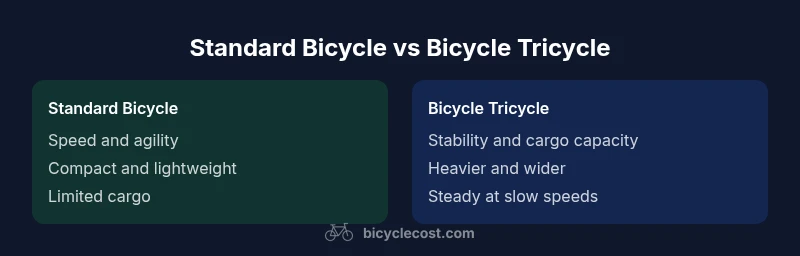
Here is a concise comparison: A standard bicycle offers greater speed and nimble handling, while a bicycle tricycle delivers superior stability and cargo capacity. The two options suit different riders—learners or older riders may prefer a tricycle, whereas commuters seeking efficiency may favor a traditional two-wheeler. This page breaks down the key differences in stability, use cases, weight, and price to guide your choice.
Why the bicycle tricycle matters in modern cycling
The bicycle tricycle is not a relic of the past; it remains relevant for a broad range of riders. The three-wheeled design offers a stable platform for learning, rehabilitative riding, and practical transport in urban or rural settings. For new cyclists, older riders, or caregivers transporting children or cargo, a tricycle provides confidence and safety where a two-wheel bike might feel unstable. In addition, the extra wheel can smooth out uneven terrain and help riders maintain balance on rough surfaces. This article compares the two main configurations—standard bicycles and bicycle tricycles—against a consistent set of criteria so you can choose with clarity and evidence-based reasoning. The discussion keeps practicality in focus, avoiding hype or overstatement.
Key dimensions: stability, weight, and handling
The most immediate differences between a standard bicycle and a bicycle tricycle are stability, weight distribution, and steering feel. On a two-wheeled bike, balance is dynamic and requires rider input to stay upright; this can be challenging for beginners, taller riders learning urban maneuvers, or riders navigating uneven pavement. In contrast, the three-wheeled design provides a broader base of support, reducing tipping risk and increasing confidence in straight lines and slow-speed maneuvers. Weight distribution shifts: a tricycle carries more mass over the front wheel and frame, which can affect acceleration and braking. Handling tends to be steadier but less responsive in tight turns. Understanding these dimensions helps align your choice with your local riding context.
Use-case scenarios: who benefits most
Different riding scenarios favor different bike configurations. For daily commuters who prioritize speed, efficiency, and minimal effort, a standard bicycle is usually the better choice. For learners, seniors, or caregivers who need to maintain balance while carrying children or groceries, a bicycle tricycle offers a compelling advantage. Rural riders facing gravel lanes or sloped driveways may prefer a tricycle’s stability, while urban riders with favorable bike lanes can leverage the agility of a two-wheeler. Finally, mixed-use riders who alternate between errands and casual rides may benefit from modular setups that allow a quick switch between configurations or accessories.
Cargo and storage considerations
Cargo capacity is a practical differentiator. Standard bicycles rely on panniers, baskets, or trailers to haul items, which adds some complexity and weight but preserves speed. Bicycle tricycles often integrate rear racks, front baskets, or even passenger seats; this makes them well-suited for shopping trips, transporting kids, or carrying tools and equipment. If you routinely carry heavier loads or run a small business on wheels, a tricycle’s stability reduces load-shift risk. However, the added weight and width can complicate parking and garage storage.
Variants and configurations
There is a surprising variety of bicycle tricycles and standard bicycles. On the two-wheeler side, you can choose road, hybrid, mountain, or commuter models with varying gear ranges and brake systems. On the three-wheeler side, you will encounter delta and tadpole layouts (three wheels in a triangle), different seating options, cargo configurations, and some electric assist variants. Some riders opt for folding designs to ease transport in apartments or vehicles. Evaluate whether you need a rear-mounted child seat, a front basket, or a step-through frame to simplify mounting and dismounting.
Safety considerations and braking performance
Braking performance is a vital safety factor. Standard bicycles typically use disc brakes or rim brakes with strong modularity; braking efficiency improves with weight reduction and proper tire pressure. Bicycle tricycles require attention to brake balance across three contact points and, in some configurations, larger stopping distances due to added weight. Always check that wheel alignment is true, tires are in good condition, and that the braking system is compatible with the riding environment. Visibility and helmet use remain essential for both options.
Sizing and fit considerations for riders of different ages
Fit is critical for comfort and safety. For children and beginners, smaller frame sizes with adjustable seat heights help build confidence without fatigue. For adults, ensure the saddle height allows a slight knee bend at the bottom of the pedal stroke; a suitable handlebar height reduces strain on wrists and shoulders. For bicycle tricycles, pay special attention to step-through options and cockpit layout: more space between the wheelbase and the rider can improve balance and visibility. In all cases, the right size improves control, reduces injuries, and enhances enjoyment.
Costs and long-term value
Price is a practical consideration. Standard bicycles can range from budget-friendly models to higher-end performance bikes, with costs influenced by frame materials, components, and brand perception. Bicycle tricycles typically cost more upfront because of the extra wheel and stabilizing framework, but they can offer better cargo capacity and longer usable lifespans for users who value stability or multi-person transport. When assessing long-term value, consider maintenance costs, expected mileage, and the potential savings from removing the need for a trailer or alternative transport. Look for models with modular components that can be upgraded over time.
Maintenance and part availability
Maintenance for two-wheel bikes is generally straightforward, with widely available parts and a large network of shops. Three-wheel designs may require more specialized components, including specific brake configurations and wheel assemblies, which can increase service costs and lead times. The best approach is to select trusted brands with wide dealer support or to opt for models with standardized components that interchangeable between wheel configurations. Regular checks of tires, chains, and bearings ensure longevity for both configurations.
Terrain and environment compatibility
Urban paved streets reward lighter, efficient two-wheel designs, while rough roads, gravel MTB trails, or country lanes can favor a tricycle's stability. If you frequently ride in crowded spaces, the three-wheel setup can offer better balance and predictability at slower speeds. However, in steep hills or high-speed descents, weight distribution and wheel performance are critical: ensure your brakes and gearing are appropriate for the terrain. Consider weather as well: wet surfaces increase stopping distance, especially on older alloys.
Accessibility and inclusivity benefits
Bicycle tricycles play an important role in improving access to mobility for people of all ages and abilities. They provide a practical option for riders who struggle with balance, arthritis, or knee pain, enabling participation in community rides or family outings. For communities that prioritize inclusive recreation, tricycles can be paired with child seats or cargo solutions to expand participation in events and daily errands. Accessibility should always be evaluated alongside safety training and helmet use.
Buying options: new vs used
New bicycles and tricycles offer latest safety features, warranty protection, and customization options, but cost more upfront. Used models can deliver significant savings if inspected carefully for frame integrity, rust, and worn components. When evaluating used options, ask about maintenance history and prior accidents, if any, and request a test ride to assess structural soundness. Always inspect tires, brakes, and bearings before purchasing. If possible, choose certified pre-owned from reputable dealers to reduce risk.
Test rides: how to evaluate both options
A thorough test ride covers different riding scenarios: slow-speed balance tests, cornering, braking, and load carrying if you're evaluating cargo options. For the bicycle tricycle, test stability during entry and exit, as well as turning and maneuvering with a load. Bring a friend or mentor to observe posture and balance, and take notes on comfort, seat quality, cockpit ergonomics, and gear shifting. Use a checklist to compare options side by side after the ride.
Practical buying checklist
Create a pragmatic checklist before buying. Confirm fit by measuring inseam, saddle height, and reach. Check tire condition and tread depth; inspect brakes and shifting performance. Decide on desired features such as racks, baskets, or child seats, and verify compatibility with your local storage space. Review warranty terms and service networks in your area. Finally, compare total cost of ownership, including accessories and ongoing maintenance.
Accessories and safety gear for bicycle tricycle riders
Even with a stable platform, accessories can boost safety and practicality. Consider integrated lights, panniers, child seats, reflectors, and helmets that meet local safety standards. For cargo-focused setups, choose durable racks and weatherproof bags. Ensure aftermarket parts do not compromise stability or brake performance. Regularly inspect accessories and adjust them for proper fit to maintain balance and control during rides.
Comparison
| Feature | Standard bicycle | Bicycle tricycle |
|---|---|---|
| Stability on flat surfaces | Moderate stability; balance is rider-driven | High stability with three-point contact; lower tipping risk |
| Maneuverability and turning radius | Laster turning radius; highly agile | Larger turning radius; steadier in slow turns |
| Cargo capacity | Limited cargo options; racks optional | Integrated racks and potential passenger/cargo solutions |
| Weight and portability | Lighter; easier to lift and transport | Heavier; wider footprint and more components |
| Price range | Typically lower to mid-range | Typically mid to higher range |
| Best use | Commuting, speed, sport riding | Learning, cargo, and multi-person transport |
| Maintenance complexity | Fewer components; broader support network | More components; potential spare-parts variability |
Pros
- Greater stability reduces tipping risk for new riders
- Better cargo carrying capability makes it practical for families or shopping
- Simpler ride feel for learners and rehabilitation scenarios
- Wide availability of accessories and customization options
Downsides
- Heavier and bulkier, impacting storage and transport
- Usually higher upfront cost and ongoing maintenance
- Lower top speeds and reduced maneuverability compared to two-wheel bikes
Bicycle tricycle is better when stability and cargo beat speed and agility
If you prioritize balance, safety for loads or passengers, and ease learning, a tricycle is the clear choice. If you value speed, efficiency, and compact storage, a standard bicycle remains preferable.
People Also Ask
What is the main difference between a standard bicycle and a bicycle tricycle?
The standard bicycle uses two wheels and relies on rider balance for stability, offering higher speed and agility. The bicycle tricycle uses three wheels, providing greater stability and cargo-carrying capacity. Your choice should reflect balance needs, load considerations, and space constraints.
Two wheels give you speed and quick handling, while three wheels make balance easier and help with carrying loads.
Who should consider a bicycle tricycle?
Riders new to cycling, older adults, people with balance concerns, parents needing to transport children, and anyone regularly carrying groceries or equipment may benefit from a tricycle. It’s especially useful for mobility in uneven terrain or when stability is paramount.
Great for learners, seniors, and folks who carry stuff or kids.
Are bicycle tricycles safe for children?
Yes, with proper sizing, supervision, and helmet use. Choose a tricycle that fits the child’s height and leg reach, and ensure baskets or seats are securely installed. Always follow local safety guidelines for young riders.
Kids should ride under supervision with a good helmet and a properly sized tricycle.
Do bicycle tricycles require special maintenance?
Some components may be unique to tricycles, such as different brake configurations or wheel assemblies. Regular checks of tires, brakes, steering, and bearings remain essential, and a dealer with experience in three-wheel designs is helpful.
You’ll want a shop familiar with three-wheel setups for checks and parts.
Can adults use a three-wheeled bicycle for commuting?
Absolutely. A tricycle can be a practical commuting option if stability and cargo are priorities, but expect slower acceleration and potentially larger storage needs compared to a two-wheeler.
Yes, for stability and cargo, though it may be slower than a two-wheeler.
What should I test during a ride?
Test balance at slow speeds, evaluate steering feel, braking responsiveness, seating comfort, and cargo handling if applicable. For tricycles, assess stability with a load and ease of mounting/dismounting.
Check balance, brakes, and comfort during a ride.
Quick Summary
- Assess balance needs before choosing.
- Two-wheel bikes excel in speed; three-wheel bikes excel in stability and cargo.
- Consider storage space and transport when evaluating options.
- Account for maintenance costs with heavier tricycles.
- Test ride both configurations to confirm comfort and fit.