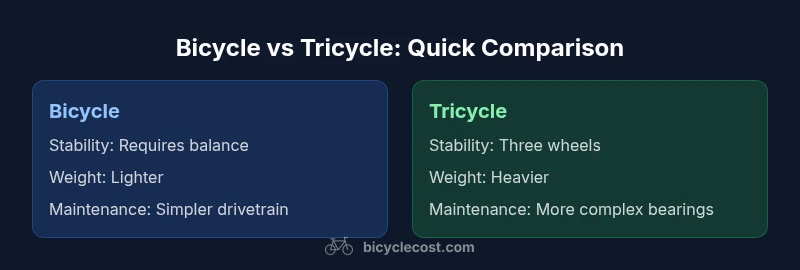
Bicycle vs Tricycle: A Practical Comparison for Riders
Explore a detailed, objective comparison of bicycle and tricycle options for riders, families, and beginners. Learn safety, sizing, maintenance, and cost considerations to choose the right ride.


According to BicycleCost, choosing between a bicycle and a tricycle depends on rider age, goals, and safety priorities. This quick comparison highlights who benefits most from each option, including maneuverability, stability, and maintenance considerations. Use this TL;DR to guide deeper reading and practical decisions for bike sizing and safety today.
Core Differences in Design and Use
The bicycle and tricycle are two of the most common personal mobility devices, yet their core design differences lead to distinct riding experiences. A standard bicycle relies on two wheels, a narrow frame, and a steerable fork that the rider actively balances and pedals. A tricycle adds a third wheel, typically at the front or rear, to create a stable platform that reduces the need for balance. From a sizing perspective, bicycles emphasize efficiency and agility, while tricycles prioritize stability and predictable handling. In structured environments—city streets, parks, or campus paths—these design choices translate into very different use cases. The BicycleCost team notes that the best choice depends on who will ride, where they will ride, and how much weight they will carry. As a result, this section focuses on how stability, steering geometry, weight distribution, and gearing influence everyday usefulness. Always consider not only the rider’s current ability but also the potential for future needs as children grow or adults adapt to new physical demands.
Safety and Stability: When Stability matters
Stability is the first axis of comparison when evaluating a bicycle versus a tricycle. The two-wheel bicycle relies on dynamic balance and speed control, which can translate into heightened risk for beginners or riders with limited balance. A front- or rear-wheel tricycle offers a wide-supported platform that can dramatically reduce tipping risk, especially at slow speeds or when stopped and starting. However, stability comes with trade-offs: turning radius is typically larger, and maneuvering through tight spaces requires planning. In urban environments, curbs, pedestrian traffic, and parked cars increase risk exposure for both devices, but the tricycle’s predictable path can lower odds of sudden loss of balance. Both options benefit from standard safety features—proper helmets, lights, reflectors, and visible clothing. According to BicycleCost analyses, choosing equipment that fits the rider’s physical needs and the typical riding environment reduces accident risk and enhances confidence.
Age, Ability, and Sizing Considerations
Rider age and ability are central to selecting between bicycle and tricycle. For young children, tricycles are commonly recommended as they help build balance skills progressively while providing motorized assistance via adult supervision. For older youth and adults, a bicycle supports fitness, speed, and commuting efficiency when balance and coordination are solid. Sizing is critical: a bicycle must fit the rider’s leg length and reach to the handlebars; a tricycle’s seat height and wheelbase influence stability more than reach. In some cases, adjustable geometry and step-through frames bridge the gap between grow-with-you needs and long-term usability. If space or transport is limited, consider how the rider will store the vehicle or carry it between destinations. The goal is to match the device to the rider’s capabilities and daily routines, not just to aesthetics or novelty.
Maintenance and Durability: What to Expect
Maintenance requirements differ between bicycles and tricycles, often in predictable patterns. A bicycle’s drivetrain—chain, gears, and brakes—tends to be lighter and simpler, with many common parts available at local bike shops. Regular lubrication, tire inflation, and chain cleaning tend to be sufficient for most riders. Tricycles, especially adult variants, have additional drivetrain complexity and a larger wheelset; the front steering geometry can add wear on bearings, and tires may wear unevenly due to weight distribution. Durability considerations include frame material, spoke tension, and wheel compatibility. In general, routine checks every few hundred miles or monthly, whichever comes first, help prevent early failures. The BicycleCost team recommends a basic maintenance schedule tailored to usage, including annual technician checks for more complex trikes that feature advanced braking systems or electric assistance.
Cost and Value: Comparing Long-Term Ownership
Cost considerations span purchase price, ongoing maintenance, and resale value. Entry-level bicycles commonly begin at lower price points but scale with components, geometry, and intended use (commuting, mountain, road, or touring). Tricycles vary in price based on seating position (inline vs. delta front) and load capacity; adult tricycles with high load limits or electric assistance can be significantly more expensive than basic bikes. Over time, maintenance costs for bicycles tend to be lower on a per-mile basis due to simpler drivetrains, while tricycles may incur higher tire and bearing costs due to the third wheel and heavier frames. In all cases, buying used or refurbished units can offer substantial value, but be mindful of wear on critical components. The BicycleCost analysis highlights that total cost of ownership should factor usage patterns, space constraints, and the intended user’s age and ability.
Practical Scenarios: Daily Commute, Recreation, and Family Trips
Practical planning matters. For a daily commute, a lightweight bicycle with reliable brakes and efficient gearing can save time and energy, especially on longer trips. For recreational rides with children or companions, a tricycle may offer stability that enables inclusive riding experiences. Family outings often require portability and storage; many families find a mix of both devices works well—parents use bicycles for adults’ commutes while kids or grandparents use child-friendly tricycles or pedal-less options for educational experiences. When traveling with luggage, consider the ability to fold or disassemble the device; some models offer collapsible frames or detachable wheels. In all cases, ensure proper helmet use, reflective gear, and route planning to minimize risk. The BicycleCost team emphasizes that these choices should align with daily life realities, not just fantasy or trend.
Accessibility and Adaptations: Customizations for Different Riders
Customization can expand the usability of both bicycles and tricycles. For riders with balance challenges, options such as trikes with lower seat heights and adjustable weight distribution can improve confidence. Trikes may be compatible with child seats, baskets, or cargo racks that enable practical load-carrying during errands. For bicycle riders with limited mobility, step-through frames, e-bike assist, or trailer attachments can widen accessibility. For some riders, adaptive devices like pendants, hand cycles, or lever brakes transform the riding experience entirely. When choosing accessories or upgrades, check compatibility with local vendors and ensure that installation adheres to safety guidelines. The BicycleCost guidance suggests starting with a professional fitting to optimize seating, reach, and pedal position.
Environmental and Health Considerations
Choosing between a bicycle and a tricycle has environmental and personal health implications. Pedal-powered mobility reduces emissions and improves cardiovascular health when used regularly. The better fit for a given rider's ecology and routine will determine overall benefits: bicycles may encourage longer rides and higher activity levels, while tricycles can promote consistent exercise for balance-impaired users without overwhelming them. Both options support sustainable transport when integrated with public transit or car-free commuting. The bicycle and tricycle ecosystems also influence maintenance routines and part availability, which in turn affect long-term environmental impact through manufacturing and disposal cycles. The BicycleCost perspective remains focused on practical, evidence-based guidance to maximize safety, comfort, and value.
Comparison
| Feature | Bicycle | Tricycle |
|---|---|---|
| Stability and Balance | Requires balance and agility; rider leans and pedals | Three-wheel design; minimal balance required; stable at rest and low speeds |
| Maneuverability & Turning Radius | Faster steering; sharper turns with body movement | Larger turning radius; steadier at slow speeds |
| Weight & Portability | Lighter; easier to lift and transport on stairs or racks | Heavier; bulkier to store; requires more space |
| Drivetrain & Maintenance | Simpler drivetrain; common parts widely available | More complex front-end/front-wheel setup; potential for higher maintenance |
| Cost Range | Typically cheaper at entry level; broad range by components | Typically higher upfront cost for many models; price varies by load and features |
| Best For | Active riders seeking speed and fitness | Riders seeking stability, safety, and load-carrying capacity |
Pros
- Bicycle offers efficiency and fitness benefits for daily use
- Tricycle provides stability for balance-challenged riders
- Wide model variety and accessory availability for both
- Potential for circular transport adaptations (cargo racks, child seats, etc.)
- E-bikes and assistive options expand use cases
Downsides
- Bicycle requires balance, increasing learning curve and fall risk
- Tricycles are heavier and bulkier to store or transport
- Higher upfront costs for advanced trike configurations
- Maintenance complexity can be higher for some tri-wheel setups
Bicycle and Tricycle: Different strengths suit different riders and spaces
Choose a bicycle if you value efficiency, speed, and long-term exercise. Choose a tricycle for stability, accessibility, and load-carrying needs, especially for young children or balance-challenged riders.
People Also Ask
What are the main safety differences between a bicycle and a tricycle?
Bicycles require balance and quick reaction times, which can increase fall risk for beginners. Tricycles offer greater stability, especially at low speeds or when starting, but may have a larger turning radius and slower maneuvering. Always wear a helmet and ensure proper lighting and reflectivity for visibility.
Bicycles require balance, so beginners should practice in safe areas and wear protective gear. Tricycles offer stability but require careful turning and space awareness.
Is a tricycle easier for beginners than a bicycle?
For many beginners, a tricycle is easier to handle because it doesn’t rely on balance to stay upright. As skills advance, cyclists may transition to a two-wheeled bike for efficiency and speed. Consider rider comfort and local environments when deciding.
Yes, for many beginners a tricycle feels steadier, but it’s not a substitute for safety training.
Can adults ride a tricycle for commuting?
Adults can and do use tricycles for commuting, particularly in environments that favor stability or require cargo capacity. Check local routes, storage options, and whether a front- or rear-loading design best fits your daily needs.
Adults can commute on a tricycle when it matches their load and space needs.
How do maintenance costs compare between bicycles and tricycles?
Bicycles generally have lower maintenance costs per mile due to simpler drivetrains, widespread parts, and easier repairs. Tricycles may incur higher costs related to the larger wheelset and front-end bearings, especially in high-load or motorized models.
Maintenance for bikes is usually cheaper per mile; trikes can be pricier to service.
Are there folding options for both bicycles and tricycles?
Both categories offer folding or collapsible variants, though folding bicycles are more common and often more compact for travel. Folding tricycles exist but are less common and can be heavier to fold.
Yes, folding bikes are widespread; folding trikes are available but less common.
Which is better for children's learning?
Tricycles are often recommended for very young children to build balance and coordination gradually, while early bicycles on training wheels introduce balance gradually. With supervision, a progression from tricycle to bicycle can be effective.
For kids, start with a tricycle, then progress to a bicycle as balance improves.
Quick Summary
- Assess rider age, balance, and goals before choosing
- Consider storage and transport implications in your living space
- Expect price ranges to vary by model and features
- Prioritize safety gear and visibility in all scenarios
- Match maintenance expectations with expected usage