Why Are Bicycle Seats So Uncomfortable? Quick fixes and expert guidance
Urgent guide to understanding and fixing saddle discomfort in 2026. Learn quick checks, fit adjustments, and when to upgrade your saddle for lasting comfort.


Saddle discomfort usually stems from a poor fit or the wrong saddle shape for your anatomy. Start with quick checks: confirm saddle height, fore-aft position, and tilt to a neutral angle, then test a wider or different-shaped saddle if pain persists. These adjustments reduce pressure and friction early in every ride.
What makes bicycle seats uncomfortable?
Discomfort often results from a mismatch between your sit bone width, saddle shape, and riding posture. According to BicycleCost, saddle comfort hinges on fit as much as padding. The BicycleCost team found that most riders experience pain when their bike setup tolerates pressure in the perineal region or soft tissues rather than distributing it across the sit bones. In this guide, we break down why seats feel uncomfortable and how to fix it quickly, safely, and affordably.
Common causes of saddle discomfort
- Incorrect saddle width: A saddle that's too narrow concentrates pressure on soft tissue and nerves.
- Fore-aft alignment: Sitting too far forward or back shifts weight and increases pressure on sensitive areas.
- Improper saddle tilt: A nose-down or nose-up tilt can pinch or rub during pedal strokes.
- Saddle shape and cut-out: A shape that doesn’t match your anatomy can cause friction or pressure points.
- Sloppy fit or worn components: Worn padding, a bent saddle rail, or a badly adjusted seatpost multiplies discomfort.
- Clothing and lubrication: Inadequate chamois padding or poor lubrication can magnify chafing.
Quick fit checks you can do today
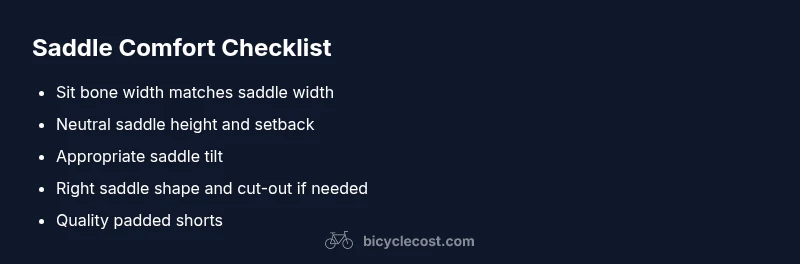
- Measure sit bone width (via a professional or at-home method) and compare with saddle width; aim for 0.5–1.5 cm clearance on each side.
- Check saddle height so your knee has a slight bend at the bottom of the pedal stroke.
- Set fore-aft position so your knee tracks over the pedal axle when the crank is horizontal.
- Adjust tilt gradually toward a neutral angle (slightly nose-down is common but avoid extreme angles).
- Try different saddle shapes or widths if pain persists after adjustments; padding alone rarely resolves fit issues.
- Wear properly padded cycling shorts with a high-quality chamois for friction reduction.
Step-by-step: Fixing saddle discomfort (diagnostic approach)
Use a structured approach to diagnose the top causes of discomfort. Start with the easiest adjustments (fit and padding) and progress to Shape or type changes. Always test each change with a short ride before making the next adjustment. If pain persists beyond a few rides, seek a professional fitter. Safety note: avoid aggressive height or tilt changes that could affect pedal stroke or knee health.
Prevention tips & maintenance
- Schedule a professional bike fit if you frequently experience pain, numbness, or saddle sore that doesn’t improve with adjustments.
- Regularly inspect the saddle rails, seatpost clamp, and rails for damage. Replace worn components promptly.
- Keep your bike and components clean; lubricate moving parts to ensure smooth saddle angle changes.
- Consider a fresh saddle only after confirming fit issues aren’t the root cause; cheap saddles rarely fix chronic discomfort.
- Document changes you try and ride durations to track what works and what doesn’t.
When to seek professional help
If self-adjustments don’t relieve pain after several rides, a professional bike fitter can evaluate your torso length, pelvic tilt, and knee extension to recommend a saddle, width, and post position that suit your exact biomechanics. Persistent numbness or pain warrants immediate evaluation to avoid longer-term issues.
Choosing the right saddle for your riding style
Saddle selection should match your riding goals. Road cyclists may prefer narrow, flat profiles for efficiency, while mountain bikers benefit from a contoured shape and additional support for rough terrain. If you ride long distances, a cut-out or channel can relieve perineal pressure for many riders, but it’s not universal. The key is trial—ride-select, then swap back if symptoms reappear.
Correct bike fit: saddle height, setback, and reach
Saddle height should allow near-full knee extension without overreaching. The setback (fore-aft position) determines knee over pedal axle alignment; incorrect setback shifts weight and changes hip angle. Reach affects your torso angle; too aggressive a reach can force you forward, increasing saddle pressure. A precise bike fit aligns all three factors to distribute weight evenly and minimize friction.
Steps
Estimated time: 60-90 minutes
- 1
Assess current saddle and riding setup
Document your current saddle width, height, tilt, and fore-aft position. Note pain location and duration after rides to guide adjustments.
Tip: Take photos of your setup from side and rear to compare after changes. - 2
Check saddle height
Ensure your knee has a slight bend at the bottom of the pedal stroke. A too-high or too-low saddle alters weight distribution and can worsen pressure.
Tip: Use a mirror or have a friend observe your knee angle during a pedal stroke. - 3
Adjust fore-aft position
Move the saddle forward or backward so your knee tracks over the pedal axle when the crank is horizontal. This aligns weight distribution.
Tip: Small increments matter—test each change on short rides. - 4
Tighten or loosen tilt gradually
Set tilt toward a neutral angle; slight nose-down is common, but avoid steep nose-down or nose-up angles that increase pressure.
Tip: A 1–2 degree adjustment can make a big difference. - 5
Evaluate saddle shape/width
If pain remains, trial a different saddle width or contour suited to your pelvis and riding style.
Tip: Take notes on comfort after each trial ride. - 6
Upgrade shorts and lubrication
Pair saddle adjustments with high-quality padded shorts and proper lubrication to reduce friction.
Tip: Ensure stitching and chamois align with your sit bones for comfort. - 7
Test ride and iterate
Ride 20–30 minutes after each change to assess impact. Repeat steps 2–6 as needed.
Tip: Be patient—optimal comfort often requires several small tweaks.
Diagnosis: Rider experiences persistent numbness, aching, or pain in the perineal area during or after rides
Possible Causes
- highIncorrect saddle width
- mediumPoor fore-aft alignment
- mediumExcessive saddle tilt
- lowUnsuitable saddle shape or cut-out
Fixes
- easyMeasure sit bone width and compare with saddle width; choose a saddle that matches or slightly exceeds measured width
- easyAdjust saddle height to achieve a comfortable pedal stroke with neutral knee angle
- mediumFine-tune fore-aft position so knees track over the pedal axle
- easyExperiment with saddle tilt toward neutral; avoid extreme angles that increase pressure
- mediumTry different saddle shapes or widths; consider a cut-out if perineal pressure persists
- easyUpgrade padded shorts and ensure proper lubrication to reduce friction
People Also Ask
What causes bicycle seat discomfort?
Discomfort typically results from improper saddle width, misalignment, or an unsuitable saddle shape. Posture and riding style also influence pressure distribution. Even small setup errors can produce significant pain over time.
Discomfort usually comes from a poor saddle fit or shape, plus how you sit and ride. Small setup tweaks make a big difference.
How do I measure saddle width and select the right saddle?
Consult a professional to measure sit bone width, then choose a saddle that matches your width with a slight clearance on each side. If unsure, try saddles marketed as wider and those with broader rear sections.
Measure your sit bones and pick a saddle width that matches, giving a little room on each side.
Is a cut-out saddle always better?
Not always. Cut-outs reduce perineal pressure for some riders, especially those with sensitive anatomy, but others may find support and stability with a solid saddle. Trial and fit matter more than the feature alone.
Cut-outs help some riders, but it isn’t universal. Try different shapes to see what feels best.
Can shorts padding fix saddle discomfort?
Padded shorts reduce friction and provide comfort, but they can’t fix an inherently ill-fitting saddle. Proper saddle fit is essential first, padding helps during the transition.
Padding helps, but you still need a good fit.
When should I upgrade to a new saddle?
If adjustments don’t relieve pain after several rides, it’s time to try a different saddle shape or width. Persistent discomfort often signals a fundamental fit issue.
If pain persists after adjustments, consider a new saddle.
Should I see a professional fitter?
Yes, a professional fitter can assess pelvic tilt, torso length, and reach to recommend a saddle, width, and post position tailored to you. Persistent pain should not be ignored.
A bike fitter can personalize saddle fit and setup for you.
Watch Video
Quick Summary
- Check saddle width first before changing other parts
- Tune height, tilt, and fore-aft for neutral posture
- Test ride changes to confirm relief before the next adjustment
- Consider a professional fit for persistent discomfort
- The BicycleCost team recommends prioritizing fit and gradual trials for lasting comfort