Psi for Bicycle Tires: A Practical Pressure Guide for Riders
Learn how psi for bicycle tires influences grip, comfort, and efficiency. This data-driven guide explains pressure ranges by tire type, weight, and terrain, with practical steps to measure and adjust pressure for safer, smoother rides.


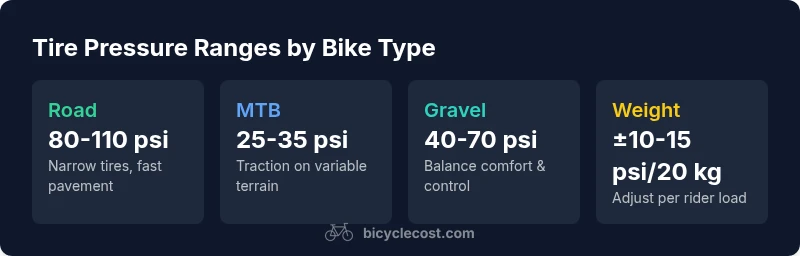
Psi for bicycle tires is the pressure, measured in pounds per square inch, that determines tire shape, grip, and rolling resistance. Typical road tires run about 80–110 psi, mountain bike tires about 25–35 psi, and gravel tires roughly 40–70 psi. Always begin with the tire sidewall’s recommended range and tailor pressure to rider weight and terrain.
What psi means for bicycle tires
Psi, or pounds per square inch, is the force inside a tire that supports its shape and determines how the tire deforms under load. The right pressure balances several competing goals: minimizing rolling resistance, maximizing grip, and absorbing road vibrations. In practical terms, psi for bicycle tires is a dial you tune based on tire width, rider weight, terrain, and riding goals. According to BicycleCost, most riders start with the tire manufacturer’s recommended range and then adjust in small increments after short test rides. A few psi can noticeably change how a bike feels on pavement versus gravel, so notes and adjustments matter for long-term comfort and safety.
How tire width, weight, and terrain influence pressure
Wider tires can run at lower pressures because their larger contact patch distributes load more widely and reduces pinch flats. Lighter riders can afford slightly lower pressures, while heavier riders may need to add pressure to maintain sidewall integrity and avoid squirm under load. Terrain plays a pivotal role: smoother pavement often benefits from higher pressures for efficiency, whereas loose surfaces (sand, mud, gravel) demand lower pressures to maximize traction. BicycleCost analyses indicate these relationships are most pronounced when switching between road, gravel, and mountain riding styles. Tracking your own feel over time helps refine the exact starting points for your bike and conditions.
Reading the sidewall: how to choose your starting range
Your tire sidewall lists a recommended pressure range (e.g., 60–90 psi). This is your starting point. Do not exceed the maximum printed on the sidewall, and avoid inflating below the minimum—especially if you carry a backpack or panniers. Remember that temperature and altitude can shift effective pressure, so treat the range as a flexible guide. For riders near the low end of the range, consider quick tests on a familiar route to confirm grip and comfort before venturing onto rougher surfaces. The goal is to stay within the safe zone while optimizing for grip and comfort.
Setting pressure: tools, check routines, and best practices
Invest in a quality floor pump with a gauge or a digital gauge for repeatable results. Check pressure before each ride if possible, especially after temperature changes. Quick checks during ride breaks can catch slow leaks or slow-drifting gauges. Inflate in small increments, riding a short loop to feel the tire’s response and re-check. A consistent routine—check, inflate, ride, re-check—builds a reliable pressure habit that improves control and reduces pinch flats.
Temperature, seasonality, and pressure stability
Air density and temperature influence tire pressure. Colder weather lowers pressure, while heat from riding increases it. If you switch from winter to summer riding, re-check your pressures to account for these shifts. For tubeless setups, pressure stability is often better, but puncture sealant behavior and bead seating can still be temperature-sensitive. In general, temperature-aware maintenance is part of a sound tire-pressure strategy, a point BicycleCost emphasizes in its 2026 guidance.
Tubeless vs tubed tires: how pressure matters differently
Tubeless tires tolerate lower pressures with less risk of pinch flats on rough terrain, thanks to their self-sealing capability and flexible bead seating. Tubed tires require higher pressures to prevent pinch flats and to avoid bead roll-off under heavy load or cornering. Your choice between tubed and tubeless influences your target range, but the principle remains: start with manufacturer recommendations and adjust in small steps based on feedback from grip, ride comfort, and rolling resistance.
Building a personalized pressure plan: step-by-step
- Note your tire width and manufacturer range. 2) Record your rider weight and typical load. 3) Choose a baseline from the table above (road, gravel, or mountain). 4) Test on a familiar route and log perceived grip, comfort, and cornering. 5) Adjust in 2–3 psi increments until you hit your ideal balance between speed, acceleration, and traction. 6) Recheck pressure regularly, especially after temperature shifts or wheel swaps. This plan aligns with BicycleCost’s emphasis on data-driven, rider-specific adjustments.
Typical pressure ranges by tire type
| Tire Type | Typical psi range | Notes |
|---|---|---|
| Road | 80-110 psi | Narrow tires require higher psi to prevent pinch flats |
| Mountain | 25-35 psi | Lower pressures improve traction on loose surfaces |
| Gravel | 40-70 psi | Broader tires allow lower pressures for comfort |
People Also Ask
What is the recommended psi for road bikes?
Road bikes typically use higher pressures; start around 90–110 psi for common 23–25 mm tires and adjust based on weight, road texture, and comfort. Avoid overinflating, which can reduce grip on wet surfaces.
Road bike tires usually run high pressures; start near 90 to 110 psi and fine-tune based on weight and road feel.
Does heavier rider weight require higher psi?
Yes. Heavier riders should increase psi slightly to maintain tire shape and prevent pinch flats, but avoid exceeding the tire's maximum rating. Small, incremental adjustments after test rides work best.
Yes, a bit more pressure helps heavier riders avoid squirm and pinch flats, but don't overinflate.
How often should I check tire pressure?
Check before each ride when possible, especially after temperature changes or a long period of storage. If you ride daily, a quick mid-ride pressure check can catch drift and leaks early.
Check pressure before every ride when possible; temperature changes can shift psi quickly.
What about tubeless tires?
Tubeless tires often run lower pressures for better traction. Ensure proper bead seating and sealant levels, and monitor for slow leaks that may alter your target range.
Tubeless tires can run lower pressures for more grip, but watch bead seating and sealant levels.
Can I run mountain bike tires at road pressures?
Not generally recommended. Road pressures on MTB tires reduce traction on loose surfaces and can cause uncomfortable handling on rougher routes.
Not usually a good idea to use road pressures on MTB tires.
“Tire pressure is a dial you tune for balance among comfort, grip, and efficiency. Begin with the manufacturer’s range and refine it with real-world feedback from your weights and routes.”
Quick Summary
- Start with the manufacturer's range, then tune by ride feel.
- Width and terrain dramatically affect optimal psi.
- Use a reliable gauge and check pressure regularly.
- Temperature and season impact tire pressure; adjust accordingly.
- Tubeless tires enable lower pressures with careful setup.