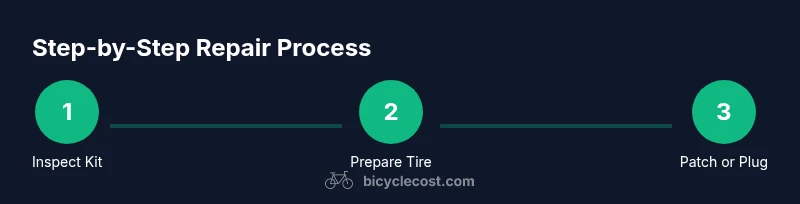
How to Use a Bicycle Tire Repair Kit: Step-by-Step
Learn how to use a bicycle tire repair kit to fix punctures, patch tubes, seal tubeless tires, and safely reinflate. Practical, BicycleCost-backed guidance with a clear, step-by-step process for riders on the go.


With a bicycle tire repair kit, you’ll diagnose punctures, patch tubes or seal tubeless holes, and re-inflate safely. Gather basic tools (patch kit, levers, pump, sandpaper, glue) and follow a clean, step-by-step process. This guide covers setup, patch placement, sealant use where applicable, and leak testing to ensure a reliable ride.
Understanding Your Kit and Tire Types
Knowing the exact components of your bicycle tire repair kit is the first step in how to use it effectively. Most kits include patches or plugs, tire levers, a small sandpaper or steel wool pad, glue (for traditional patching), a sealant syringe or bottle for tubeless setups, a small knife or blade for trimming patches, and a mini pump or CO2 inflator. Before you ride, take a few minutes to familiarize yourself with what’s in your kit and how each item works. This knowledge is especially important if you ride a mix of tubeless and tubed tires because the repair method changes with tire construction.
BicycleCost’s guidance emphasizes recognizing tubed vs tubeless tires. Tubed tires use patches and glue to seal punctures in the inner tube, while tubeless setups rely on sealant and rapid-plug techniques or patching the bead. The kit you carry should reflect your tire type, valve type (Presta or Schrader), and your typical riding environment. Remember: the goal of a repair kit is not to replace a tire but to buy time until a proper fix can be performed.
According to BicycleCost, the most common punctures are from nails, glass, thorns, and stray tire beads. While many riders carry a compact patch kit for tubes, tubeless riders should be prepared to insert a plug and top up sealant. Keep in mind that sidewall damage is not repairable with a kit and requires tire replacement. By understanding both tire types and the repair tools, you’ll be better prepared for roadside flats.
In the field, your kit should be organized and easy to access. A well-packed kit reduces the time you spend searching for items, minimizes further tire damage, and increases your confidence on longer rides. If you’re new to this, practice a dry run at home so you’re faster and more precise when you’re on the road. This approach aligns with best practices from BicycleCost and helps you ride with greater peace of mind.
noteOrNull”:null} ,
Tools & Materials
- Mini pump or CO2 inflator(Choose a unit compatible with your valve type (Presta or Schrader).)
- Tire levers(At least two levers; plastic or metal are fine, but plastic reduces rim risk.)
- Tubed repair patch kit (glue patches) or tubeless plug kit(For tubes, patches with glue; for tubeless, plug-and-sealant options.)
- Sandpaper or abrasive pad(600–800 grit works well for prepping patches.)
- Utility knife or scissors(Optional for trimming patches or cutting sealant cartridges.)
- Sealant (for tubeless tires)(Ensure you have an appropriate type and amount for your tire volume.)
- Rag or paper towels(Clean hands, tire surface, and remove debris.)
- Gloves(Protect hands from sharp objects and adhesives.)
- Rim tape and spare tube (for tubed tires)(Carry a spare inner tube if you don’t trust the patch alone.)
Steps
Estimated time: 20-60 minutes
- 1
Inspect the kit and prepare your area
Open your repair kit and lay out tools on a clean, dry surface. Confirm you have a spare tube or tubeless repair components, a lever, patch kit, sandpaper, glue, and a pump or inflator. Clear a space around your bike so you won’t lose small parts and you can work safely. This step ensures you know exactly what’s available before you touch the tire.
Tip: Do a quick inventory check against your tire type (tube vs tubeless) to select the correct repair method. - 2
Remove the wheel and deflate
If you’re on the road, shift to the smallest chainring and loosen the axle or quick-release. Remove the wheel, then fully deflate the tire to allow the bead to loosen from the rim. This makes it easier to work the tire bead over the rim when you reassemble. Keep your hands clear of the brake rotor or disc area.
Tip: Deflate slowly to avoid chamber blowout; if using a floor pump, release pressure in stages. - 3
Locate the puncture and prepare the punctured area
Spin the wheel slowly to identify where the puncture is. For tubed tires, locate the hole on the inner tube. For tubeless setups, identify the hole in the tire and assess whether sealant has clogged the puncture. Clean the surface with a rag and roughen the area with sandpaper if you’re patching a tube.
Tip: If you can’t locate the puncture, submerge the tire or submerge the tube in water to see bubbles—this helps identify leaks. - 4
Patch or plug the puncture (tubed vs tubeless)
If repairing a tube, roughen the patch area, apply glue, wait a few minutes until tacky, then press the patch firmly over the hole. If tubeless, insert a plug into the puncture using the plug tool and trim the excess; add a small amount of sealant if recommended for your kit. Allow glue or sealant to set as directed by the product instructions.
Tip: Patience matters here: don’t rush the patch or plug—proper adhesion prevents leaks later. - 5
Re-seat the tire bead and reinstall the tube (if applicable)
Carefully push the tire bead back onto the rim, ensuring the patch or plug sits flat against the tube. If you used a patch kit, reinsert the tube through the valve and align it with the rim hole. Make sure the tire sits evenly around the rim without pincers or twists.
Tip: Run your fingers around the tire to ensure the bead is fully seated all the way around the rim before inflation. - 6
Inflate and test for leaks
Inflate slowly to a riding pressure, checking for any hissing sounds or slow leaks. If you’re tubeless, inflate to the recommended PSI gradually and inspect the bead seating. If you repaired a tube, check the patch integrity by pressing lightly around the patch.
Tip: Don’t exceed recommended pressure in the first few minutes; gradual inflation helps you spot leaks early. - 7
Reassemble, ride-test, and clean up
Reinstall the wheel, put tools away, and take a short test ride in a safe area to confirm the repair holds. After riding, recheck tire pressure and patch or plug condition. Store your kit in a designated bag so you’re ready for the next ride.
Tip: Always inspect the tire after a repair to prevent a second puncture from the same cause. - 8
Safety check and future planning
If the tire shows sidewall damage, deep cuts, or multiple punctures in a short span, replace the tire. Consider upgrading to a tire with better puncture resistance or carrying spare patches and a spare tube for longer rides. Total estimated time for a roadside repair is typically 20–60 minutes depending on tire type and puncture complexity.
Tip: Field repairs can be unpredictable; when in doubt, seek professional service at the earliest safe opportunity.
People Also Ask
Can I fix a tubeless tire puncture with a standard patch kit?
Tubeless tires are repaired with plugs and sealant rather than standard patches. If the puncture is small and the bead is intact, a plug can be used along with sealant. For larger or sidewall damage, replace the tire or seek professional help.
Tubeless tires use plugs and sealant for punctures. If you’re unsure, replace the tire or consult a professional.
Is it safe to ride after a tubed puncture repair?
Yes, if the patch is firmly adhered and the tube is seated properly. Check for leaks and test inflation before continuing. If the patch fails or the tube remains soft, replace the tube.
Yes, but test for leaks first; if in doubt, replace the tube.
How long should glue dry before testing a patch?
Let the glue dry according to the patch kit instructions, typically a few minutes until tacky. A longer dry time may improve adhesion but isn’t always necessary.
Let the glue set for a few minutes until tacky before testing the patch.
Can I reuse patch patches after removing them?
No. Patches are single-use items designed to seal a specific hole. Reusing a patch is unreliable and defeats the repair’s purpose.
Patch patches aren’t reusable, so use a fresh patch for each repair.
What if the puncture is on the sidewall?
A puncture on the sidewall often means tire replacement is the safer option because patching can compromise tire integrity.
If the puncture is on the sidewall, it’s usually best to replace the tire rather than repair it.
Do I need to carry a spare tube even if I have a tubeless setup?
Having a spare tube is useful for quick roadside fixes on tubed tires. For tubeless riders, a repair kit with plugs and sealant is still essential, and a spare tube may be carried as a backup.
Even tubeless riders benefit from a spare tube as a backup option.
Watch Video
Quick Summary
- Patch tubes correctly to seal punctures.
- Tubeless repairs require plugs and sealant, not patches.
- Bead seating and controlled inflation prevent future leaks.
- Carrying a compact kit reduces roadside downtime.
- If sidewall damage is present, replace the tire promptly.