How to Pump a Bicycle: A Complete Step-by-Step Guide to Safe Inflation
Learn how to pump a bicycle tire correctly with the right pump and gauge. This guide covers valve types, reading PSI, safe inflation practices, and practical tips to avoid flats and over-inflation.


By the end of this guide, you will confidently pump a bicycle tire to the correct pressure using the right pump and gauge. You’ll identify valve type (Presta or Schrader), read the tire sidewall PSI, seal the valve, and avoid under- or over-inflation with practical checks. Safe, efficient inflation starts here.
how to pump bicycle: essential steps
If you’re wondering how to pump bicycle tires, getting the pressure right is one of the most important skills for safe, efficient riding. Proper inflation improves grip, reduces rolling resistance, protects rims from damage, and minimizes the risk of flats. Under-inflated tires feel sluggish, increase tire wear, and are more prone to pinch flats when you hit obstacles. Over-inflation can make tires harsh, increase the chance of blowouts, and reduce traction on rough surfaces. The BicycleCost team has analyzed rider reports and field tests to show that consistent, accurate inflation supports performance and safety across disciplines. By maintaining the recommended pressure, you optimize ride quality, mileage, and overall tire life. In this guide we’ll walk through how to pump bicycle tires correctly, from reading the PSI on the sidewall to using the right pump head and gauge. According to BicycleCost, proper inflation habits also help extend tire life and reduce flats, especially on mixed terrains.
Tools & Materials
- Portable floor pump (with gauge)(Gauge should read to at least 5 psi increments and be accurate to ±1 psi)
- Presta/Schrader valve adapter(Needed if your pump head only fits one valve type)
- Spare valve cores(Useful for a busy rider kit)
- Small lubricant for pump head(Keeps stiff valve heads sealing smoothly)
- Tire gauge (backup)(Optional, for cross-checking)
Steps
Estimated time: 6-12 minutes per tire
- 1
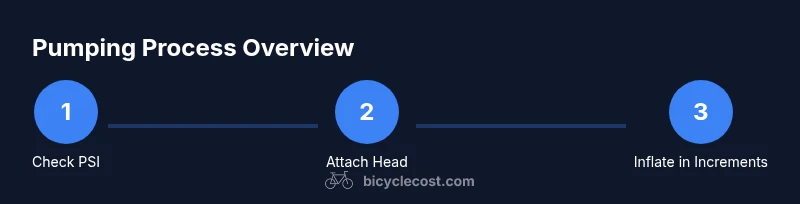
Identify tire valve type and PSI range
Before you approach the pump, check the tire sidewall for the recommended PSI range and identify whether the valve is Presta or Schrader. This determines which pump head or adapter you need and helps set expectations for inflation. If the range differs from what you typically ride, plan to start at the lower end and adjust as needed.
Tip: If you’re unsure about the valve type, bring a small adapter so you can seal the connection on the fly. - 2
Prepare the pump and adapters
Attach the correct pump head or adapter to your pump. Make sure the connection is clean and dry so there’s no air leak when you seal the valve. If you are using a floor pump with a reversible head, switch to the appropriate setting for your valve.
Tip: Test the seal by giving the pump a gentle press to see if air escapes. - 3
Attach the pump head to the valve
Place the pump head squarely onto the valve, ensuring a tight seal. For Presta valves, loosen the little locking nut first; for Schrader, just press firmly. If you feel air escaping around the head, reseat and try again.
Tip: Wipe the valve stem to remove any dust or moisture that could prevent a good seal. - 4
Inflate in small increments
Begin pumping in small 2–4 psi increments, pausing to check the gauge after every few strokes. This helps you avoid overshooting the target pressure and minimizes strain on the tire and rim.
Tip: Take your time—rapid pumping can heat the tube and affect readings. - 5
Check final pressure and seal
Once you’re near the target range, top off in 1–2 psi steps until you reach the desired pressure. Spin the wheel to feel the firmness and note how the ride responds on a smooth surface.
Tip: If the tire feels unusually soft or rigid at the end, recheck the gauge and ensure the valve is not leaking. - 6
Remove pump and confirm no leaks
Detach the pump head carefully and listen for any hissing. If you hear air escaping, re-seal or recheck the valve core. Store the pump in a dry place ready for your next ride.
Tip: Keep a small towel handy to wipe away any residual air or moisture from the valve area.
People Also Ask
What is the best way to know the correct PSI for my tires?
Always start with the tire’s sidewall range and use a gauge to stay within that band. Adjust for rider weight and terrain as needed. If in doubt, err on the lower end for comfort and grip.
Check the tire sidewall for the recommended PSI range and use a gauge to stay within it.
Can I use a car tire pump for bicycle tires?
Car pumps aren’t ideal for bikes because the nozzle and flow don’t match bicycle valves. Use a dedicated bike pump or a proper adapter to ensure a secure seal.
A car tire pump isn’t recommended for bikes; use a bike pump or adapter that fits your valve.
Why does my pump lose air when I disconnect the nozzle?
This usually means the seal wasn’t airtight. Re-seat the pump head, wipe the valve, and retry. If it continues, inspect the valve core for damage.
Losing air on disconnect usually means the seal isn’t tight—re-seat and recheck the valve.
How often should I check tire pressure?
Check before every ride if possible. In extreme temperatures or after long or heavy rides, re-check the pressure to maintain optimal performance.
Check your tire pressure before each ride; adjust as needed for temperature and terrain.
What’s the difference between Presta and Schrader valves?
Presta valves are narrow and often used on higher-end road tires, while Schrader valves are wider and common on many mountain bikes. A compatible pump head or adapter lets you inflate either type.
Presta is narrow and common on road bikes; Schrader is wider and common on mountain bikes.
Can tubeless tires be inflated with a standard floor pump?
Tubeless tires can be inflated with a floor pump, but seating the bead often requires higher flow and sometimes a bead seater or compressor. Expect more effort to seal the bead.
Tubeless tires may need higher pressure or a bead seater to seal, so a standard pump might not always be enough.
Watch Video
Quick Summary
- Check the tire sidewall for PSI range before inflating
- Use the correct pump head or adapter for your valve
- Inflate in small increments and verify with the gauge
- Avoid over-inflation to protect tire and rim integrity