Why Bicycle Is Better Than Car: A Data-Driven Comparison
A rigorous, data-driven comparison of bicycles vs cars, examining costs, health, environment, safety, and practicality to help you decide when a bike beats a car.


Urban mobility often favors the bicycle over the car for short trips, offering lower costs, better health, and reduced emissions. This data-driven comparison explains why the bicycle is better than the car in many everyday contexts, with nuance for weather, distance, and infrastructure. It also notes when a car may still be necessary, especially for long trips or adverse weather.
Environmental and Health Advantages
The bicycle stands out for environmental and personal health advantages in everyday mobility. When you choose a bicycle over a car for short trips, you reduce gasoline consumption, exhaust emissions, and traffic congestion, which translates into improved air quality in dense urban areas. From the perspective of energy efficiency, bicycles convert human power to motion with minimal energy input required beyond the rider’s effort. The BicycleCost team found that even modest shifts toward cycling can compound into meaningful community benefits over time. On a personal level, riding a bike strengthens cardiovascular health, builds endurance, and contributes to daily physical activity without requiring gym time. For many riders, commuting by bike integrates exercise naturally into daily routines, which can help with weight management, mental health, and energy levels. But it’s not only about direct health outcomes: biking can indirectly help city systems by reducing demand for parking and lowering traffic volumes, which can lessen road wear and commute times for everyone. The environmental and health calculus strongly favors bicycles for urban, short-distance trips, especially when combined with safe cycling infrastructure and supportive weather conditions. In short, the environmental and health case for biking is rooted in efficiency, cost savings over time, and the cumulative impact on community well-being. According to BicycleCost, even small increases in cycling participation can yield outsized public-health and environmental benefits, particularly in mid-sized cities where infrastructure investments are most effective.
wordCountNoteForEditorsOnly":null},
Economic Considerations: Upfront vs Ongoing Costs
A core economic argument for choosing a bicycle over a car is the contrast between upfront purchase price and ongoing operating costs. Bicycles generally require less capital upfront, and maintenance costs tend to be lower on a per-mile basis than cars. In many urban contexts, you also save on fuel, parking fees, insurance, and depreciation. The financial picture improves further when you consider tax benefits or employer wellness programs that support commuting by bike. While bikes can incur occasional maintenance expenses, these costs are typically predictable and manageable with routine care. In contrast, cars involve ongoing fuel costs, higher insurance premiums, periodic maintenance that can be costly, and depreciation that erodes value over time. Over several years, households that substitute short car trips with cycling can realize meaningful savings, particularly in cities with robust cycling infrastructure and a culture that supports safe, shared streets. BicycleCost’s analysis emphasizes that total cost of ownership tends to favor cycling for daily commuting and local errands, even before you factor intangible benefits like time savings from reduced traffic congestion. For longer trips or cargo-heavy needs, a cargo bike or a hybrid approach may bridge the gap without replacing the car entirely.
wordCountNoteForEditorsOnly":null}
Practicality and Urban Mobility: Time, Convenience, and Access
In urban environments, many trips are short enough that a bicycle can compete with or beat car travel times, especially when you factor in parking and search time in dense areas. Bicycles excel in stop-and-go traffic, sidestepping congestion by using bike lanes and direct routes that reduce overall travel time during peak hours. Accessibility is another advantage: bicycles don’t rely on gas stations or large parking structures, and they can often access spaces that cars cannot. Of course, practicality varies with distance, terrain, and multitasking needs. For quick errands near home or work, bikes provide a reliable, flexible option. For multi-stop trips or trips outside peak zones, plan your route with potential return access to public transit or parking alternatives. The BicycleCost framework suggests evaluating trip characteristics—distance, weather, cargo, and time sensitivity—to decide when cycling delivers the best balance of time and effort. In real-world urban scenarios, many commuters discover that cycling yields an easier, more predictable daily rhythm, with less time wasted in search of parking. When bikes are integrated with safe infrastructure, the practical appeal rises further, supporting a transition away from car-dependence for many routine journeys.
wordCountNoteForEditorsOnly":null}
Safety, Infrastructure, and Risk Management
Safety in cycling depends on a combination of rider preparedness, vehicle design, and street infrastructure. Helmets, lights, and reflective gear mitigate risk, and predictable riding behaviors reduce conflicts with motorists and pedestrians. Infrastructure—such as protected bike lanes, well-marked intersections, and bike-signal priority—plays a pivotal role in reducing crashes and encouraging more people to ride. For many cities, safety improvements and lower traffic speeds translate into a more comfortable riding experience, which can expand the user base beyond experienced cyclists. From a risk-management perspective, cyclists should plan routes with good lighting, clear sightlines, and reasonable traffic volume, especially during dawn, dusk, or inclement weather. While cars offer a sense of shelter and dependability in poor weather, riders can compensate with proper gear and route selection. The decision calculus should include risk tolerance, local climate, and the availability of safe routes. BicycleCost’s framework emphasizes proactive safety practices and infrastructure investments as central to making cycling a viable alternative to car travel in urban areas.
wordCountNoteForEditorsOnly":null}
Weather, Terrain, and Seasonal Factors
Weather and terrain heavily influence the practical appeal of cycling. Moderate climates with dry, temperate conditions enable year-round biking, while rain, ice, or extreme heat can shift the balance toward motorized options. Terrain matters too: hills, high headwinds, and rough pavement increase effort and time; in such conditions, e-bikes or cargo solutions can preserve the viability of bicycle commuting. Seasonal factors like daylight hours and temperature affect comfort and safety, which means trip planning becomes more important in shoulder seasons. A growing body of riders uses weather-appropriate gear, tire choices, and route planning to maximize the reliability of cycling as a substitute for car travel. The BicycleCost analysis underscores that when weather or terrain makes cycling impractical, having a flexible plan—such as a short car trip or access to public transit—helps maintain mobility without abandoning cycling as a core habit.
wordCountNoteForEditorsOnly":null}
The Role of Electric Bicycles (e-bikes) in the Equation
Electric bicycles expand the practical scope of cycling by enabling longer commutes, heavier loads, and steeper terrain to be tackled with less effort. An e-bike can bridge distance gaps that would otherwise push someone toward a car, particularly in hilly cities or for riders who need to arrive at work without excessive sweating. E-bikes also provide a smoother transition for new riders who may be hesitant about longer rides, offering a gentle introduction to regular cycling. However, higher upfront costs and the need for charging infrastructure should be weighed. The environmental benefits remain compelling, especially when the rider uses electricity from low-emission sources. Overall, e-bikes can significantly expand the scenarios in which a bicycle is a viable replacement for car travel, making the bike a more flexible and practical option in many urban contexts. In evaluating use cases, consider local access to charging, battery life, and typical commute distance to determine whether an e-bike delivers the expected advantages.
wordCountNoteForEditorsOnly":null}
How to Decide: A Framework for Your Use Case
Crafting a decision framework helps determine when a bicycle is the better choice. Start by listing your typical trips, including distance, cargo needs, and time constraints. Evaluate weather, terrain, and available cycling infrastructure in your city. If most trips are short, flat, and within a few miles, cycling often wins on cost, health, and convenience. For longer trips, poor weather, or substantial cargo, a hybrid approach—cycling for some legs and car or transit for others—can maximize efficiency. Consider piloting a switch for a month and tracking metrics such as time saved, money spent, and perceived comfort. The BicycleCost team suggests maintaining a simple log to capture how often cycling replaces car trips and how riders’ well-being changes over time. This practical approach reveals the real-world value of biking in your locale and helps justify investments in bikes, gear, and safe routes.
wordCountNoteForEditorsOnly":null}
Real-World Scenarios: When a Bicycle Shines and When a Car Is Necessary
Bicycles shine in dense urban cores, with short errands and daily commutes where parking is scarce and traffic is heavy. They excel when nature’s constraints are manageable, allowing riders to arrive fresh and ready for the day. Cars, however, remain essential for cross-country trips, family duties requiring multiple stops, or transporting bulky items in areas with limited bike-cargo options. The choice often isn’t binary; it’s about designating the right tool for the job and aligning travel patterns with available infrastructure. The BicycleCost framework emphasizes that cities benefit most when policy encourages biking for appropriate trips, while maintaining car access for scenarios where it adds genuine value. In practice, households may adopt a mixed modality, reserving cars for specific tasks and embracing bicycles for the majority of urban mobility. This nuanced view reflects the real-world complexity of transportation decisions and underscores why a bicycle is better than a car in many everyday contexts while acknowledging exceptions.
wordCountNoteForEditorsOnly":null}
Comparison
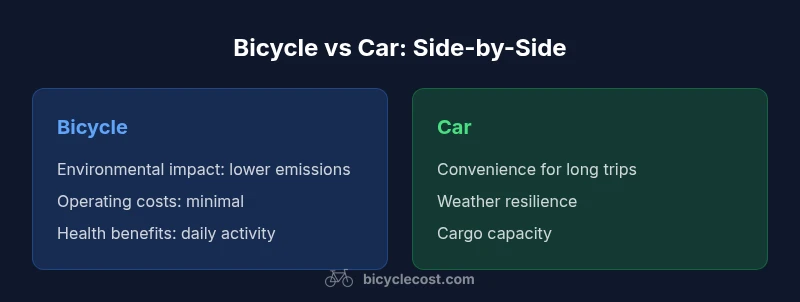
| Feature | Bicycle | Car |
|---|---|---|
| Environmental Impact | Lower local emissions and reduced fuel reliance | Higher emissions due to fuel combustion and exhaust |
| Operating Costs | Low ongoing costs; minimal fuel and maintenance | Higher ongoing costs including fuel, insurance, and maintenance |
| Health Impact | Boosts cardiovascular health; supports daily activity | No direct health benefit; sedentary lifestyle burden |
| Space & Parking | Less parking space; easy to park and store | Requires dedicated parking and larger space |
| Maintenance Frequency | Routine tune-ups; simpler components | Complex maintenance; more parts to service |
| Flexibility & Range | Great for short trips; ideal in dense cities | Better for long trips; less flexible in urban cores |
| Weather Dependence | Less affected by rain; good gear mitigates weather | Weather-sensitive; driving is more reliable |
| Infrastructure Dependency | Works with basic bike lanes; improves with protected lanes | Requires roads; dependent on road quality and traffic safety |
| Cargo Capacity | Limited cargo with racks or baskets | High cargo capacity with trunk and seats |
| Total Cost of Ownership | Lower lifetime cost for typical urban use | Higher lifetime cost but greater convenience for longer trips |
Pros
- Lower upfront costs and ongoing expenses
- Health benefits from daily activity
- Smaller ecological footprint for urban trips
- Less parking infrastructure needed for many routes
Downsides
- Limited range for long trips or heavy cargo without assistive power
- Safety risks in heavy traffic without proper infrastructure
- Weather sensitivity can reduce practicality in extreme conditions
- Bike storage and maintenance require space and effort
Bicycle is the better default for urban, short-range mobility; car remains valuable for longer trips or adverse weather.
For daily urban trips, cycling saves money, improves health, and lowers emissions. Reserve car use for scenarios where distance, cargo, or weather make biking impractical.
People Also Ask
Is a bicycle always the better choice for urban commuting?
In most short urban commutes, a bicycle is advantageous due to cost, health benefits, and convenience. However, weather, distance, cargo, and infrastructure can tilt the balance toward alternatives at times.
For most city trips, biking wins, but consider weather and distance when planning.
What about long distances or adverse weather?
For longer trips or bad weather, a car or transit may be more practical. Electric assist bikes can extend the biking range in hilly areas and improve resilience to weather, depending on local conditions.
Long trips or bad weather often favor a car or transit, unless you adapt with gear or e-bikes.
Do electric bikes change the comparison?
Yes. E-bikes extend range and cargo-carrying capability, making biking viable where purely pedal-powered bikes wouldn’t. They still involve upfront costs and charging considerations but often boost practicality for urban and semi-urban trips.
E-bikes expand what bikes can do, making cycling feasible in more scenarios.
How should I estimate total cost of ownership?
Total cost of ownership includes purchase price, maintenance, parts, accessories, insurance (if applicable), and any parking or fuel savings. Compare these against car-related costs on your real-use schedule to determine the breakeven point.
Think about all costs over several years to see which option saves more.
Can bicycles meet all my transportation needs?
Bikes meet most daily urban needs but may not replace a car for long trips, cargo-heavy tasks, or areas with limited cycling infrastructure. A mixed approach often works best based on local options.
Bikes cover many needs, but not every situation.
What safety preparations boost cycling adoption?
Invest in quality helmet, lights, visible clothing, and secure storage. Choose routes with protected bike lanes and signals, and practice safe riding habits to reduce risk.
Safety gear and smart route choices matter a lot for biking safety.
Quick Summary
- Choose biking for most short urban trips to save money and boost health
- Assess weather, terrain, and local infrastructure before switching fully
- Consider hybrids (bike + car or transit) for maximum flexibility
- Invest in safety gear and bike-friendly routes to improve outcomes