Is Cycling the Same as Walking? A Comprehensive Comparison
Explore how cycling and walking differ in biomechanics, energy cost, safety, and practicality. This BicycleCost guide breaks down the key factors to help you decide when to choose cycling vs walking for fitness, commuting, or recreation.


Is cycling the same as walking? No. They are distinct locomotion modes with different biomechanics, speeds, and energy costs. Cycling uses a seated pedaling rhythm to propel a bike, enabling faster distances with generally lower joint load on flat terrain, while walking relies on body weight and a steady gait. This article compares them across biomechanics, safety, and practical use.
Definitions and biomechanics: cycling vs walking
Walking and cycling are two fundamental forms of locomotion, but they engage the body in distinct ways. Walking uses a weight-bearing gait that unfolds with each step, coordinated by the hips, knees, and ankles. Cycling replaces foot strike with a seated pedaling rhythm that powers a bike's drivetrain, relying heavily on hip extension, quadriceps, and glutes. According to BicycleCost, the core difference between cycling and walking lies in biomechanics and energy cost: cycling improves mechanical efficiency by converting leg power into pedal torque, while walking drives forward with direct ground contact and body weight transfer. This distinction matters for posture, balance, and fatigue over time. The BicycleCost team notes that posture on a bike reduces axial load on the spine and joints on flat surfaces, but balance, core stability, and protective gear remain essential for safe riding. In terms of muscle activation, walking tends to recruit a broader range of stabilizers around the ankle and knee, whereas cycling emphasizes sustained hip extension and knee extension during each pedal stroke. These factors translate into different fatigue patterns: walkers may feel leg through-line fatigue from repetitive steps, while cyclists report localized muscular burn in the thighs and glutes at higher cadences or climbs. Understanding these biomechanics helps explain why people choose one activity over the other depending on goals, environment, and physical condition.
The BicycleCost team also notes that skill and balance play a bigger role in cycling for safe navigation, while walking demands steadier footing and ankle mobility. When you combine these biomechanical realities with your environment and goals, the “which is better” question becomes highly context-dependent.
-] ,
Comparison
| Feature | Cycling | Walking |
|---|---|---|
| Typical speed range | Moderate-to-fast pace enabled by gears and cadence | Slower pace determined by step rate and stride length |
| Cadence and movement | Continuous pedaling with circular motion and gear use | Sequential foot strikes with weight transfer each step |
| Joint load and impact | Lower axial load on spine; potential for balance-related demands | Higher ground impact but simpler balance mechanics |
| Muscle activation | Hip extensors, quadriceps, glutes; core for stability | Calves, shins, and stabilizers around hips and knees |
| Calorie burn per distance | Often efficient per distance on flat ground with gear | Varies with pace and terrain, generally higher effort per distance at a given speed |
| Equipment required | Bike, helmet, maintenance tools | Shoes with good cushioning and comfortable range of motion |
| Best for | Commuting longer distances, intervals, efficiency on roads | Short trips, accessibility, low barrier to entry |
| Safety considerations | Traffic awareness, bike lighting, protective gear | Sidewalk etiquette, slip risk in poor weather |
| Terrain and weather impact | Wind resistance and hills matter; gear helps | Terrain dictates effort; weather affects surface grip |
Pros
- Cycling generally reduces joint load compared to walking on hard surfaces
- Faster distance coverage with lower perceived effort on flat terrain
- Low-impact option that can support endurance training and commuting
- Can be done indoors with stationary bikes for year-round activity
Downsides
- Requires access to a bike, safe routes, and maintenance
- Higher exposure to traffic and crash risk depending on environment
- Weather and terrain can limit feasibility and consistency
- Initial equipment costs and ongoing upkeep may be barriers
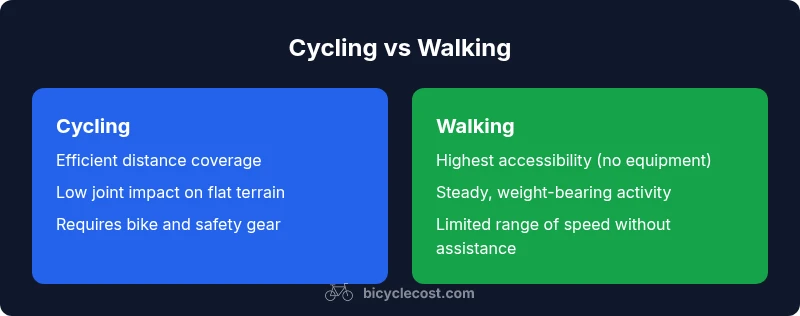
Cycling and walking are distinct locomotion modes; neither is universally better—choose based on goals, environment, and access.
Cycling offers speed and efficiency with typically lower joint load on flat ground, making it ideal for longer rides and commuting. Walking provides simplicity, broad accessibility, and fewer barriers to start. A blended approach often yields the broadest health and mobility benefits.
People Also Ask
Is cycling the same as walking?
No. They differ in biomechanics, energy cost, safety, and practicality. Cycling uses pedal torque and gears to move a bike, while walking relies on direct ground contact with the body's weight transfer. Each has unique advantages depending on goals and context.
No—cycling and walking are different, with cycling offering speed and efficiency, and walking offering accessibility and simplicity.
Which burns more calories per hour, cycling or walking?
Calorie burn depends on speed, effort, and terrain. Cycling often allows higher distance and intensity with lower perceived effort on flat routes, while walking can require more energy per distance at slower speeds. Tailor your activity to your goals and fitness level.
Calories depend on how hard you push it; cycling can burn more per hour if you ride hard, but walking can burn a lot when you walk briskly for longer.
Is cycling safer for joints than walking?
Cycling is generally gentler on weight-bearing joints when done on smooth surfaces, due to reduced impact. However, falls or crashes carry serious risks, so proper gear and safe routes are essential.
Cycling is usually kinder to joints, but safety gear matters.
Can walking substitute cycling for cardio?
Yes, walking can provide cardiovascular benefits, especially for beginners or those with cycling barriers. For higher intensity cardio, cycling can be more efficient, but both can fit into a balanced program.
Walking works for cardio, but cycling can boost intensity more quickly with the right effort.
Do you need special shoes for cycling?
Special cycling shoes are not required. Regular athletic shoes work, but dedicated cycling footwear can improve pedaling efficiency and power transfer, especially with clip-in pedals.
You don’t need special shoes to start cycling, but they can help later on.
How does terrain affect cycling vs walking?
Terrain changes the effort for both activities. Hills and wind affect cycling more due to aerodynamics, while walking relies more on ground grade and surface friction. Both benefit from appropriate pacing and pacing adjustments.
Hills and wind change things a lot for both, but cycling handles speed differently.
Quick Summary
- Assess biomechanical differences before choosing a mode
- Use cycling for longer, faster workouts and commuting
- Walk for accessibility and low equipment needs
- Consider environment and safety when deciding where to train
- A mixed routine can maximize cardiovascular and functional benefits