Is Biking the Same as Running? A Thorough Comparison
Explore whether is biking the same as running. This objective guide compares biomechanics, injury risk, training goals, and practical plans to help cyclists and runners choose the best approach for endurance and health.


Is biking the same as running? They share cardio benefits but are not identical. Running delivers higher impact, bone loading, and faster cadence of human movement, while cycling provides low-impact endurance with greater leg strength focus. Training volume, recovery needs, and injury risk differ, so choose based on goals, joints health, and available time. Both build aerobic fitness, but tactics vary.
Physiology of Movement: Why The Two Activities Feel Different
Many athletes ask whether is biking the same as running. The short answer is that both activities train the cardiovascular system, but they use the body in distinct ways. Running involves weight-bearing locomotion that recruits a broad mix of muscles with high impact, which stimulates bone density and motor patterns tied to impact absorption. Biking, by contrast, is a seated, cyclic motion that reduces joint loading while emphasizing steady leg drive and endurance. This fundamental difference shapes performance ceilings, injury risk profiles, and how you should structure workouts. Understanding the mechanical demands helps you tailor training plans that respect your joints, goals, and available time while avoiding false equivalence between the two disciplines.
Impact and Injury Risk: What Joints Feel
When comparing is biking the same as running, impact becomes the most obvious differentiator. Running transfers force directly through the feet, ankles, knees, and hips with every step, producing higher acute load and a greater risk of overuse injuries if volume outpaces recovery. Cycling keeps the seat under you and distributes load through the glutes, hamstrings, and calves with minimal impact on the joints. This makes cycling a popular option for injury rehab or for people with joint limitations, but it also means different stress patterns that can influence where pain emerges and how training fatigue accumulates over time.
Muscle Activation: Where the Load Goes
Muscle engagement differs markedly between the two activities. Running tends to recruit the ankle plantarflexors, quadriceps, hamstrings, and core for stabilization under variable terrain, often producing faster neuromuscular adaptations for sprinting or hill work. Cycling emphasizes the quadriceps and glutes with substantial contribution from the calves and hip flexors, but the lever arm is smoother and more continuous. Consequently, runners may develop denser bone loading and tendon stress in high-impact zones, while cyclists often gain muscular endurance and strength in the quads and glutes with lower joint compression.
Energy Systems and Endurance Training
Both modalities build aerobic capacity, yet they emphasize energy systems differently. Running commonly stresses rapid aerobic metabolism with opportunities for high-intensity intervals that push VO2 max and lactate threshold. Cycling enables longer steady-pace sessions and controlled intervals, often allowing higher overall weekly volume without excessive joint strain. The broader takeaway is that you can achieve substantial aerobic gains with either activity, but the pathways and pace at which you progress will differ, influencing how you periodize training across weeks.
Calorie Burn and Perceived Exertion
Calorie burn is influenced by effort, duration, terrain, and body mass, but the perception of exertion tends to diverge between activities. Running often delivers a higher perceived exertion for the same time due to impact and muscular demand across stabilizing muscles. Cycling can feel more comfortable at equivalent pace, which can enable longer sessions or larger training blocks without excessive fatigue in joints. For weight management, both activities can be effective when paired with a well-rounded diet and consistent training cadence.
Training Volume, Recovery, and Scheduling
Managing training volume requires different approaches depending on the sport. Running may necessitate more rest days to heal impact-related microtrauma, especially after hard workouts or back-to-back days. Cycling tends to tolerate greater weekly volume when fused with structured recovery and strategic cadence changes, but long rides can still overreach if sleep and nutrition are neglected. A balanced plan often blends both activities, leveraging cycling for base endurance and running for high-intensity or bone-loading work, while carefully tracking fatigue signals.
Equipment, Terrain, and External Factors
The practical aspects strongly influence outcomes and perceived effort. Running demands only shoes and appropriate surfaces, making it easy to start quickly in varied environments. Cycling requires a bike, helmet, appropriate apparel, and safe riding routes. Terrain adds another layer: hills on a bike require cadence management and gear shifts, while running hills demands impact absorption and leg strength. Weather, daylight, and road conditions also shape safety, pace, and training consistency for both activities.
Transitioning Between Activities: When to Cross-Train
Cross-training can harmonize the benefits of running and cycling. For beginners, cycling offers a gentle path to build cardiovascular base, while adding occasional short runs can help bone health and running-specific neuromuscular adaptations. Intermediate and advanced athletes may cycle to maintain volume during injury recovery periods or to reduce load on joints while preserving endurance. The key is to schedule runs and rides to complement each other, avoiding excessive total load and ensuring adequate rest.
Practical Training Scenarios: Plans for Beginners, Intermediates, Athletes
A practical approach starts with goals and constraints. Beginners may begin with two cycling sessions and one short run weekly, gradually increasing volume by small increments. Intermediates can incorporate one quality run per week with two moderate rides, plus a longer weekend session on either modality. Athletes aiming for race readiness can structure a mixed plan with dedicated cycling base weeks and run-specific workouts, including tempo and interval sessions. Throughout, listen to fatigue cues, protect joints, and adjust nutrition for longer sessions.
Common Myths Debunked
One common myth is that biking and running are interchangeable for all fitness outcomes. While both deliver cardio benefits, they train different tissues, joints, and neuromuscular systems. Another misconception is that cycling automatically compensates for running fatigue; in fact, the different load patterns can mask overtraining if training logs and recovery are ignored. Finally, many assume running is superior for bone health; while running offers bone loading, cycling still supports bone health through resistance training modalities and weight-bearing activities beyond cycling alone.
Real-World Scenarios: Case Studies
Consider an endurance-focused adult who wants to protect joints while maintaining volume. A mixed plan with cycling for base endurance and short, targeted runs can deliver similar aerobic outcomes with lower joint strain. In another scenario, a recreational runner recovering from knee irritation might substitute cycling for several weeks to preserve cardiovascular fitness while healing. For a non-elite athlete, building cross-training habits with both activities reduces boredom, spreads novelty, and supports consistent adherence over seasons.
Putting It All Together: Building a Dual-Training Week
A practical dual-training week could balance cycling and running to optimize endurance while protecting joints. Start with two cycling sessions, one steady long ride, one interval session, plus one shorter run emphasizing form rather than distance. Over weeks, adjust the ratio based on fatigue, performance markers, and goal progression. The aim is to create a sustainable weekly rhythm that aligns with lifestyle and minimizes injury risk while maximizing training gains.
Comparison
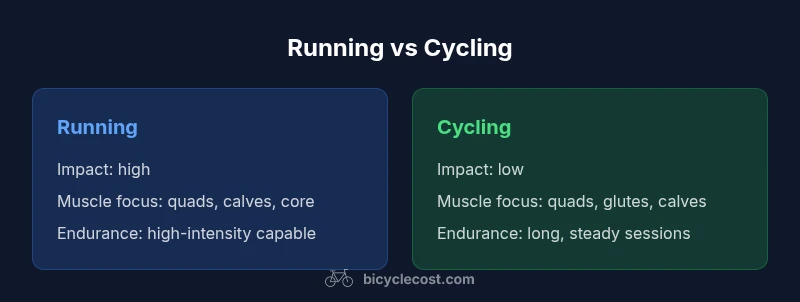
| Feature | running | cycling |
|---|---|---|
| Impact on joints | high impact (running) | low impact (cycling) |
| Muscle emphasis | full lower-limb engagement with bone loading (running) | quads/glutes emphasis with smoother load (cycling) |
| Endurance training suitability | high-intensity intervals and bone-loading potential | long steady-volume sessions with controlled effort |
| Calorie burn characterization | often higher burn per unit time at similar effort | variable burn with potential for long sessions |
| Best for | bone health, rapid intensity gains, simple setup | joint-friendly volume, year-round comfort |
Pros
- Low joint impact makes cycling accessible to more people
- Cycling enables higher weekly training volume with less joint pain
- Cross-training flexibility supports year-round endurance
- Moderate equipment needs; bike-based workouts are versatile
- Running offers bone-loading benefits and fast strength gains
Downsides
- Running increases bone density but raises injury risk with overtraining
- Cycling requires access to a bike and safe riding routes
- Running creates higher fatigue per session and more recovery time
- Bike maintenance and fit can complicate consistency
Bike-based training offers similar endurance benefits with lower joint impact; running provides bone loading and high-intensity conditioning.
For most people, cycling is a joint-friendly way to build endurance, while running excels for bone health and high-intensity conditioning. Use cycling to increase volume safely and running to stimulate bone-loading and specific speed work.
People Also Ask
Is cycling better for beginners than running?
For beginners, cycling can be a gentler way to build base cardiovascular fitness due to lower joint impact. It also allows longer training blocks with less knee or hip stress. However, including short runs can help bone health and run-specific neuromuscular adaptation as fitness improves.
Cycling tends to be gentler on joints for beginners, but adding short runs can help bone health and start building running-specific adaptations.
Can I train for a running race by cycling?
Yes. Use cycling to boost aerobic capacity and endurance while protecting joints. Incorporate run workouts to develop speed, form, and bone loading. A blended plan can help you accumulate sufficient running-specific volume without excessive impact.
Absolutely—cycle to build endurance and pair with targeted runs to train for a race.
Which activity is better for bone health?
Running generally provides higher bone-loading stimuli due to impact forces, which can benefit bone density. Cycling, while low impact, can complement bone health through resistance work and weight-bearing activities outside cycling.
Running tends to be better for bone density, but cycling still fits into a bone-healthy program with other activities.
How should I mix biking and running in a weekly plan?
Aim for a balanced approach: two to three cycling sessions focusing on endurance, one to two running sessions emphasizing quality work, and a longer day for either activity depending on goals. Schedule rest and listen to fatigue signals to prevent overtraining.
Mix cycling and running with a plan that includes endurance days plus quality workouts and plenty of rest.
What are common risks when switching between activities?
Common risks include overuse injuries from repetitive movement patterns and improper technique when switching surfaces or gear. Start gradually, maintain good form, and ensure proper footwear, bike fit, and terrain choices to minimize risk.
Watch for overuse injuries and technique issues when switching; go gradual and use proper gear.
Quick Summary
- Recognize the fundamental biomechanical differences between biking and running
- Prioritize joint health with cycling while using running for bone-loading benefits
- Structure a mixed plan to maximize endurance without overloading joints
- Consider terrain, equipment, and recovery when choosing activities
- Start with a balanced weekly schedule and adjust based on fatigue signals