Is Cycling the Same as Treadmill? An Evidence-Based Comparison for Training
Explore whether cycling on a stationary bike and treadmill running are truly the same. This evidence-based comparison analyzes biomechanics, training goals, safety, and practical substitutions to guide training decisions.


Is cycling the same as treadmill? Not exactly. Both raise heart rate and build endurance, but they differ in biomechanics, impact, and muscle recruitment. This quick comparison helps you decide which modality fits your goals and schedule, and when substitutions make sense in a mixed-training plan.
Is cycling the same as treadmill? Defining the activities
Is cycling the same as treadmill is a common question for mixed-training weeks. The quick answer is no, they are distinct modalities with overlapping benefits. On a stationary bike, you sit and pedal with adjustable resistance, which tends to create a smooth, low-impact motion that stresses the quadriceps, glutes, and calves in a continuous circle. A treadmill, by contrast, asks the body to propel forward with a running or walking stride, which introduces impact, balance demands, and a dynamic hip extension pattern. According to BicycleCost, understanding these mechanics helps cyclists and fitness enthusiasts select the best tool for a given training objective. The goal of this guide is to map how the two activities align on cardio output while highlighting where the differences matter most—especially when you plan substitutions or cross-training during a busy week. For many athletes, is cycling the same as treadmill only in intent (both raise heart rate and improve endurance); in practice, the equipment, impact profile, and muscle engagement diverge in meaningful ways. By breaking down biomechanics, muscle recruitment, and practical training implications, readers can design safer, more effective workouts regardless of the device available.
Core similarities between cycling and treadmill running
Both cycling and treadmill running rely on aerobic energy systems and can push heart rate into similar zones when adjusted for intensity. Practically, you can structure intervals, steady-state cards, and endurance blocks on either machine to achieve comparable training outcomes. The cardiovascular adaptations—improved stroke volume, VO2 max potential, and sustained aerobic capacity—tend to parallel each other when effort levels are matched, cadence is controlled, and duration is appropriate. In addition, both modalities benefit from progressive overload: increasing resistance on the bike or incline and speed on the treadmill facilitates continued improvements. From a training-planning perspective, these commonalities offer flexibility; you can preserve weekly volume by swapping days between machines without losing overall cardio density. The BicycleCost team notes that while the modalities share outcomes, the path to those outcomes differs in mechanics and load distribution, which matters for injury prevention and adaptation timing.
Key differences: biomechanics, training goals, and safety
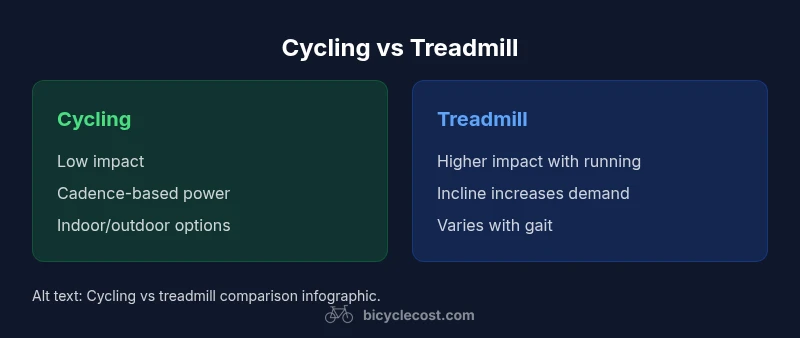
The most pronounced difference lies in biomechanics and impact. Cycling is a seated, low-impact activity that emphasizes a smooth pedaling circle, concentric leg drive, and core stabilization to maintain posture. Treadmill running or walking introduces impact forces, a more dynamic gait, and greater ankle and knee flexion range, which can elevate bone-loading stress and risk of overuse injuries if not managed. Training goals diverge as well: cycling often prioritizes leg endurance, cadence control, and power development via resistance, while treadmill workouts emphasize pace, running economy, and bone stress tolerance. Safety considerations also differ; the treadmill requires fall risk awareness and belt-contact coordination, whereas cycling demands proper bike fit and seat/handlebar ergonomics to avoid knee, back, and hip strain. Finally, recovery signals differ: running can provoke higher impact soreness, while cycling tends toward muscular fatigue zones with less joint impact. These distinctions are critical when planning a weekly routine that alternates between machines or substitutes one for the other during travel or gym access gaps.
How to translate workouts between cycling and treadmill workouts
Translating workouts between cycling and treadmill sessions requires a thoughtful approach to intensity, duration, and recovery. Start by equating effort rather than speed: use rate of perceived exertion (RPE) or heart rate zones to gauge intensity. A 30-minute steady ride at a moderate resistance can map to a 25–30 minute steady jog on a treadmill at a comfortable pace, provided you acknowledge the higher impact on running. For intervals, adjust work/rest ratios to reflect machine differences: 1–2 minute hard intervals on the bike with equal recovery can map to 30–60 second faster intervals on the treadmill, complemented by a walk or very light jog recovery. If you’re using incline on the treadmill to simulate resistance, mirror that effect by increasing cadence or resistance on the bike. Finally, pay attention to muscle-specific signals: if quads and glutes are fatigued on the bike, shorten the ride and add a light jog for balance; if calves or Achilles feel strained on the treadmill, swap in cycling for a few days. The aim is continuity and progression without overloading a single joint or tissue.
Practical considerations for home vs gym setups
Your environment heavily influences your training choices. A dedicated home cardio space with a quality stationary bike and a treadmill offers flexibility, but cost and maintenance matter: bikes require regular chain and belt care, while treadmills need belt lubrication and motor checks. Noise, floor protection, and fan ventilation also shape enjoyment and adherence. If space is limited, a foldable or compact bike plus a compact treadmill can fit most apartments, but you may sacrifice some features (like high incline or multiple resistance settings). Gym access provides varied models and expert coaching, which can accelerate adaptations but demands travel time and scheduling. For home setups, consider a quality bike fit to minimize knee strain, and choose a treadmill with shock absorption and proper belt tension. Regardless of setting, ensuring comfortable exercise shoes, stable footwear, and a clear workout area reduces injury risk and improves technique on both machines.
Is cycling a better option for certain goals?
Yes. If your primary goal is joint-friendly cardio, long-duration endurance, or a low-impact routine during recovery days, cycling often offers a safer route with easier progression. If your aim centers on running-specific conditioning, speed work, race preparation, or bone-loading benefits, treadmill work provides a more direct path. For most cyclists, including a mix of both modalities enhances overall fitness, improves neuromuscular coordination, and reduces the monotony of a single modality. For gym-goers who want to simulate outdoor riding or maintain cycling cadence at off-season times, a higher resistance on the bike and lower-impact incline on the treadmill can approximate similar cardio stimuli while reducing peak joint load. The key is to tailor the mix to your goals, available time, and injury history.
How to design a mixed cardio plan that uses both
A balanced weekly plan might include two cycling sessions, two treadmill sessions, and one mixed day that alternates between the two. Start with a two-week block: week one emphasizes endurance with longer, steady blocks on both machines; week two introduces intervals and tempo efforts on either device, depending on progress and fatigue signals. For example, a sample week could be: Monday cycling steady 45 minutes, Tuesday treadmill intervals, Thursday cycling tempo, Saturday treadmill long run, Sunday recovery or light cross-training. When combining modalities, adjust nutrition and hydration to reflect the different energy costs, and ensure you allocate at least one rest day to support recovery. Over time, we recommend progressively increasing volume or intensity on the machine where you are seeing the strongest gains, while maintaining a minimum number of joint-friendly sessions to protect against overuse.
Practical takeaways for decision-making
- Start with clear goals to determine if cycling or treadmill fits best.
- Consider joint health and injury history when choosing a primary modality.
- Use substitutions to maintain training continuity during travel or gym access gaps.
- Structure a weekly plan that alternates modalities to balance load and prevent plateaus.
- Invest in proper form, shoes, and equipment fit to maximize efficiency and reduce pain.
Comparison
| Feature | Cycling (stationary bike) | Treadmill running/walking |
|---|---|---|
| Impact on joints | Low to moderate (depends on resistance and cadence) | Moderate to high (surface impacts and running gait) |
| Muscle engagement | Quadriceps, glutes, hamstrings with a circular pedal stroke; core stabilization | Calves, quadriceps, hamstrings; hip extensors; foot strike affects load |
| Cardiovascular demand | Achieve high HR zones with cadence/resistance | Achieve high HR with speed and incline |
| Calorie burn potential | Comparable at matched effort; depends on resistance and cadence | Comparable at matched effort; depends on speed and form |
| Accessibility & safety | Low fall risk; controlled environment; easy to fit | Requires balance; fall risk on belt; proper form essential |
Pros
- Clarifies how each modality supports different goals
- Helps plan substitutions without losing training density
- Highlights safety and joint considerations for each option
- Encourages balanced cardio by integrating both modalities
Downsides
- Substitution may not perfectly replicate all stimulus
- Equipment costs and space requirements vary by modality
- Overemphasis on one option can reduce cross-training benefits
Cycling and treadmill are complementary, not interchangeable
Both tools deliver cardio benefits, but they engage the body differently. Use cycling for low-impact endurance and gait-free sessions; use treadmill work for running-specific conditioning and bone loading. A mixed plan offers the best overall transfer to diverse goals.
People Also Ask
Is the calorie burn the same on a stationary bike vs treadmill?
Calorie burn can be similar when effort is matched, but differences in biomechanics and impact influence overall energy expenditure. Running generally elevates bone-loading and muscular fatigue differently than cycling, so counts may differ across individuals. Use RPE or heart rate to align training intensity rather than relying solely on calories.
Calorie burn can be similar with matched effort, but running and cycling tax the body differently. Use effort-based measures to compare workouts rather than calories alone.
Can I substitute treadmill workouts for cycling in a training plan?
Yes, you can substitute with similar duration and effort, adjusting for impact. Start with a conservative swap and monitor joints and fatigue. Use incline or resistance to approximate cardiovascular load when needed.
You can substitute with similar effort, but watch impact and fatigue; adjust incline or resistance to match effort.
What muscle groups are engaged differently between cycling and treadmill running?
Cycling primarily targets the quadriceps, glutes, and hip flexors with a seated pedal stroke and core support. Treadmill running engages calves, quadriceps, hamstrings, hip extensors, and requires greater ankle and knee range of motion with impact.
Cycling focuses on quads and glutes with less impact; treadmill uses calves and hamstrings with higher impact.
Which is better for knee health: cycling or treadmill?
Cycling is generally gentler on the knees due to low-impact pedal motion, whereas treadmill running can increase knee and cartilage load if done with high impact or poor form. If knee pain is a concern, prioritize cycling and use treadmill with care.
Cycling is typically kinder to the knees; use treadmill cautiously if knee pain exists.
How should I adjust intensity when switching between the two?
Treat intensity as a proxy measure. Use HR zones or RPE to match effort; for intervals, swap duration and recovery to reflect impact differences. Start with shorter, lower-impact intervals when transitioning.
Use heart rate or effort levels to map workouts; start with shorter intervals when switching.
Does incline on treadmill affect comparison with cycling?
Incline increases treadmill cardiovascular demand and leg work, which can help approximate resistance on a bike. When comparing, consider both incline and pace to equalize effort.
Incline boosts treadmill effort and can mimic cycling resistance; balance pace and incline to match effort.
Quick Summary
- Define your goal before choosing modality
- Account for joint health and load differences
- Plan substitutions to maintain training continuity
- Balance weekly load across both machines
- Incorporate proper form and equipment fit