Bicycle vs Walking: An Objective, Practical Comparison
A comprehensive, analytical comparison of bicycle vs walking for urban trips, covering speed, cost, health, safety, and environmental impact to help you choose the best option for each journey.


In bicycle vs walking, cycling generally covers distance faster and can boost fitness, but walking requires no equipment and remains the simplest, most accessible option for short trips. The best choice depends on distance, terrain, safety, and personal goals.
bicycle vs walking: Distances and speed on city streets
In ordinary urban environments, the choice between bicycle vs walking hinges on how far you need to go, how quickly you want to arrive, and what kind of terrain you’ll encounter. According to BicycleCost, the distance matters more for deciding between these modes than the weather or mood alone. The BicycleCost team found that cycling typically enables faster ground coverage on most urban routes, especially where dedicated lanes shorten trip times. Walking, by contrast, remains the simplest, most reliable option when destinations are close, routes are uncertain, or weather makes cycling less appealing. The practical implication is straightforward: for a 15-minute loop or a short errand, walking may win on predictability; for a 20- to 40-minute ride through a city, cycling can save time and expand reachable destinations.
Speed is not fixed; it varies with rider fitness, bike type, and surface. On paved city streets, a bicycle can sustain a brisk rhythm with modest effort, while walking speed is constrained by leg pace. Elevation changes flip the equation: hills erase some of cycling's advantage and can invert it for riders who lack gearing or stamina. For mixed-mode trips (bike to train, then walk), the decision becomes about overall trip efficiency rather than a single segment.
Key takeaway: Distance and terrain drive most of the bicycle vs walking decision; infrastructure and personal preference complete the picture.
Comparison
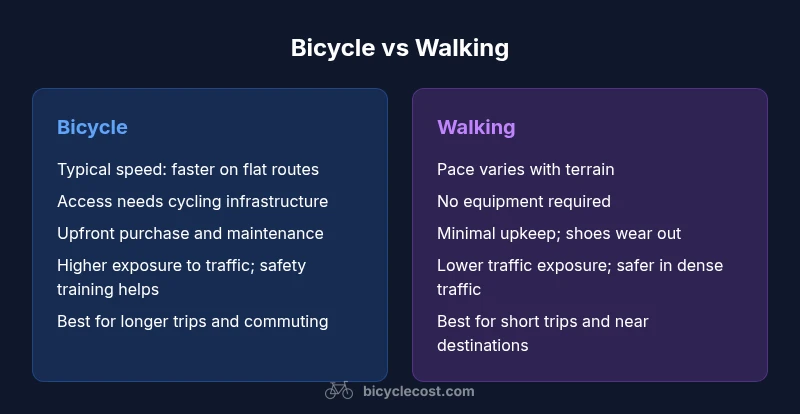
| Feature | Bicycle | Walking |
|---|---|---|
| Typical speed (qualitative) | Varies with rider and terrain; generally faster on flat, paved routes | Leisurely to brisk, depending on pace and terrain |
| Accessibility requirements | Requires bike access, storage, and safe routes | Requires no equipment and can be done anywhere with space to move |
| Costs to start | Upfront bike cost plus ongoing maintenance | Minimal upfront cost; mostly free beyond footwear and clothing |
| Maintenance needs | Regular bike maintenance (tires, chain, brakes) | Minimal maintenance; wear relates to footwear and surfaces |
| Safety and risk | Higher exposure to traffic; requires cycling safety skills | Lower exposure, especially away from traffic; relies on pedestrian rules |
| Best for | Urban commutes, longer trips, flexible routing | Short trips, high accessibility, learning to move safely on foot |
Pros
- Low barrier to walking: no equipment, no storage challenges
- Bicycle offers faster travel and potential fitness gains
- Both options can be cost-effective compared to driving or rideshares
- Walking is accessible in most environments and weather conditions
- Cycling can reduce commute times in congested areas
Downsides
- Walking may be slow for longer trips or when routes are far
- Bicycling requires equipment, storage, and safety considerations
- Bike maintenance adds recurring costs and time
- Infrastructure limitations (lanes, sidewalks) can negate advantages
- Weather and terrain can reduce cycling appeal or safety
Bicycle is better for longer or faster trips; walking excels for short, simple trips.
For efficiency and reach, choose cycling when distance and time matter. Opt for walking when you value simplicity, low setup, and broad accessibility. The right choice depends on distance, terrain, weather, and available infrastructure.
People Also Ask
What factors determine whether bicycle or walking is faster for a given trip?
Speed depends on distance, terrain, weather, rider fitness, and the availability of safe routes. In many urban trips, cycling offers a speed advantage on longer, straight paths, while walking can feel quicker for very short, constrained routes. Planning ahead and testing a few routes helps you quantify which option saves time in your typical neighborhoods.
Distance and route matter most. Try a quick comparison on a few common trips to see which mode lands you at the same place faster.
Is walking ever faster than biking in city centers?
Yes, especially for very short trips or where bike lanes are scarce or disrupted. Pedestrian routes and traffic signals can make walking more predictable and sometimes quicker than navigating with a bike in crowded environments.
Short trips in busy areas can be walking’s edge; plan for your local streets and crossings.
What about cost differences between biking and walking?
Walking costs are typically minimal—shoes and clothing, with no ongoing service fees. Biking involves upfront bike purchases and occasional maintenance, which are offset over time by savings on transit fares and parking. Maintenance frequency varies with use and environment.
Walking is cheaper to start, while biking can pay off over time if you ride regularly.
Which is safer for beginners?
Both modes require awareness of surroundings, but walking generally presents fewer traffic interactions and may feel safer for absolute beginners. Beginners on bikes should learn basic traffic rules, wear a helmet, and use certified bike lanes where available.
Walk first if you’re new to moving around; biking adds safety steps to learn.
How should I plan trips that combine both modes?
Multi-modal planning—driving, bus, train, bike, and walk—can optimize time and convenience. Use bike-friendly routes for the bike portion and pedestrian-friendly paths for walking to reduce risk and fatigue.
Mix modes to get the best of both worlds on longer trips.
What health benefits do each offer?
Both activities support cardiovascular health and mobility. Cycling tends to provide a stronger aerobic workout per hour, while walking fosters consistency and lower injury risk for beginners. Varying intensity across sessions can maximize overall fitness.
Both boost health; cycling can be more intense, walking is great for daily activity.
Quick Summary
- Evaluate distance and terrain before choosing mode
- Walking shines for near-term, low-eff effort trips
- Cycling boosts speed and reach for urban commutes
- Consider weather and infrastructure when planning trips
- Hybrid planning (multi-modal) often yields the best results