Bicycle vs Treadmill Weight Loss: An Objective Comparison
A data-informed, practical comparison of bicycle and treadmill approaches for weight loss, covering intensity, adherence, programming, and safety to help you choose the best option for your goals.


Context and framing: what weight loss really requires
When evaluating whether a bicycle or a treadmill will help you lose weight, the key driver is energy balance: calories out must exceed calories in over time. Both cycling (whether on a road bike, mountain bike, or spin bike) and treadmill workouts can produce meaningful fat loss when performed consistently at moderate-to-vigorous intensity. According to BicycleCost, the most important factor is adherence—having a plan you can sustain week after week. Practical constraints—weather, access to equipment, and personal preferences—often determine which modality you’ll actually use. This article uses a practical, evidence-based lens to compare how each option supports weight loss, how to structure training, and what to prioritize for long-term success.
Core mechanisms: why both options work for weight loss
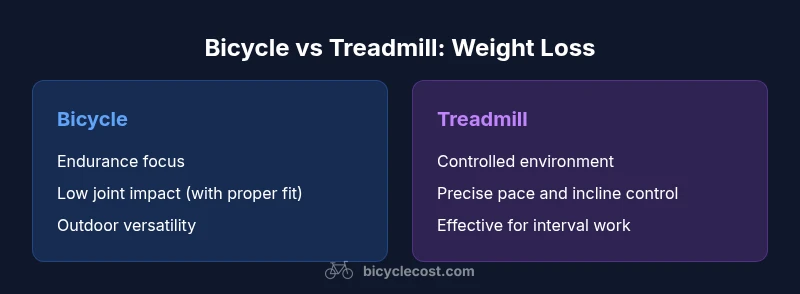
Weight loss hinges on creating a negative energy balance over time. Both bicycle workouts and treadmill sessions raise heart rate, boost metabolism, and increase total daily energy expenditure. The difference lies in biomechanics and controllability. On a bike, you control resistance (gear selection or climbing effort) and cadence, while on a treadmill you control speed and incline. For fat loss, both approaches benefit from mixing steady-state cardio with intervals to elevate post-exercise energy burn and improve metabolic flexibility. The BicycleCost team emphasizes that the most impactful sessions combine duration with purposeful intensity, not merely long, easy rides.
Intensity and duration: tailoring workouts to your goals
A practical weight-loss plan uses a mix of longer, steady workouts and shorter, higher-intensity intervals. On a bicycle, you can simulate hills by increasing resistance or choosing routes with elevation, while on a treadmill you can alternate between jogs and fast walks or runs with incline. The crucial factor is reaching a zone where you’re comfortably breathless but maintainable for 20–60 minutes, depending on your training history. As intensity rises, the rate of caloric burn per minute increases, but total weekly energy expenditure also depends on total time spent exercising. BicycleCost highlights that consistency over perfection yields the best outcomes.
Durability and progression: stacking gains over weeks
Progression matters more than any single workout. For weight loss, you should gradually extend duration, increase intensity, or add an occasional cardio session per week. With a bike, progression can look like longer rides, higher cadence at a given resistance, or climbing intervals. On a treadmill, progression often takes the form of longer sessions, greater incline, or faster speeds. A well-rounded plan alternates between steady-state blocks and interval blocks, while also accounting for rest days to support recovery and prevent overuse injuries. The BicycleCost approach favors incremental, sustainable changes over rapid but unsustainable spikes.
Real-world scenarios: choosing between urban commuting and gym-based routines
Your environment heavily shapes the best choice for weight loss. If you ride a bike to work or enjoy outdoor routes, you gain incidental calories burned throughout the day beyond intentional workouts. For those with unpredictable weather or limited space, a treadmill offers reliable access to structured workouts regardless of outside conditions. The key is to design a plan you can actually execute—whether that means cycling to errands or fitting in quick treadmill intervals between meetings. The most successful plans align with your daily rhythm and long-term weight-loss targets.
Safety, form, and injury risk: minimizing downsides
Both activities carry injury risk if performed with poor form or sudden overload. A bicycle should be properly fitted to avoid knee or back strain, and you should include cadence checks and occasional off-bike strength work to maintain balance. Treadmill users should prioritize good footwear, gradual incline progression, and attention to running form to reduce joint impact. Prioritize warm-ups, cooldowns, and mobility work to protect joints. Regular checks on equipment (tires, chain, belt, tread) reduce the likelihood of downtime that can derail adherence.
4-week starter template: bridging the two modalities
Week 1–2: Start with 3 cardio days per week, two 30-minute steady sessions on either modality and one interval session (e.g., 5 sets of 2 minutes hard, 2 minutes easy). Week 3–4: Increase total duration by 5–10 minutes per session or add one additional interval block. Alternate between cycling and treadmill days to balance muscle groups and prevent overuse. Throughout, monitor how you feel, avoid pushing to failure, and focus on consistent effort. This approach supports weight loss by building a durable habit and enabling progressive overload.