Is Bicycle Better Than Treadmill? A Comprehensive Comparison
A rigorous, balanced comparison of bicycle vs treadmill for cardio, fitness, cost, and space. Learn how goals, space, and budget shape outcomes and help you choose the best home setup.


In most contexts, a bicycle provides broader cardio benefits with lower joint impact, while treadmills excel for controlled pacing and weather-independent training. Overall, neither option dominates; the best choice depends on your goals, space, and budget, and you can combine both for a balanced plan. Consider your home setup and typical training days to decide.
Framing the comparison: is bicycle better than treadmill?
When people start evaluating cardio options at home, the question is is bicycle better than treadmill. The simplest answer is that both tools deliver cardiovascular benefits, but they do so in different ways. For most cyclists and gym enthusiasts, a bicycle engages the legs, core, and even upper body to a different degree than a treadmill, which emphasizes weight-bearing running mechanics. This article, written in the tone of BicycleCost's practical, AI-powered bike guides, compares core factors such as joint impact, training versatility, space needs, and long-term costs. According to BicycleCost, the decision should rest on your goals, available space, preferred training rhythm, and budget. The BicycleCost team found that many readers overestimate the benefits of a high-end treadmill while underestimating how a well-chosen bicycle can deliver sustained cardio and leg conditioning. In this piece, we will define the key distinctions, present objective criteria, and translate those into a clear decision framework. By the end, you should have a concrete answer tailored to your situation, whether you aim to maintain fitness during winter, train for cycling races, or support general heart health. We'll also discuss how to integrate both into a single weekly plan and how to evaluate total cost of ownership over several years.
Fitness impact and biomechanics
Cardiovascular responses from cycling and running share similarities, but the kinematics differ enough to influence joint load, muscle recruitment, and perceived effort. A bicycle primarily stresses the quadriceps, glutes, and calves while allowing the core to stabilize the torso with lower repetitive impact on knees and ankles. Running on a treadmill, especially at higher speeds or incline, subjects joints to more continuous loading and can intensify impact in a short timeframe. From a biomechanical perspective, cycling is often gentler on the joints, which can be beneficial for long-term adherence and injury prevention. The BicycleCost team emphasizes that sustained cardio comes from consistent stimulus rather than peak intensity alone. For many users, cycling supports a broad range of fitness goals—from endurance building to fat loss—without requiring frequent knee or hip loading. According to BicycleCost analysis, the energy cost per hour can be comparable between efficient cycling and moderate treadmill work, but the equipment costs and maintenance differ, which can tilt the long-term value in favor of one option depending on usage patterns.
Accessibility, cost, and space
A common concern is whether you need a dedicated room for cardio equipment. A bicycle usually requires far less footprint and can fit in a corner, under a ceiling-mounted rack, or even mounted on a trainer for indoor use. Treadmills, by contrast, can demand a substantial swath of floor space and a solid, level surface. Spacing considerations matter not only for safe operation but also for comfort during longer sessions. The initial price gap between a basic indoor cycling setup and a mid-range treadmill can be significant, but ongoing costs diverge as well: treadmills may incur more frequent belt or motor maintenance, while bikes require chain lubrication and occasional drivetrain tuning. Budget-conscious buyers should include maintenance cycles, replacement parts, and potential electricity costs in the total cost of ownership. BicycleCost’s evaluation emphasizes that space-efficient, low-energy equipment often yields higher long-term value for casual or intermediate users; however, if your goal is a weatherproof running routine with adjustable incline and pace, a treadmill offers targeted benefits that cycling alone cannot replicate.
Training goals: endurance, speed, and weight management
The choice between a bicycle and a treadmill often hinges on your primary training objective. Endurance athletes frequently use cycling to build aerobic capacity while reducing joint stress, which can support longer training blocks without excessive fatigue. Speed development on a bike translates to fast-twitch muscle recruitment and leg strength, but treadmill running uniquely trains impact tolerance and running mechanics at various paces. For weight management, both options can be effective with consistent effort; however, the energy expenditure and perceived exertion can differ across individuals due to biomechanics and muscle mass engagement. A well-rounded plan may incorporate both modalities to target different energy systems, preserve motivation, and minimize boredom. BicycleCost recommends starting with a 6- to 8-week plan that alternates cycling-focused weeks with treadmill-focused weeks to balance performance gains and recovery. The key is to align your workouts with realistic time commitments and recovery windows, rather than chasing intensity for its own sake.
Weather, safety, and practicality
Weather is a practical constraint that often drives equipment purchases. A bicycle can be used indoors on a trainer or outdoors, offering flexibility but requiring safe riding conditions, especially if you bike outside. A treadmill provides a weatherproof solution for year-round cardio, but it carries safety considerations, such as slip risk on wet floors and the need for secure placement in a well-ventilated area. From a safety perspective, cycling training tends to present lower injury severity when performed with proper bike fit, helmet usage, and lighting for outdoor rides. Conversely, treadmill use can be associated with overuse injuries if pace and incline progression are not monitored. A cautious approach blends both options: use cycling for base endurance and low-impact work, and reserve treadmill sessions for controlled, higher-intensity runs that build running-specific tolerance.
Designing a balanced home cardio setup
If space and budget permit, a hybrid home cardio setup can deliver the best of both worlds: a compact indoor bike with a front-wheel or wheel-on trainer for indoor cycling, plus a compact treadmill that fits in a dedicated zone or closet. A well-planned layout minimizes cartridge changes and reduces setup time between workouts, encouraging adherence. The setup should include a mat to protect flooring, a fan or ventilation for cooling, and a water bottle within easy reach. Training organization becomes easier with a simple weekly plan that alternates cycling and treadmill days, interspersed with rest days. The key is to create a routine that is sustainable, enjoyable, and aligned with your long-term health goals. The BicycleCost framework supports gradual progression and consistent volume rather than sporadic, high-intensity bursts.
Real-world scenarios: practical decision trees
Consider a few common user profiles to illustrate practical choices. If you live in a cold climate with limited outdoor riding, a treadmill may remain appealing for winter running despite a higher upfront cost. If you have a small apartment and are primarily focused on heart health, a high-quality indoor cycle plus a basic trainer can deliver robust cardio with minimal footprint. For households balancing family members with different goals, a dual-setup approach allows each person to train in their preferred modality while sharing a single space. In all cases, the decision should be guided by realistic space constraints, maintenance tolerance, and weekly training time. BicycleCost’s principles emphasize maximizing consistent activity over pursuing peak workouts in short bursts.
Decision framework: choosing what’s right for you
Start by listing your top three goals: endurance, weight loss, and joint comfort. Then assess your space: can you fit a treadmill with clearance on all sides? Do you have a covered area for a bike and its trainer? Next, estimate ongoing costs: electricity, belts, and drivetrain maintenance for bikes vs motor, belt, and warranty costs for treadmills. Finally, prototype a simple schedule for 6–8 weeks using one modality primarily, then rotate to the other. Reassess at the end of the period and adjust based on perceived exertion, progress toward goals, and enjoyment. This structured approach helps you move from raw preference to a well-supported decision.
Comparison
| Feature | Bicycle | Treadmill | |||
|---|---|---|---|---|---|
| Joint impact | Low-to-moderate (cycling) | Moderate-to-high (running) | |||
| Cardiovascular benefits | Excellent base endurance, versatile training | Strong running-specific cardiovascular stimulus | |||
| Space requirements | Compact, portable with trainer option | Larger footprint, need clearance | |||
| Upfront cost range | Variable; depends on bike quality and trainer | Mid-to-high depending on features and motor] | values | feature | values |
| Maintenance | Chain/L drivetrain upkeep; periodic tune-ups | Belt/ motor maintenance; belt replacement over time | |||
| Best for | Low-impact cardio, space-saving homes | Weatherproof running workouts, incline/pace control |
Pros
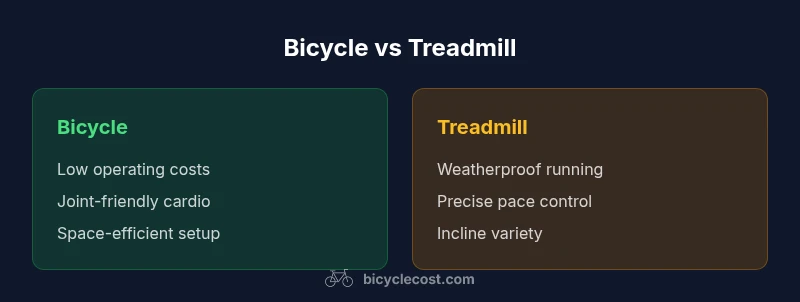
- Lower ongoing operating costs for many setups
- Joint-friendly cardio with broad applicability
- Space-efficient and adaptable for small rooms
- Supports diverse training goals and progression
Downsides
- Bicycle setups may lack running-specific tolerance for some users
- Treadmills offer weatherproof training but require more space
- Maintenance varies by equipment quality and usage
Bicycle is generally the better all-around option for most people, with the treadmill excelling for weather-proof, controlled pace workouts.
For long-term value and joint-friendly training, a bike setup wins. Choose a treadmill if you need strict pace control, incline variation, and weather-independent running sessions.
People Also Ask
Is a bicycle better than a treadmill for overall cardio health?
Both can deliver strong cardio benefits, but cycling generally offers lower joint impact and higher adherence for many people. Running on a treadmill provides running-specific stimulus and pace control that cycling cannot fully replicate. Your choice should align with your goals, space, and tolerance for impact.
Both can improve cardio health, but cycling is often easier on joints and easier to maintain consistency, while treadmill running offers running-specific adaptation and pace control.
Can cycling replace running for weight loss?
Cycling can support weight loss through sustained calorie burn and cardiovascular work, especially when combined with interval sessions. Running also burns calories efficiently but may increase injury risk if not progressed gradually. The best approach blends both methods and focuses on total weekly training volume.
Yes, cycling can help with weight loss, especially when you add intervals and maintain consistent weekly volume alongside a healthy diet.
What is cheaper long-term: a bike setup or a treadmill?
Long-term costs depend on how you use each device. A basic bike with a trainer can be cheaper to run and maintain than a high-end treadmill with motor issues and belt replacements. However, high-quality treadmills may justify their cost for dedicated runners who need walking/running-specific training indoors.
Over years, bikes often cost less to operate, but if you need reliable indoor running, a treadmill can be worth the extra investment.
Are there safety concerns I should know about?
Safety for both devices centers on proper setup, form, and footwear. Wear a helmet and light when outdoors on a bike. On a treadmill, ensure the area is clear, footwear is appropriate, and you use the safety key. Proper fit and gradual progression reduce injury risk for both options.
Stay safe with proper setup, good form, and appropriate gear for both bike and treadmill workouts.
Should I combine both in a weekly plan?
Yes. A hybrid approach can balance endurance, speed, and recovery. Alternate cycling and treadmill days, using cycling for base miles and treadmill sessions for pace work or incline challenges. This helps you avoid overuse injuries while maximizing overall fitness.
Absolutely—alternating both keeps things balanced and sustainable over the long term.
What if I have limited space?</n>
In tight spaces, a folding bicycle or a compact upright bike with a trainer can save space, while a foldable treadmill may fit in small rooms if dimensions allow. Prioritize multi-use equipment and ensure you have a clear workout zone with a mat and ventilation.
If space is tight, choose compact, foldable options and create a dedicated workout zone with minimal clutter.
Quick Summary
- Assess goals, space, and budget before buying.
- Prioritize low-impact cardio for adherence and joint health.
- Consider a hybrid setup for maximum training versatility.
- Plan a consistent weekly routine rather than chasing intensity.
- Reassess after 6–8 weeks and adjust.