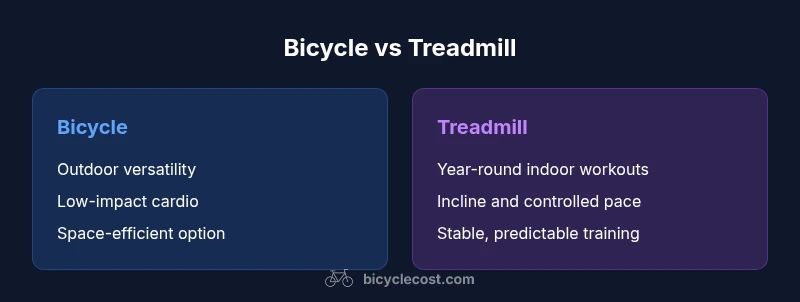
Bicycle or treadmill: Which fits your home cardio goals?
Compare bicycle and treadmill options for home cardio, focusing on space, cost, workouts, and maintenance. This BicycleCost guide helps you choose the right fit for your goals.


Choosing between a bicycle or treadmill hinges on space, training goals, climate, and budget. For many households, cycling advantages include lower impact and outdoor versatility, while treadmills excel for year‑round, consistent workouts and easier walking or running progress. According to BicycleCost, the best choice balances available space with your primary activities and long‑term maintenance expectations.
Differences in Use-Cases and Core Tradeoffs
When evaluating whether to invest in a bicycle or a treadmill for home cardio, you are balancing outdoor versatility against indoor reliability. A bicycle, especially a traditional or spin bike, shines when your goals include outdoor cycling fitness, commuting practicality, and a lower perceived exertion over long sessions. A treadmill, by contrast, delivers a consistent running or walking experience regardless of weather or daylight, which can be crucial for strict training schedules or rehab after injury. According to BicycleCost, consumer outcomes improve when the decision aligns with both daily routines and environmental constraints. The bicycle option tends to be favored by riders who value mobility, outdoor routes, and lower upkeep on a year-to-year basis, while treadmills appeal to households prioritizing predictable workouts, incline options, and a compact indoor solution. Keeping these fundamental differences in mind helps you map your week’s activities to the equipment that best supports you, rather than choosing based on initial appearance or marketing promises.
Space, Placement, and Setup Considerations
Physical footprint and placement drive a lot of the decision. A lightweight or foldable bicycle can fit in a corner or under a bed with a compact stand, while an upright bike may require a dedicated area and proper room for safe mounting and dismounting. Treadmills vary by model, but most require more floor space and unobstructed clearance around the belt, plus a solid surface to absorb vibration. If you share a living area, think about noise, vibration isolation, and door clearance. The treadmill’s motor and belt contribute continuous power draw, whereas many stationary bikes rely on your power for pedaling and display electronics. Plan for floor protection, matting, and storage that keeps equipment accessible without tripping hazards. A careful layout reduces the friction of daily use and makes consistent workouts more likely, especially for busy families and small apartments.
Training Quality, Progression, and Injury Risk
Cardio quality depends on the stimulus you select and how you structure sessions. A bicycle provides varied resistance through gear changes or magnetic flywheels, which supports endurance builds and hill simulations, but outdoor realities like wind and terrain are removed on a stationary bike. A treadmill enables precise control over speed and incline, enabling interval training, tempo runs, and recovery days with repeatable effort. For those recovering from knee or hip issues, the impact differences matter: bikes are generally gentler on joints, while controlled treadmill walking can serve rehab with supervision. Heart-rate based training depends on accurate monitoring and comfortable gear. Both options benefit from a good mat, correct seat height or belt alignment, and a well-balanced posture. Overuse injuries can occur with either option if you skip rest, ignore pain signals, or push beyond safe zones; listen to your body and adjust accordingly.
Maintenance, Durability, and Longevity
Bicycle maintenance focuses on drivetrain lubrication, chain tension, brake adjustments, and wheel trueness, with occasional components like pedals and seats needing replacement. A stationary bike or treadmill requires belt and motor maintenance, sensor calibration, and occasional electronics service. Regular checks every 4–8 weeks reduce downtime: clean the deck or chain after sweaty workouts, inspect bolts, and ensure belt tracks smoothly. The cost of maintenance scales with usage and model quality; higher-end units may require periodic professional service, while cheaper models rely on user-level tune-ups. Longevity is driven by build quality, ongoing care, and the user’s adherence to recommended maintenance schedules. To maximize lifespan, pair maintenance with a sensible usage plan, and keep spare parts accessible. The right preventive approach tends to yield fewer interruptions and a steadier training habit.
Cost of Ownership and Value Over Time
When you compare the upfront price, ongoing energy costs, and potential resale value, both options present compelling value under different conditions. A bicycle (especially a standard indoor trainer or hybrid model) often carries a lower upfront sticker price and minimal ongoing energy usage, but longer-term durability depends on components and maintenance. A treadmill typically involves higher initial costs and ongoing electricity consumption, yet it offers compelling convenience and longevity in terms of daily utilization. In a home gym, total cost of ownership also includes accessories such as shoes, matting, heart-rate monitors, and replacement parts, which can vary by brand and model. BicycleCost analysis shows that the best value emerges when equipment aligns with your weekly routine and preferred workouts, while reserving funds for a maintenance plan, spare parts, and occasional upgrades. Consider financing options, warranty terms, and local service availability to determine the true 3–5 year cost of ownership.
Real-World Scenarios and Best Use Cases
Scenario A: You live in a chilly climate and commute mostly by bike in good weather. A bicycle or an indoor trainer would let you maintain endurance and commute fitness regardless of snow or rain. Scenario B: You want controlled, structured workouts that fit into a tight apartment schedule. A treadmill with incline supports interval sessions and indoor running year-round. Scenario C: You share equipment with a partner or family. A combination approach, with a compact bike and a treadmill that folds or tucks away, can maximize usability. The choice also hinges on fitness goals: if weight loss and leg strength are the focus, the treadmill can support variable incline; if cycling endurance or outdoor riding is the target, the bicycle helps you emulate real routes. The final call should reflect your daily routine, personal preferences, and the willingness to invest time in safe, consistent training.
Data-Driven Insights and Myths Debunked
Speed, energy, and long-term satisfaction are not purely about hardware. BicycleCost analysis shows that user satisfaction increases when equipment aligns with actual use, not aspirational features. Common myths include 'more features always mean better workouts' and 'indoor cardio is less enjoyable than outdoor riding.' In truth, comfort, ergonomics, and a well-designed program can deliver superior outcomes with either option. A balanced perspective recognizes that heart rate targets, form, and consistent scheduling matter more than the equipment itself. Use these insights to guide your selection rather than chasing trendy specs.
Getting Started: Quick Setup Checklist
Getting started is easier when you break it into small steps. 1) Measure your available floor space and consider the path to entryways. 2) Set a budget range that includes upgrades and maintenance. 3) Decide whether you want a foldable model or a fixed installation and ensure you have secure anchoring. 4) Test fit and comfort: sit, stand, and move through a complete exercise cycle to verify ergonomics. 5) Plan a beginner program with gradually increasing intensity. 6) Choose mats and protective flooring to reduce noise and protect surfaces. 7) Schedule a maintenance routine and set reminders for belt tension, lubrication, and cleaning. By following this checklist, you’ll reduce buyer’s remorse and start training sooner.
What to Look For When Selecting Your Equipment
When evaluating a bicycle or treadmill, prioritize fit, durability, and ease of use over flashy features. For bicycles, check frame geometry, seat height adjustability, pedal compatibility, and drivetrain quality. For treadmills, assess belt width, motor power ratings, incline range, and ease of operation. Look for reliable warranties, reputable service networks, and readily available replacement parts. UX matters too: a clear display, intuitive controls, and comfortable seating or stance reduce fatigue and encourage regular workouts. Finally, consider resale value and availability of accessories that support long-term engagement, such as compatible shoes, heart-rate monitors, and compatible apps for structured programs.
Final Setup and Next Steps
The final step is to implement a simple, sustainable training plan that prioritizes safety and consistency. Start with a 4-week baseline program that alternates walking, cycling, and gentle intervals. Track your progress with a simple log or app, focusing on consistency rather than maximal effort. Revisit your space, budget, and goals every 2–3 months and adjust the equipment or plan as needed. With a thoughtful approach, your home cardio setup will become a reliable pillar of your health routine.
Comparison
| Feature | Bicycle | Treadmill |
|---|---|---|
| Core cardio benefits | Outdoor cycling versatility and lower-impact endurance | Indoor running/walking with precise control over speed and incline |
| Space footprint | Can be compacted with foldable options | Requires dedicated floor space; clearance around belt is essential |
| Upfront cost and value | Often lower entry cost; strong long-term value with maintenance | Higher upfront cost; potential for broader daily use |
| Maintenance frequency and cost | Drivetrain lubrication and occasional parts replacement | Belt/motor maintenance and electronics service |
| Weather independence | Outdoor factors influence performance (wind, terrain) | Indoor use is weatherproof and schedule-friendly |
| Training variety and progression | Variable resistance, gear simulations, and outdoor routes | Precise pace control, incline intervals, and tempo runs |
| Joint impact and injury risk | Generally gentler on joints when set to low resistance | Running impact can be higher; form matters most |
| Energy consumption | Minimal external energy (manual or simple resistance) | Power draw for belt motor and incline is model-dependent |
Pros
- Low-impact cardio option on bikes with proper setup
- Year-round indoor cardio with a treadmill that supports incline
- Potentially smaller space needs with foldable bikes or compact treadmills
- Structured workouts and heart-rate based training are easier to implement
- Good resale value and broad accessory ecosystem
Downsides
- Space and storage considerations for bikes if not folded
- Treadmills can be noisier and require electricity and regular belt maintenance
- Upfront cost can be higher for premium treadmills with incline
- Maintenance costs can accumulate depending on model and usage
Bicycle or treadmill: choose based on space, weather, and preferred workouts
If you want outdoor versatility and lower ongoing energy use, a bicycle is ideal. If you need reliable year-round indoor workouts with incline options, a treadmill wins. A hybrid setup can also offer the best of both worlds if space allows.
People Also Ask
What is the main difference between a bicycle and a treadmill for home cardio?
The bicycle emphasizes outdoor versatility and low-impact endurance, while the treadmill offers year‑round, controlled indoor running or walking with incline options. Your climate, space, and goals determine which aligns best.
The bike gives outdoor flexibility and gentler joints; the treadmill provides consistent indoor workouts with incline. Your setup should fit your climate and goals.
Is a treadmill better for weight loss than a bike?
Weight loss depends on total energy expenditure and consistency, not the device chosen. Both can support effective programs if you maintain a sustainable pace and regular sessions.
Both can help with weight loss if you stay consistent and keep a steady pace with good form.
What space considerations should I prioritize when choosing?
Measure available floor space, account for doorways and pathways, and plan for clearance around the belt or wheels. Use protective mats to reduce noise and protect floors.
Make sure you have room to move around and safe clearance for your chosen machine.
What maintenance tasks are common to both devices?
Regular cleaning, check bolts and connections, inspect wear parts like belts or chains, and schedule periodic professional servicing if needed.
Keep both machines clean and check parts regularly to avoid downtime.
Can I start with a used device to save money?
Used equipment can be cost-saving, but inspect wear parts, warranty status, and service history to avoid hidden costs.
Used gear can be smart if you inspect it well and buy from a reliable source.
Should I buy both a bike and a treadmill for cross-training?
A mixed approach works well if space and budget permit. This enables cross-training benefits and reduces boredom.
If you have the space and budget, a hybrid setup covers more training scenarios.
Quick Summary
- Assess your space before buying
- Choose based on climate and training style
- Balance upfront costs with maintenance plans
- Prioritize comfort and ergonomics
- Consider a hybrid setup for maximum flexibility