Bicycle vs Scooter: Practical Commuter Guide 2026
A thorough, data-informed comparison of bicycle and scooter for urban commuting. Learn to map your distance, terrain, storage, and safety needs to the right choice with actionable guidance.


When deciding between a bicycle or scooter for urban commuting, choose based on distance, storage, and health goals. A bicycle generally offers more range, cargo capacity, and fitness benefits, while a scooter shines for short trips, easy storage, and multi-modal setups. According to BicycleCost, the total ownership costs in many cities favor bicycles over time, but scooters can be cheaper upfront and easier to park in tight spaces. See our detailed comparison for nuances.
Why the bicycle remains a versatile choice for urban mobility
In the debate of bicycle or scooter for city travel, the bicycle often emerges as the more flexible option. The BicycleCost team notes that bicycles tend to deliver a broader range of benefits, including better range on longer commutes, the ability to carry groceries or work gear, and the health improvements from regular pedaling. For many riders, a bicycle is a practical, durable tool for daily mobility, with simple maintenance that can be performed at modest cost. The choice hinges on context: distance, terrain, storage space, and where you live. If you face hills, varied terrain, or you value exercise as part of your commute, a traditional or e-bike might be the natural pick. But in tight urban cores with frequent stops, a scooter can be easier to park and maneuver when speed over distance matters. The key is to map your typical trips and storage constraints to the fundamental strengths of each option.
Key differences at a glance: range, cost, maintenance, storage, safety, and accessibility
- Typical use-case: bicycles excel on longer trips and varied terrain; scooters are optimized for short hops in dense urban environments.
- Upfront cost: basic bicycles can sit in a broad price range; scooters often start lower but can rise with electric variants.
- Operating costs: both are low compared with cars; bicycles require less ongoing maintenance, while electric scooters add charging costs and battery considerations.
- Maintenance frequency: bikes require routine chain lubrication and tire checks; scooters depend on battery health and tire condition.
- Storage and portability: scooters are generally more compact and easier to store in small spaces; bicycles require more room or a mounting solution.
- Safety considerations: helmets and visibility matter for both; protected bike lanes and curb-guarded paths influence risk differently.
- Accessibility: bikes are often more forgiving for beginners but require a proper fit and riding confidence; scooters can be more approachable but may have weight limits and folding mechanics to learn.
In short, the decision is highly dependent on your environment and daily routines. The BicycleCost framework emphasizes evaluating distance, weather, and parking along with your physical comfort to determine which option better fits your life.
Cost and value: upfront price, operating costs, and resale value
Price is a major factor in the bicycle or scooter decision. For basic, non-motorized bicycles, typical price ranges are broad, roughly $300-$1200 for everyday city bikes, with higher-end models and specialized frames pushing beyond. In contrast, basic kick scooters can start around $120-$300, while more capable electric scooters often range from $400-$1500, with premium options climbing higher. Operating costs mirror usage more than sticker price: bikes require occasional tune-ups, puncture repair, and chain maintenance, while electric scooters incur charging costs, battery replacements, and tire wear. Over time, bicycles generally offer more durable long-term value, especially if you choose a robust frame and proper maintenance. However, if upfront affordability and storage simplicity are paramount, a foldable scooter can be an attractive short-term solution. The BicycleCost analysis highlights that total ownership often favors bicycles in dense urban areas due to durability and cheaper maintenance, but local incentives, terrain, and storage capabilities can shift the balance.
Practical considerations by use-case: commuting distance, terrain, cargo, and parking
Different contexts demand different gear. A short, flat-distance commute across a city with ample bike lanes can be well served by both options, but the details matter. If you routinely commute 3-6 miles, a bicycle offers comfortable cruising, variable speeds, and the ability to carry a bag or groceries in a pannier. In a campus or apartment setting where parking is scarce, a scooter’s smaller footprint and foldability may win out. Cargo capacity matters: bikes can accommodate panniers, baskets, and rack-mounted bags; scooters may struggle with large loads unless outfitted with special racks. For those who frequently ride with a passenger or need to haul heavier items, the bicycle’s load-bearing capabilities tend to be superior. When storage is extremely restricted, consider folding scooter models or compact city bikes paired with wall mounts or ceiling hoists. Ultimately, match your daily trips to the strengths of each option.
Maintenance and repair: what to expect
Maintenance routines differ in kind between a bicycle and a scooter, but both reward regular care. A standard bicycle needs periodic chain lubrication, tire pressure checks, brake inspections, and occasional gear tuning. You can usually perform many tasks at home with basic tools, keeping ongoing costs modest. Electric scooters introduce a new dimension: battery health, charging habits, motor protection, and tire wear; battery longevity depends on charging cycles and storage conditions, which affect long-term cost and reliability. When choosing between a bicycle or scooter, consider your comfort with DIY maintenance and access to local service shops. A well-maintained bike often requires less specialized service than an electric scooter, but high-quality scooters with battery systems can offer excellent performance when serviced by trained technicians.
Safety and regulatory considerations
Safety should be a central criterion in any transportation decision. Helmets are standard protective gear for both bicycles and scooters, and visibility gear increases daytime and nighttime safety. Bicycle routes and bike lanes in many cities provide safer corridors, but rider behavior remains crucial—predictable movements, proper signaling, and staying alert to pedestrians help reduce accidents. In some jurisdictions, electric scooters are subject to different rules, including speed limits, age restrictions, and parking regulations. Understanding local regulations around where you can ride, helmet requirements, and whether a device requires registration or insurance is essential. This knowledge helps mitigate risk and aligns your choice with your comfort level and legal responsibilities.
Weather, durability, and lifecycle: how climate shapes your choice
Weather sensitivity influences long-term satisfaction with bicycle or scooter ownership. Wet or icy conditions may call for different tire choices, fenders, or additional protective gear. Bicycles generally fare well in varied weather when maintained and stored properly; wheels, brakes, and frames should be inspected after exposure to moisture to prevent rust and wear. Scooters, including many e-scooters, have battery-related vulnerabilities in extreme cold, requiring careful charging practices and storage. The lifecycle of each option depends on usage intensity and build quality. A well-maintained bike can last many years with proper care, while a motorized scooter’s battery and electronics determine its usable life. Planning for weather-appropriate gear and storage solutions is prudent for any urban rider.
Environmental and health impact: the broader picture
Choosing between a bicycle or scooter can influence your environmental footprint and daily health. Bicycles typically produce zero emissions during operation, support cardiovascular health, and encourage daily activity through regular riding. Scooters reduce space needs and can lower trip friction in dense urban cores, potentially promoting more trips by micro-mobility. From a sustainability perspective, the best choice often aligns with your commuting distance, available infrastructure, and willingness to engage in physical activity. Both options contribute to reducing traffic congestion and air pollution, especially when they replace car trips. The BicycleCost view emphasizes considering local infrastructure and personal health goals to maximize positive outcomes for communities and riders alike.
How to test before buying: a practical checklist
Before purchasing, conduct a hands-on evaluation. Test ride each option on typical routes—include hills, curbs, and turns to assess handling and comfort. Check fit for your height, reach, and seating position; measure standover height for bikes and ensure scooter weight limits accommodate you. Inspect critical components: brakes, tires, and drivetrain on bikes; tires, battery, motor, and charging setup on scooters. Evaluate storage needs at home and at work; visualize parking availability and how easy it is to carry or mount the device. If possible, borrow or rent for a day to gauge real-world usability. Consider maintenance expectations and service availability in your area; a short-term trial can reveal hidden drawbacks that aren’t obvious in magazines or online listings.
Integration with public transit and multi-modal trips
Many urban riders use a combination of transport modes. A bicycle can be taken on light-rail or bus services in many cities, expanding your range beyond walking distance. Foldable scooters often integrate well with transit, allowing you to complete a trip with one or two transfers. If you anticipate frequent multi-modal trips, examine your local transit policies on vehicle carry-ability, storage limits, and any required passes or fees. Carrying ability, ease of use in transitions, and reliable parking near transit hubs are critical to a smooth multi-modal pattern. Plan for seasonal changes and daily routines to ensure your chosen option remains practical throughout the year.
Decision framework: choosing between bicycle or scooter
To decide, start with a clarity exercise: map your typical trips (distance, terrain, weather), evaluate storage constraints, and outline safety considerations. A longer, more variable commute with cargo needs favors a bicycle; if you need quick, compact trips in dense centers, a scooter may win. Consider future needs like potential weather changes, health goals, or the possibility of integrating with transit. Finally, weigh total cost of ownership, including maintenance and potential incentives. By aligning your choice with real-world requirements, you maximize reliability and satisfaction over time.
Comparison
| Feature | Bicycle | Scooter |
|---|---|---|
| Typical upfront price range | $300-$1200 (non-motorized and mid-range bikes) | $120-$600 (basic kick scooters); $400-$1500 (e-scooters) |
| Operating costs | Low; minimal maintenance and parts | Low to moderate; depends on charging and battery upkeep |
| Storage footprint | Moderate to large; requires space or mounting | Compact; folds for tight spaces |
| Portability | Less portable; easier to secure at home or work with mounts | Highly portable; foldable models simplify transit |
| Terrain suitability | Versatile; supports hills, rougher streets, and varied surfaces | Best for flat, smooth urban runs; limited off-road use without suspension |
| Maintenance frequency | Regular wheel, chain, and brake maintenance | Battery and tire checks; occasional motor servicing |
| Safety considerations | Extensive protected lanes improve safety; falls vary by rider skill | Lower-impact in some contexts; speed and battery adds different risks |
| Best for | Longer commutes, cargo, health benefits, diverse routes | Short trips, easy storage, multi-modal convenience |
Pros
- Lower long-term ownership cost for many urban riders
- Greater versatility for varied terrain and cargo
- Health and fitness benefits from regular riding
- Wide availability of spare parts and repair options
Downsides
- Requires more storage space and parking
- Higher learning curve for new riders on bikes in traffic
- Slightly higher maintenance complexity for non-durable components
- Weather sensitivity can affect usability
Bicycle generally wins for long-term versatility; scooter wins for tight spaces and short trips
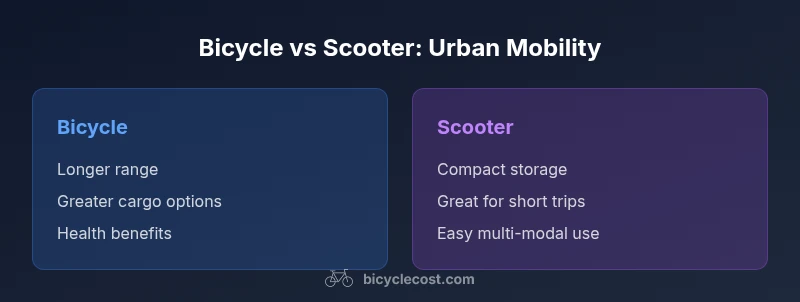
Choose a bicycle for longer distances, cargo and health benefits. Choose a scooter for compact storage, quick errands, and easy multi-modal trips.
People Also Ask
Is a bicycle better for daily commuting than a scooter?
For longer commutes and cargo needs, a bicycle often provides more comfort and versatility. Scooters can excel on shorter trips and in high-density urban cores where space is at a premium. Both can be viable with proper planning and safety gear.
For longer trips and carrying gear, a bicycle is usually better; scooters work great for short, storage-conscious rides. Test both if possible.
Are scooters safer than bicycles?
Safety depends on usage context, rider behavior, and infrastructure. Both require helmets and visibility gear; dedicated bike lanes and well-lit routes reduce risk for bikes, while speed limits and rider training help scooters as well.
Safety is about context and behavior. Helmet up, stay visible, and follow local rules for both.
Can I use a bicycle or scooter on public transit?
Most cities allow bicycles on trains or buses during off-peak hours or with designated racks. Foldable scooters are often easier to take on transit, but policies vary—check local rules and consider multi-modal routing when planning trips.
Check your transit authority's rules; foldables can be easier to carry, but policies vary.
What maintenance should I budget for?
Bicycles require periodic chain lubrication, brake checks, and tire maintenance. Scooters require battery health checks and tire care; electric models benefit from occasional professional servicing for the motor and electrical components.
Budget regular maintenance for bikes; scooters need battery and tire upkeep plus occasional service.
Which is cheaper over time, a bicycle or scooter?
Bicycles often deliver lower long-term costs due to durable components and simple maintenance, though high-end e-bikes may tilt the economics. Scooters can be cheaper upfront but battery replacement or motor issues can raise costs later.
Long-term, bikes usually cost less; scooters can be cheaper upfront but battery costs can appear later.
How do weather conditions affect each option?
Wet or icy conditions require careful gear and route planning for both. Bikes tolerate a range of weather with proper storage and maintenance; scooters may face battery performance issues in extreme cold or heat.
Weather changes riding comfort for both; have appropriate gear and plan routes accordingly.
Quick Summary
- Assess typical trips before choosing between bicycle or scooter
- Consider storage capacity and parking availability
- Factor in weather, terrain, and maintenance comfort
- Weigh long-term ownership costs alongside upfront price
- Test in real-world scenarios to confirm fit and comfort