How to Measure Wheel Size on a Bicycle: A Practical Guide
Learn how to measure wheel size on a bicycle, including BSD vs overall diameter, tire markings, and common sizes. Practical steps and safety tips from BicycleCost.


Goal: Learn how to measure wheel size bicycle accurately. This quick guide covers bead seat diameter (BSD) and overall wheel diameter, how to read tire and rim markings, and how to identify common sizes like 26in, 27.5in (650b), 29in, and 700c (622mm). It also explains converting between standards and how to verify measurements on your bike.
Why wheel size matters
Wheel size affects fit, handling, braking performance, gearing, and tire selection. Using wheels that don’t match your frame can cause rubbing, brake interference, and unsafe riding conditions. Accurate measurement helps you select compatible rims and tires, reduces the risk of costly mismatches, and makes maintenance easier. According to BicycleCost, many sizing issues come from assuming wheel diameter equals tire width or relying on a single size label. The BicycleCost team emphasizes that precise sizing is a foundation for reliable upgrades and safe riding across road, mountain, and hybrid bikes. Beyond safety, correct sizing also helps preserve braking performance and suspension compatibility on mixed-geometry frames. A small miscalculation can cascade into incorrect gear inches, rubbing, or rotor/frame interference during tight turns or steep descents.
BSD vs overall diameter: what you need to know
Bead Seat Diameter (BSD) is the inner circle where the tire beads sit on the rim. It is the key constant you should measure when assessing wheel compatibility, since many rims and tires are designed around a fixed BSD. The overall diameter, by contrast, includes the tire and can vary with tire width and tread pattern, affecting ground clearance, fender fit, and brake clearance. For example, a typical bicycle uses BSD values around 559mm for 26in wheels, 584mm for 27.5in (650b), and 622mm for 29in and 700c. When you mount wider tires, the outer diameter increases slightly, which can impact frame clearance and chainstay or brake caliper positioning. For safety and interoperability, always distinguish BSD from overall diameter and confirm which measurement your replacement wheel specs reference. Some shops label wheels by overall diameter including tire, which can be misleading if you’re swapping tires of different widths.
Reading tire markings and rim labels
Tire sidewall markings are a quick way to infer wheel size, but they can be ambiguous across brands. Look for ISO/ETRTO sizing such as 47-622, where 47 is the tire width in millimeters and 622 is the BSD in millimeters. Older labels like 29 x 2.0 or 27.5 x 2.4 approximate outer diameter and tire width, not the precise BSD. When possible, rely on the ISO size because it maps directly to bead seating and rim width. Rim labels may also show the same BSD value and, occasionally, the intended tire width range. If you’re unsure, measure BSD directly with calipers and cross-check with the rim’s specifications to avoid compatibility issues.
Tools you’ll need to measure accurately
To measure wheel size reliably, you’ll want a few essential tools and a stable workspace. A metric tape measure or digital calipers provides the precision needed for BSD. A ruler or straightedge helps you verify outer diameter. Having a notebook or digital device to record values prevents mix-ups later. If possible, use a bike stand or a secure, level surface to keep the wheel from twisting. A marker can help you annotate measurement points for clarity during rechecks.
Plan your measurement approach
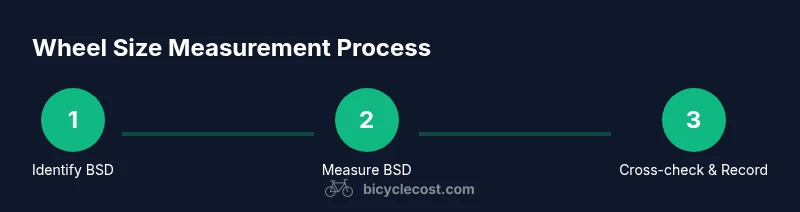
Before you start, decide whether you will measure BSD (the most important number for rims and tires) or the overall diameter (useful when evaluating tire height effects). If you’re measuring without removing the tire, you’ll get a rough BSD estimate; for accuracy, remove the tire and measure BSD directly across the bead seats. Deflate the tube fully to avoid bead slippage during measurement. Document both BSD and outer diameter when possible so you have a complete reference for future upgrades or replacements. This approach reduces the chance of ordering mismatched components and helps you compare apples to apples when shopping for wheels or tires.
How to plan a safe and accurate measurement session
Create a clean, flat workspace and ensure your bike is stable. If you don’t have a stand, rest the bike against a wall with the drivetrain facing you to minimize movement. Take measurements at least twice and record the most precise values. Use a consistent reference point for each measurement—e.g., measure across the true center of the tire’s tread for outer diameter and straight across the bead seats for BSD. Cross-check your measurements with a trusted spec sheet or manufacturer data to confirm accuracy before purchasing parts.
Tools & Materials
- Measuring tape (metric, at least 2 meters)(Flexible and accurate to 0.5 mm for BSD readings.)
- Calipers (digital or vernier)(For precise BSD measurement between bead seats.)
- Ruler or straightedge(Helps align measurement across the wheel.)
- Notebook or digital device(Record measurements and notes.)
- Bike stand or stable support(Safer setup, especially for repeated measurements.)
- Marker or tape(Annotate measurement points on wheel.)
Steps
Estimated time: 15-25 minutes
- 1
Prepare the bike and workspace
Position the bike on a stable surface or in a bike stand. Clear the area of any loose tools to prevent accidents during measurement. If you will remove the tire, deflate the tube first to reduce bead tension.
Tip: Stability reduces motion, which improves accuracy. - 2
Identify the measurement type
Decide if you’re measuring BSD (the most reliable for rims) or the overall diameter (useful when comparing mounted tires). Keep both values if possible for a complete reference.
Tip: BSD is the standard reference for rims and tires. - 3
Measure BSD with calipers
Use calipers to measure the distance between the two bead seats across the rim’s inside diameter. Record the value in millimeters. If you don’t have calipers, use a ruler with careful alignment as a rough estimate.
Tip: Measure perpendicularly to avoid angular error. - 4
Estimate BSD with a tape if needed
If calipers aren’t available, wrap the tape across the inside of the bead seat and read the distance. Repeat to confirm accuracy.
Tip: Take multiple readings and average them. - 5
Measure the overall diameter with the mounted tire
With the tire inflated to your normal riding pressure, measure from the very outer edge of the tire on one side to the opposite edge across the wheel. This gives you the outer diameter, which changes with tire width.
Tip: Tire tread and width affect outer diameter, so consistency matters. - 6
Record, compare, and verify
Document BSD (and outer diameter if measured) and compare to standard sizes (e.g., 559mm BSD for 26in, 584mm for 27.5in, 622mm for 29in/700c). If measurements don’t align with a known standard, consult the manufacturer or a professional.
Tip: When in doubt, contact the wheel or bike shop for confirmation.
People Also Ask
What is bead seat diameter (BSD) and why does it matter?
BSD is the internal diameter where tire beads seat on the rim. It’s the most reliable reference for rim and tire compatibility. Incorrect BSD can lead to fit problems or braking clearance issues.
BSD is the key measurement for rim and tire compatibility. If you match BSD, you’re much more likely to have a safe, correct fit.
Can I measure wheel size without removing the tire?
You can estimate outer diameter with the tire mounted, but BSD is best measured with the tire removed. For accuracy, remove the tire and measure the bead seats directly.
Yes, you can estimate with the tire on, but for accuracy, remove the tire and measure the bead seats.
Do different brands use different size labels?
Some brands label wheels by outer diameter including tires, which can be misleading. Rely on BSD (in millimeters) and ISO sizing for consistent comparisons across brands.
Some labels can be confusing; focus on BSD and ISO sizes for consistency.
How does tire width affect diameter measurements?
Wider tires add to the outer diameter, so outer diameter readings can vary with tire width even if BSD remains the same. Always record both BSD and outer diameter when possible.
Wider tires make the wheel look larger; BSD stays the same, but outer diameter changes with tire size.
What should I do if I’m buying new wheels?
Compare BSD and rim width specifications from the seller, and confirm compatibility with your frame, brakes, and fenders. When in doubt, consult a professional.
Check BSD and rim width, and verify it fits your bike before buying.
Watch Video
Quick Summary
- Measure BSD first for compatibility
- Different tires change outer diameter slightly
- Use ISO/ETRTO sizing for accuracy
- Double-check measurements before buying wheels
- Record measurements for future upgrades