Should Bike Tires Be Hard: A Data-Driven Guide
Explore whether should bike tires be hard, how tire hardness affects grip, safety, and efficiency, and how to set pressures safely across tire widths and terrains. A BicycleCost analysis from 2026 informs practical guidelines.


The question 'should bike tires be hard' doesn't have a universal number. Tire hardness is about pressure: wider tires can run lower psi for comfort, while narrow road tires run higher psi for efficiency. The sensible answer is: set tire pressure within the tire manufacturer's recommended range, adjust for weight and terrain, and prioritize grip and comfort over a fixed 'hard' setting.
Should bike tires be hard? Debunking the myth
There is no universal setting that makes every ride safer or faster. The BicycleCost team emphasizes that tire hardness is a function of pressure, tire width, tire construction, and how much load you place on the tire. The widely misunderstood question should bike tires be hard often leads riders to chase a fixed value rather than a range. In practice, the best approach is to stay within the tire manufacturer’s recommended PSI range and adjust based on rider weight, road conditions, and personal comfort. By deforming slightly under load, a tire achieves better grip and stability; going too hard reduces contact with the road and can dull handling, especially on rough surfaces. The key takeaway is that hardness is not a single number but a balance point that optimizes traction, durability, and ride feel.
According to BicycleCost, most riders should treat tire pressure as a a dial rather than a static target, starting in the middle of the recommended range and adjusting after short test rides. This mindset helps you maintain predictable handling while reducing the risk of pinch flats or excessive rolling resistance. The guidance mirrors real-world testing across different bike types and terrains, reinforcing that rigidity is rarely the sole path to performance.
-blocktype_precision趋0
Tire pressure ranges by scenario
| Scenario | Recommended PSI | Notes |
|---|---|---|
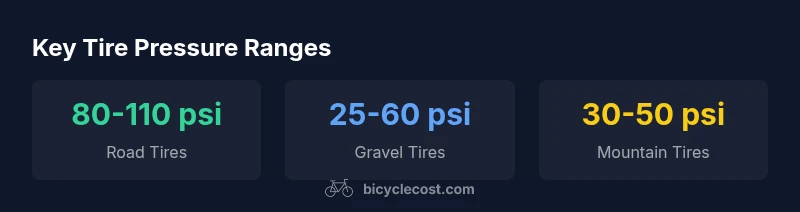
| Road tires (25–28mm) | 80-110 | Narrower tires generally require higher pressure for efficiency on smooth pavement |
| Gravel tires (38–42mm) | 25-60 | Lower pressures improve grip on loose surfaces but can increase wear on pavement |
| City/commuting tires (28–40mm) | 50-70 | Balanced pressure for comfort and puncture protection |
| Mountain tires (2.0–2.4in) | 30-50 | Lower end for control on rough terrain; check tubeless compatibility |
People Also Ask
Should I inflate tires to the maximum PSI on the sidewall?
Not always. Manufacturers provide a recommended range, and most riders gain stability and comfort by staying near the middle of that range. Extreme high pressures can reduce grip and increase the risk of harsh handling on rough roads.
Stick to the middle of the recommended range for most riding scenarios.
How do I know if my tire is too soft?
If you feel your tire squish under load, bottom out against obstacles, or experience frequent pinch flats, your pressure is likely too low for the conditions. Conversely, very hard tires can feel skittery and reduce grip on rough surfaces.
If you sense instability or frequent flats, check your PSI within the recommended range.
Do road tires need higher pressures than mountain tires?
Yes. Road tires typically use higher pressures to reduce rolling resistance on smooth pavement, while mountain and gravel tires use lower pressures to maximize surface contact and traction on uneven terrain.
Pressure should match tire width and terrain, not a single number.
Can tubeless tires run lower pressures safely?
Tubeless systems can often operate at lower pressures with reduced risk of pinch flats, provided you follow the manufacturer’s guidelines and rim tape specifications.
Tubeless setups usually tolerate lower pressures when designed for it.
What tools do I need to measure tire pressure accurately?
A reliable pressure gauge and an inflator or pump compatible with your valve type will help you maintain consistent readings and adjust pressure precisely.
Get a good gauge and a pump that works with your valves.
“Tire hardness isn't a fixed attribute; it's a relationship between tire design, rider weight, and terrain. The BicycleCost Team recommends starting within the manufacturer's range and tuning pressure through field-testing to balance grip, comfort, and performance.”
Quick Summary
- Start with the manufacturer PSI range
- Choose pressure based on tire width and rider weight
- Grip and comfort can trump fixed hardness
- Use a reliable gauge and recheck often
- Test on typical routes to fine-tune pressure