How to Shift Gears on a Bicycle: A Practical Guide
Learn how to shift gears on a bicycle with clear steps, maintenance tips, and safety guidance from BicycleCost. Improve cadence, efficiency, and control across varied terrain using correct shifting techniques.


Mastering gear shifts lets you ride smoother, conserve energy, and handle varied terrain with confidence. This quick answer outlines the core steps to shift correctly on most bikes, from understanding the drivetrain to practicing on hills. Before you begin, ensure your cables are in good condition and your derailleur indexing is dialed in for reliable, quiet shifting.
Understanding how gears work on a bicycle
Gears on a bicycle change the relationship between pedal effort and speed. By selecting front chainrings and rear cogs, you adjust the gear ratio, which determines how hard you must pedal to move forward. The derailleur guides the chain between rings and sprockets, while the shifter communicates with the derailleur to move the chain to a different gear. Understanding this relationship helps you shift smoothly and avoid wasted energy. According to BicycleCost, mastering gear shifts improves efficiency and control for riders of all levels. The BicycleCost team found that riders who maintain a steady cadence and plan shifts ahead conserve energy and ride more comfortably across varied terrain. When you know how the chain engages with the cassette and chainrings, you can anticipate changes in terrain, reducing dropped chains and jerky transitions.
To start, think of gears as a ladder: lower gears (smaller chainrings and larger sprockets) make pedaling easier but slower, while higher gears make the bike faster but require more effort. The goal is to match your cadence to the terrain so your legs stay comfortable and your speed remains steady.
Essential terminology
- Gear ratio: The relationship between the number of teeth on the chainring and the cog you’re on; it determines effort vs. speed.
- Front derailleur: Moves the chain between chainrings on the crankset.
- Rear derailleur: Moves the chain across the cassette on the rear wheel to different gears.
- Shifter: The lever you use to request a gear change; it signals the derailleur via a cable or electronically.
- Indexing: The precise alignment of derailleur movement with the shifter clicks so you land on the exact gear you intend.
- Chain and cassette: The chain engages the teeth on the chainrings and cogs; wear affects shifting accuracy.
- Cross-chaining: Using extreme gear combinations (large ring with large cog or small ring with small cog) which wastes energy and wears the drivetrain.
Knowing these terms helps you diagnose issues quickly and communicate with others when maintaining or upgrading your bike.
How gears interact with terrain and cadence
Terrain dictates the gear you should be in for a smooth ride. Climbing steeper grades benefits from lower gears to keep your cadence steady, reducing fatigue. Descents and flat pavement often call for higher gears to maximize speed without spinning out. A comfortable cadence for most riders ranges roughly between 70 and 90 RPM, though this varies with fitness and riding style. Keeping a steady cadence improves efficiency and power transfer, making climbs feel less like an all-out effort. Practice shifting before you hit changes in terrain so your legs stay relaxed and responsive rather than shocked by abrupt gear changes. This fluidity comes from repeated practice and listening to the drivetrain as you shift.
Front vs Rear derailleur: when to use which and how to tune
The front derailleur handles gear changes across the chainrings, while the rear derailleur shifts across the cassette at the back. In practice, you’ll use the rear derailleur most of the time on flat and rolling terrain, and you’ll switch to the front derailleur for steep climbs, where a smaller chainring reduces effort. Keep in mind that misadjusted front or rear derailleurs can cause rubbing, slow shifting, or dropped chains. Regularly inspect the derailleur hangers, alignments, and cable tension, and adjust limit screws to prevent the chain from rubbing the frame or dropping off the gears. A well-tuned system shifts smoothly and quietly, even under modest loads.
Indexing and tuning: getting precise shifts
Indexing aligns the derailleur position with each shifter click so you land on the intended gear. If shifts feel sluggish or miss gears, you may need to adjust the barrel adjusters or limit screws and check cable tension. Start with small, measured turns: a quarter-turn at a time, then test. Clean and lubricate the cable housings if the feel is stiff. Regular maintenance keeps shifts precise and reduces wear on the chain and cassette. Remember, consistent indexing reduces effort and protects drivetrain longevity, a principle BicycleCost emphasizes in routine maintenance guidance.
Shifting in practice: on the bike and at speed
Practice shifting in a safe environment before tackling traffic or steep climbs. Shift gradually through the gears to maintain cadence, avoiding large, abrupt changes that can stress the chain. When approaching a hill, anticipate the shift by moving to a lower gear before you start to climb, then maintain a smooth pedal stroke. While riding, keep your hands relaxed on the bars and avoid gripping the brakes during a gear change. If you hear rubbing during a shift, stop briefly and recheck cable tension or derailleur alignment. With consistent practice, you’ll develop muscle memory and shift more instinctively on varied terrain.
Maintenance and troubleshooting: keep the drivetrain in good shape
Regular cleaning and lubrication are essential for reliable shifting. Wipe the chain and cassette after rides, inspect for wear, and replace if stretched or damaged. Check the derailleur cables for fraying and replace them if needed. If shifting remains noisy or inaccurate, revisit indexing, cable tension, and limit screws. A well-tuned drivetrain improves efficiency, reduces energy loss, and extends the life of your components. The BicycleCost team recommends setting a maintenance cadence that fits your riding frequency and terrain.
Terrain-specific shifting: climbs, descents, and city riding
On climbs, you’ll use lower gears to maintain cadence and reduce fatigue. On descents, you may prefer higher gears to control speed and avoid over-spinning. In city riding, anticipate traffic patterns and shift early to maintain a comfortable cadence for safe, smooth acceleration and braking. Keep shifts progressive and avoid cross-chaining by selecting gears that balance effort with speed. Practicing in a controlled environment helps you adapt to different terrains while protecting drivetrain wear and ensuring safer riding.
How to choose gears for terrain and fitness goals
Your optimal gear choice depends on terrain, cadence, and fitness goals. Beginners may default to a softer cadence with easier gears to build leg strength and confidence, while more experienced riders aim for a higher cadence and efficient power transfer. Start each ride with a quick gear check: confirm the chain is in a comfortable middle range and that the derailleur shifts cleanly across the range. Practice shifting in small steps to train your brain and your muscles to respond quickly when terrain changes. The BicycleCost team recommends setting a baseline cadence and gradually expanding your range of gears as you gain confidence and stamina.
Tools & Materials
- Bike with gears (road or mountain)(Gears functioning; multiple chainrings and a cassette)
- Allen wrenches (5mm, 6mm)(For derailleur limit screws and cable tension adjustments)
- Chain lubricant(Use a lubricant appropriate for conditions)
- Clean rag(For wiping chain, derailleur, and frame)
- Derailleur hanger alignment tool(Optional, helps precise alignment on misaligned hangers)
- Cable cutters(Optional for replacing worn cables)
- Bike stand or stable surface(Makes adjustments easier)
- Spare chain quick links(Useful for on-the-road chain repair)
Steps
Estimated time: 15-25 minutes
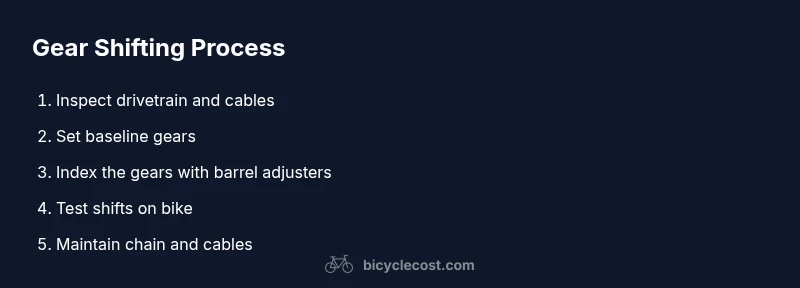
- 1
Inspect drivetrain and cables
Check chain wear, clean the drivetrain, and inspect derailleur cables for fraying or stiffness. Replace damaged components before attempting adjustments to ensure reliable shifting.
Tip: Do this before any adjustments to prevent misdiagnosis. - 2
Set baseline gears
Move to the smallest rear cog and smallest front chainring to establish a low-gear baseline. This makes initial adjustments easier and reduces the chance of overshifting.
Tip: Gentle, deliberate shifter clicks yield better indexing results. - 3
Index the gears with barrel adjusters
Turn barrel adjusters by small increments to align each shift with the corresponding gear. Test by pedaling forward and shifting through the full range.
Tip: One-quarter to one-half turn changes gear indexing; test after every adjustment. - 4
Test shifts while stationary
With the bike supported, shift through all gears to confirm clean engagement without rubbing. Address any misalignment before riding.
Tip: If the chain rubs, revisit the limit screws and cable tension. - 5
Practice shifting while riding
Shift gradually as you roll, maintaining a smooth pedal cadence. Anticipate terrain changes and shift before you feel resistance.
Tip: Keep hands relaxed on the bars to avoid abrupt reactions. - 6
Cross-chaining awareness
Avoid extreme gear combinations that produce cross-chaining, as they waste energy and wear components faster.
Tip: Prefer mid-range gears when possible for efficiency. - 7
Maintenance and follow-up
After your shift practice, clean and lubricate the chain, recheck cable tension, and schedule a tune-up if shifting remains slow.
Tip: Regular maintenance reduces the likelihood of shift issues during rides.
People Also Ask
Why is my bike not shifting smoothly?
Common causes are worn chain, dirty components, or misadjusted derailleurs. Start by cleaning the drivetrain, lubricating the chain, and checking cable tension.
If your bike isn't shifting smoothly, clean and lubricate the chain, check derailleur alignment, and adjust the cable tension.
What is cross-chaining and why should I avoid it?
Cross-chaining occurs when you ride in extreme gear combinations, such as large chainring with large cog or small chainring with small cog. It causes wear and poor shifting. Keep the chain in the mid-range gears when possible.
Cross-chaining wears the drivetrain and makes shifts harder. Try to stay in mid-range gears.
Do I need to adjust my front derailleur?
If the outer plate rubs the chain or shifts are slow, you may need to adjust the limit screws or indexing. Start with small tweaks and test.
The front derailleur may need adjustment if shifting is slow or rubbing happens.
How often should I replace a chain?
Chain wear depends on mileage and riding conditions. Inspect for stretch and replace when wear is evident; typical guidance varies by use, so check regularly.
Check chain wear every few months and replace as needed.
Can I shift gears while climbing hills?
Yes, but shift to easier gears before the incline begins and avoid forcing a shift while under heavy load. Maintain a steady cadence.
Shift in advance when approaching a hill for the easiest climb.
Is it safe to shift under heavy load?
Shifting under heavy load can damage the chain and derailleur. Ease off the pedals briefly to allow a clean shift.
Avoid shifting under heavy load; ease off the pedals briefly for a clean shift.
Watch Video
Quick Summary
- Understand gear basics to improve efficiency
- Practice smooth shifts to prevent chain drop
- Keep indexing aligned to ensure precise shifting
- Maintain drivetrain to extend gear life