How to Use Bicycle Gears: A Practical Guide
Learn how to use bicycle gears effectively with practical shifting tips for flats, hills, and diverse terrain. This step-by-step guide covers gear ranges, cadence, maintenance, and safety to help riders of all levels ride smarter.


Using bicycle gears effectively means selecting the right front and rear gears to maintain a steady cadence, conserve energy, and prevent chain wear. This guide explains gear layouts, how to shift smoothly on flats and hills, and how to avoid cross-chaining. By practicing deliberate shifts, you’ll ride more efficiently in diverse terrain.
Understanding Bike Gears and Terminology
Bicycles with gears use a front ring (or rings) and a rear cassette to create different gear ratios. The front chainrings are driven by the crank, while the rear cassette or sprockets sit on the rear wheel and connect through the chain. A derailleur mechanism moves the chain from one chainring to another (front shifts) and from one cog to another (rear shifts). Understanding terms like chainring, cog, derailleur, indexing, and gear ratio helps you anticipate how each shift will affect your pedaling resistance. In practice, more or larger teeth on the front or fewer teeth on the rear make pedaling harder (higher gear), while fewer teeth on the front or more teeth on the rear make pedaling easier (lower gear). The goal of how to use bicycle gears is to pick a comfortable cadence and a gear combination that matches your terrain, keeping your muscles engaged without overworking the knees. This section also introduces the concept of “gear inches” or“gear ratio” as a way to estimate effort for a given wheel size and chainring/cog combination.
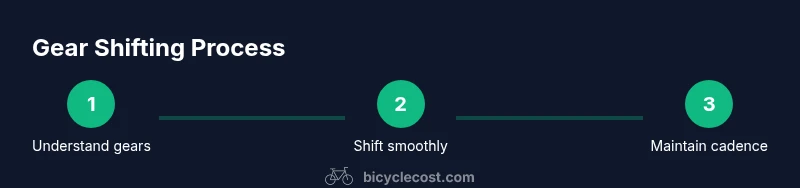
In daily riding you’ll notice that gear choices depend on terrain, wind, and your fitness. With time, the pattern becomes intuitive: you shift early to maintain cadence, avoid large jumps in effort, and stay seated or stood up as needed for stability and efficiency. BicycleCost’s guidance emphasizes consistent cadence, smooth shifts, and regular maintenance as foundations of effective gear use.
How to Read Your Gear Range
Every bike has a gear range determined by the number of chainrings at the front and the number of cogs at the rear. A typical road bike might be 2x11 (two front rings and eleven rear cogs), while many mountain bikes are 1x12 or 2x10. The total range describes how hard or easy it is to pedal from the lowest to the highest gear. To read your range, look at your cassette and chainring setup, note the smallest and largest gear combinations, and estimate the cadence you prefer on different terrains. Practically, you’ll translate gear range into usable minutes on a climb or sprint on a descent. A principle to remember is that the largest front ring paired with the smallest rear cog is the hardest gear, requiring more power but offering higher speed potential. Conversely, the smallest front ring with the largest rear cog is the easiest gear, easing you up grades and conserving energy for longer rides. For most riders, targeting a cadence of about 80–90 rpm on flat ground provides a balance of efficiency and comfort, while climbing might drop cadence to 60–70 rpm depending on incline and gearing. As you become familiar with your bike’s ranges, you’ll begin to anticipate which gear to select before you feel strain. The BicycleCost analysis, 2026, suggests tailoring your gear selection to terrain, fitness, and ride goals rather than chasing a fixed cadence on every ride.
To identify your current range, shift through the gears on a flat road and note the relative effort and cadence changes. If changes feel abrupt or you hear grinding, it may indicate indexing issues or a misaligned derailleur. Routine checks, including cable tension (if applicable) and derailleur alignment, help ensure your range stays consistent over time.
How to Shift Effectively on Flat Terrain
On flats, the objective is to hold a steady cadence while swapping between gears to maintain momentum. Start in a comfortable low-to-mid gear to warm up, then gradually shift to slightly harder gears as you accelerate. A practical rule is to shift one step at a time, especially when you approach a small increase in grade or wind resistance. Keep pedaling smoothly through the shift to avoid chain slip and ensure the derailleur can track properly. If your cadence rises too high or you feel you’re spinning out, shift to a higher gear to recover efficiency.
A key habit is to plan shifts before you reach a headwind, a corner, or a road irregularity. This preemptive shifting reduces the need for abrupt changes that can break rhythm. If you ride with a cadence monitor or a basic cadence awareness, aim for a comfortable rhythm around 80–90 rpm on the flats. This helps you conserve energy for longer rides and reduces knee strain. Regularly inspect the chain and chainring for wear because worn teeth can hamper smooth shifts and chase minor misalignment.
Note that front shifts tend to be more dramatic than rear shifts because you’re moving the chain across larger gaps between chainrings. In practice, avoid cross-chaining (using a large chainring with a large cog or a small chainring with a small cog) to minimize chain wear and drivetrain stress. Consistent maintenance, including cleaning and lubricating the chain, helps your gears move more quietly and reliably over time.
Shifting for Hills and Rolling Terrain
Hills demand a careful balance between your cadence and chosen gear. Start by selecting a comfortable low gear in the rear when you anticipate a climb, then choose a front gear that keeps your legs in a steady rhythm rather than forcing you to push beyond your preferred cadence. The trick is to shift early, before you feel the need to push hard, so you keep the power output sustainable and avoid straining the drivetrain. If you start a climb in too hard a gear and slow down, you’ll fight the bike rather than work with it; shift down smoothly and continue to pedal.
On variable terrain, you’ll often change multiple steps as gradients shift. Practice is the best way to learn how your bike responds to different combinations, and don’t hesitate to switch to a lower gear if you sense your cadence dropping toward 60–70 rpm. Keeping the cadence within a comfortable range avoids knee and hip stress and makes climbs feel more manageable. If you have a single chainring (1x) setup, you’ll rely more on the rear cassette range, so learn which rear gears strike a balance between speed and climbing ease. In all cases, anticipate shifts with clear pedal strokes and maintain chain tension to prevent slipping.
Practicing specific hill drills on a safe gradient helps you develop a reliable habit: choose a gear combination that yields steady cadence, climb a set distance, and then recover in a higher gear on the descent. The end result is a ride that feels smoother, faster, and less exhausting.
Avoiding Cross-Chaining and Common Mistakes
Cross-chaining happens when you use a combination that places the chain at an extreme angle, like a big front chainring with a big rear cog or a small front chainring with a small rear cog. This configuration increases chain tension, wears the drivetrain, and can cause poor shifting. To avoid cross-chaining, opt for combinations that keep the chain relatively straight as it travels between the chainrings and cogs. When shifting, move the chain gradually and avoid “slipping” into gears; instead, pause pedaling briefly as the derailleur settles into place. If you hear grinding or skipping, stop pedaling, ease off, and reattempt the shift with a smoother cadence.
Another common mistake is riding in too high a gear for extended periods, which forces you to push hard and tires out your legs. Conversely, staying in too low a gear for long can lead to excessive chain wear and inefficient riding. A balanced approach—using a mix of gears to keep cadence within a target range and your effort comfortable—is the best road to progress. Lastly, keep your drivetrain clean and lubricated; a dirty chain struggles to shift and increases wear across all gears.
Consistency matters: incorporate a quick check before every ride—test shift ranges, inspect the derailleur, and verify cable tension (if applicable). Small, routine checks prevent big issues and help you learn how to use bicycle gears with confidence.
Maintenance, Setup, and Fine-Tuning
Good gear operation starts with a sound drivetrain. Regularly inspect the chain for wear and replace it when necessary; a stretched or stiff chain compromises shifting accuracy. Check the front and rear derailleurs for alignment: the derailleur cages should line up with the cogs and chainrings, and the derailleur hanger should be straight. If you notice sluggish or inconsistent shifts, adjust cable tension or indexing (if your drivetrain uses a cable-actuated system). Basic tools like a hex key set and a torque wrench can help you dial in precise tension and alignment.
Lubricate the chain according to riding conditions: in dry weather, lighter lubrication reduces dirt attraction; in wet conditions, a more robust lube helps prevent creeping rust. After cleaning, re-lube and wipe away excess lube to prevent grit buildup. Keep your cassette and chain clean; a buildup of grime reduces shifting accuracy and increases wear. Finally, always perform a test ride after adjustments to confirm shifts are clean across the full range. A well-maintained drivetrain reliably supports how to use bicycle gears across a variety of terrains.
Practice Drills to Build Cadence and Confidence
Developing muscle memory for gear changes requires deliberate practice. Start with a simple drill: ride on a flat road and shift through every gear in sequence, focusing on smooth transitions and maintaining a steady cadence. When comfortable, introduce gentle accelerations to test how shifts respond under load. As you progress, practice two drills: (1) cadence-focused shifts—keep your cadence around 80–90 rpm while nudging into progressively harder gears; (2) hill simulations—select a gentle incline and ride up while maintaining cadence with incremental downshifts as the grade increases. Time-box each session and repeat twice a week to solidify the habit.
Incorporate real-world scenarios: wind resistance, traffic stops, and varying surfaces all test your ability to anticipate gear changes. Sticking to a routine that pairs intent with each gear change makes you a more efficient rider and reduces fatigue. The ultimate goal is for gear changes to become automatic so you can focus on balance, cornering, and safe riding while conserving energy for longer trips.
Tools & Materials
- Geared bicycle (with front and rear derailleurs)(Ensure both derailleurs function smoothly; check shifting from pilot to final gear before riding)
- Owner's manual or model specifications(Know your drivetrain layout and any model-specific shifting quirks)
- Basic toolkit (Allen keys, screwdriver)(Used for minor adjustments and setup checks)
- Chain lubricant(Apply after cleaning; choose appropriate viscosity for conditions)
- Degreaser or chain cleaner (optional)(Helpful for deep cleaning and removing grime)
- Clean rags(For wiping excess lubricant and grime)
- Notebook or cycling app to track cadence(Optional for cadence-based training and habit formation)
Steps
Estimated time: 30-60 minutes
- 1
Inspect and set up
Before riding, inspect the chain, derailleurs, and cassette. Make sure the bike shifts through the full range smoothly in a standing position, with minimal chain rub at each step. Ensure your shoes and feet are secure and your body position is stable for safe shifting.
Tip: If the shift is rough, stop and check derailleur alignment, then reattempt with light pressure on the pedals. - 2
Warm up in an easy gear
Start in a low gear to warm your legs and test your comfort with cadence around 80 rpm. Pedal steadily and confirm that the shifter is moving the chain cleanly across the planned range.
Tip: Avoid forcing the shift; let the derailleur settle for a smoother transition. - 3
Shift through flat terrain
As you ride on a flat surface, shift one click at a time through each gear. Maintain a consistent cadence and be prepared to adjust your pressure if the cadence rises or falls unexpectedly.
Tip: Shift early before the terrain changes (headwind or slight incline). - 4
Approach a climb with planning
Approximately 10–20 seconds before a hill, downshift to a more comfortable gear and settle into a cadence around 70–85 rpm. If you feel a stall in the climb, downshift again gradually rather than pushing beyond your limit.
Tip: Avoid shifting while pushing hard; it increases drivetrain wear. - 5
Shift on the fly with cadence in mind
When riding, shift while pedaling smoothly through the gut of the rotation; avoid coasting unless you need to reposition. Adjust in small steps to keep cadence near your target range.
Tip: If you hear grinding, pause, re-position, and shift again with a lighter pedal stroke. - 6
Downtime shifts and coast
Use easy gears during slower sections and when you’re coasting to prepare for the next acceleration. This reduces strain on the chain and helps you re-accelerate quickly.
Tip: Always reset to a comfortable gear for the next segment rather than forcing a shift mid-acceleration. - 7
Hill repeats and cadence tracking
On repeating hills, monitor cadence and adjust gears to keep a steady rhythm. If you notice cadence dropping below 65 rpm, shift to an easier gear to maintain efficiency.
Tip: Cadence targets improve endurance and reduce fatigue. - 8
Post-ride maintenance
After riding, wipe down the chain and gears, inspect for wear, and lubricate the chain if needed. A clean drivetrain shifts more reliably and lasts longer.
Tip: A quick post-ride wipe can prevent buildup that affects shifting.
People Also Ask
What do front and rear gears do on a bicycle?
Front gears (chainrings) control larger changes in resistance, while rear gears (cogs) fine-tune pedaling effort. Understanding how they interact lets you select a gear that maintains cadence and efficiency across terrain.
Front gears change bigger steps in resistance, and rear gears fine-tune effort. Use them together to keep a steady cadence.
How often should I shift during a ride?
Shift as terrain changes, aiming for steady cadence. Shift gradually one gear at a time to maintain control and avoid drivetrain stress.
Shift when the terrain changes, one gear at a time, to keep a smooth cadence.
Can I shift under load?
Shifting under heavy load can cause chain slip or wear. Ease off pressure slightly and shift, then resume pedaling smoothly.
Lighten pedal pressure when shifting under load to avoid chain slip.
What is cross-chaining and why should I avoid it?
Cross-chaining happens when you use extreme front and rear combinations. It increases wear and reduces shifting efficiency. Keep the chain aligned by choosing mid-range shifts when possible.
Cross-chaining wears the drivetrain; avoid large-large or small-small gear combos.
How do I know if my gears need adjustment?
If shifting feels rough or you hear grinding, inspect the derailleur alignment, cable tension, and limits. A simple tune-up or professional service can restore crisp shifts.
Rough shifting or grinding means you likely need an adjustment.
Are there gear recommendations for road vs mountain bikes?
Road bikes typically use closer gear spacing for high-speed efficiency, while mountain bikes favor wider ranges for steep climbs. Choose gearing that matches your terrain and cadence targets.
Road bikes have tighter gaps; mountain bikes need wider ranges for climbs.
Watch Video
Quick Summary
- Shift smoothly to maintain cadence.
- Know your bike's gear ranges for terrain.
- Avoid cross-chaining to reduce wear.
- Maintain your drivetrain regularly.
- Practice drills to build cadence and confidence.