Bikes vs Cars for the Environment: An In-Depth Comparison
Explore how bicycles reduce emissions, save energy, and ease urban congestion versus cars. This BicycleCost guide analyzes environmental impacts, lifecycle factors, and practical steps for greener commuting.


Bikes outperform cars for environmental impact across emissions, energy use, and land efficiency. In most urban settings, cycling produces far lower emissions per kilometer, uses less energy over a lifetime, and frees up space for people rather than parking. The BicycleCost team finds cycling to be a practical, scalable path to greener cities.
Why are bikes better than cars for the environment
The core question, why are bikes better than cars for the environment, centers on emissions, energy use, and land impact. In most urban contexts, bicycles avoid tailpipe emissions entirely and rely on human energy augmented by efficient components. Manufacturing and maintenance contribute to a bike’s environmental footprint, but this footprint scales far more slowly than that of a typical car. According to BicycleCost, the lifecycle emissions of a bicycle are dramatically lower when you account for production, operation, maintenance, and end-of-life disposal. This guiding principle shapes how policymakers, urban planners, and everyday riders think about sustainable mobility. From the Bike Lane to the boardroom, the environmental argument for cycling is consistently reinforced by practical observations: bikes require less space, occupy less infrastructure per rider, and enable compact, decisive urban travel.
Emissions and energy use: comparing modes
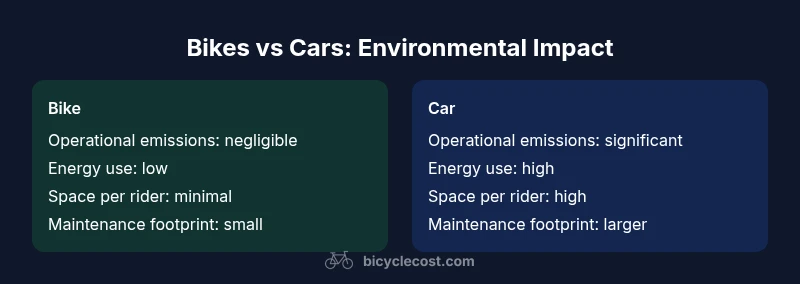
When evaluating emissions and energy, bicycles operate with minimal operational emissions compared with cars. Operationally, a bike produces near-zero emissions during use, while cars emit greenhouse gases and pollutants. Energy efficiency differs sharply: cycles convert human power plus efficient mechanical energy into movement with far less energy overhead per kilometer than internal combustion engines. Lifecycle energy costs for bikes tend to be concentrated in manufacturing and tire wear, whereas cars incur ongoing fuel energy plus maintenance and more substantial end-of-life impacts. BicycleCost research emphasizes that in dense urban networks, cycling yields outsized environmental benefits due to high trip-frequency, short distances, and the ability to replace short car trips. This combination reduces fossil fuel dependence and helps cities meet air-quality targets.
Lifecycle and manufacturing footprint
A bicycle’s production footprint is smaller and simpler than that of a car. Fewer materials, lighter components, and lower energy demands during manufacturing translate into lower cradle-to-grave energy use. Maintenance for bikes—such as tire replacements, brake adjustments, and drivetrain care—toses minimal energy and material inputs compared with motor vehicles, where every service can involve sizable parts, fluids, and energy. The end-of-life phase for bicycles generally involves recycling metals and plastics with relatively high recovery rates. These lifecycle realities contribute to bikes having a smaller aggregated environmental burden over time, particularly when riders adopt regular maintenance to extend component life. BicycleCost’s analysis highlights that even accounting for manufacturing and maintenance, bikes still present a substantially lower lifecycle footprint than cars.
Land use, space efficiency, and congestion
Urban land use and road space demand drive environmental costs beyond direct emissions. Cars impose heavier land-use and parking requirements, which leads to higher embodied energy in roads and parking infrastructure. Bikes, by contrast, require far less lane space and enable denser travel patterns per urban acre. This difference translates into lower material and energy investments for the same number of people moving through a city. Cycling also improves overall traffic efficiency by reducing congestion and creating more predictable flow. In practical terms, when more people bike, cities can repurpose vast car-centric spaces into greenways, bike corridors, and pedestrian zones, amplifying environmental and social benefits.
Cargo, range, and urban practicality
Cargo capacity and range are common questions when evaluating bikes versus cars. For many trips, a standard bicycle covers a useful urban radius with minimal energy consumption and zero tailpipe emissions. For families or shoppers, cargo bikes and pannier-equipped bikes provide viable alternatives to cars for groceries, school runs, and commuting. Range limitations are most relevant for long-distance trips and weather constraints; however, combining cycling with public transit or car sharing for occasional longer legs can preserve environmental gains while maintaining practical mobility. In short, in urban and peri-urban settings, bikes frequently deliver the right balance of energy efficiency and practicality.
Weather, safety, and rider behavior as modifiers of impact
Environmental benefits from biking can be moderated by weather, safety concerns, and rider habits. In harsh weather, ridership can decline, reducing potential environmental gains. Safety considerations—such as protected bike lanes and traffic-calming measures—significantly influence the magnitude of cycling’s impact, because more riders in safer environments tend to bike more frequently. Rider behavior, including tire choice, maintenance frequency, and route planning, further shapes the environmental footprint. The BicycleCost team notes that improvements in infrastructure, education, and gear can help sustain cycling’s environmental advantages year-round.
How to quantify your personal impact
To gauge your own environmental impact, start with a simple baseline: estimate daily trips that could be replaced by cycling. Track distance, frequency, and how often you substitute car trips. Consider maintenance costs and the embodied energy of bike parts over time. Use these inputs to model per-trip emissions reductions, recognizing that the bike’s footprint is dominated by manufacturing and end-of-life phases rather than fuel combustion. Practical tips include choosing lightweight components, maintaining tires for efficiency, and embracing multi-modal trips when appropriate. The goal is to maximize the share of daily distance covered by cycling to lift total environmental benefits.
Policy, cities, and incentives enabling greener mobility
Cities that encourage cycling tend to see larger environmental benefits from bike use. Policy levers like protected bike lanes, safe intersections, and bike-to-work subsidies can shift commuter behavior toward cycling, reducing car dependence and emissions. The environmental advantages of this shift are amplified when paired with safe, reliable transit options and integrated last-mile solutions. From a planning perspective, the environmental payoff comes not only from individual choices but from cohesive, prioritized investments in bicycle infrastructure, urban design, and incentives that lower barriers to entry for new riders.
Real-world data: urban examples and caveats
Cities implementing comprehensive cycling programs report recurring environmental wins: reduced local air pollution, lower road traffic energy use, and better urban livability. However, the magnitude of these gains depends on context—city size, climate, infrastructure, and cultural norms all shape outcomes. BicycleCost Analysis, 2026 cautions that while cycling generally lowers per-capita emissions, the net effect depends on how trips are reallocated, the availability of safe routes, and whether cycling replaces car trips rather than adding to total travel. This nuance matters for policymakers and residents aiming to maximize environmental benefits.
Authority sources
-
International and national energy and transportation authorities provide context for cycling’s environmental advantages. See EPA, Transportation Department, and World Resources Institute summaries for overview and policy implications.
-
For detailed data and methodology, consult the cited sources below and the companion infographic that contrasts bikes and cars across emissions, energy use, and space.
Practical steps for households and communities
- Start with a bike-friendly route audit: identify safe streets, protected lanes, and quiet connectors.
- Invest in basic maintenance and durable tires to maximize efficiency and longevity.
- Pair cycling with transit for longer trips, maintaining low-impact travel without sacrificing reach.
- Encourage workplace and school incentives to normalize cycling as a daily habit.
- Support local policies that expand bike network coverage and reduce car-dominant infrastructure.
The bottom line: a balanced view
While cars offer convenience for certain trips, the environmental case for bikes is strong in many contexts, especially urban and peri-urban regions. The BicycleCost team recommends prioritizing cycling for short and medium-range trips, while recognizing the value of multi-modal solutions for flexibility. Policy and infrastructure improvements can elevate cycling’s environmental benefits by making safe, reliable biking the easiest option for everyday travel.
Authority sources
- https://www.epa.gov/ghgemissions/sources-greenhouse-gas-emissions-transportation
- https://www.transportation.gov/mission/sustainability/biking-walking
- https://www.wri.org
Comparison
| Feature | Bike | Car |
|---|---|---|
| Emissions per kilometer (operational) | very low / none | high (tailpipe) |
| Energy use per kilometer | low (human-powered, efficient) | high (fuel-based) |
| Road space per rider | efficient, small footprint | |
| Maintenance impact | low energy, simple parts | |
| Cargo flexibility | good with panniers/cargo bikes | high with trunk/box options |
| Best for | urban commuting, short trips, health gains | long trips, cargo-intensive needs |
Pros
- Lower emissions and energy use overall
- Smaller land-use footprint per rider
- Less noise and air pollution in cities
- Supports physical health and local economies
- Lower long-term operating costs
Downsides
- Limited cargo capacity on many models
- Range and weather constraints in some contexts
- Requires safe infrastructure to maximize benefits
- Some trips still better served by other modes
Bikes generally offer a greener, more space-efficient option for urban travel, with cars remaining advantageous only for specific long-distance or cargo-heavy scenarios
For everyday urban commuting, the environmental case for bicycles is strong due to low operational emissions, reduced energy use, and efficient land use. Cars may be necessary for certain trips, but cycling should be the default whenever feasible to maximize environmental benefits.
People Also Ask
Do bikes really reduce emissions compared to cars in urban settings?
Yes. In urban settings, bikes produce near-zero operational emissions during use, while cars emit greenhouse gases and pollutants. Lifecycle emissions for bikes are far lower when accounting for manufacturing and end-of-life processing.
Yes. In cities, bikes emit almost nothing during riding, while cars emit pollutants that affect air quality and climate.
How does maintenance affect environmental impact?
Regular, simple maintenance (tire checks, chain lubrication, brake adjustments) keeps bikes efficient, which lowers energy use and extends component life. Car maintenance often involves more energy-intensive parts and fluids.
Maintenance matters a lot; well-kept bikes stay efficient and last longer.
Can bikes handle long commutes or cargo needs?
Bikes can handle long commutes with proper planning and, if needed, multi-modal trips. Cargo bikes and panniers expand carrying capacity, reducing the need for car trips in many urban contexts.
Yes, with the right bike and planning, long trips and cargo are doable.
What are common barriers to biking and how can they be overcome?
Barriers include weather, safety, and lack of infrastructure. Solutions include protected lanes, weather-appropriate gear, and community programs that promote cycling as a viable daily option.
Safe routes and gear make biking more feasible daily.
How can cities encourage more people to bike?
Cities can encourage biking through protected bike lanes, traffic-calming measures, secure bike parking, and incentives like subsidies or employer programs. These policies reduce barriers and shift travel behavior toward cycling.
Cities can make biking easier with protected lanes and incentives.
Is the environmental value of cycling affected by using e-bikes?
E-bikes can extend cycling’s reach, especially for hilly areas or longer commutes, still offering higher efficiency and lower emissions than cars for many trips. The net benefit depends on usage patterns and electricity sources.
Electric bikes help expand biking benefits where traditional bikes struggle.
Quick Summary
- Prioritize cycling for short urban trips to maximize environmental gains
- Invest in protected bike lanes and safe routes to boost adoption
- Adopt maintenance habits that maximize efficiency and lifespan
- Combine cycling with transit for longer trips to preserve low-impact travel
- Support policies that expand bike networks and reduce car dependence