Electric Bicycle vs Moped: A Practical Comparison
Compare electric bicycle vs moped: costs, regulations, range, safety, and maintenance to decide which urban ride fits your daily trips and budget.


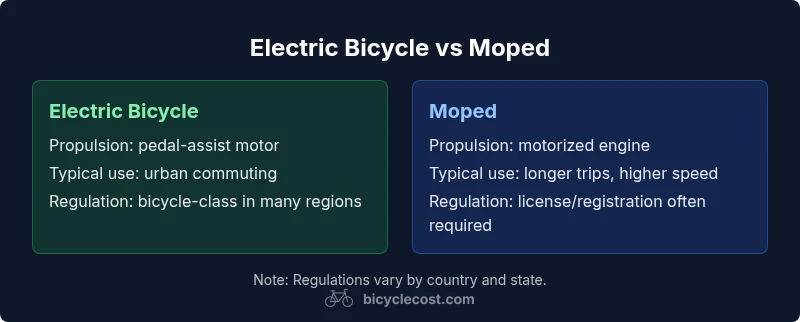
Electric bicycle vs moped: In most urban contexts, an electric bicycle offers practical daily use with lighter regulatory and maintenance demands, while a moped provides higher speeds and longer range for longer trips. Your choice should align with your typical routes, parking access, and local rules. Read on for a detailed, side-by-side comparison.
What is an electric bicycle vs a moped? Core distinctions in design, propulsion, and usage
According to BicycleCost, the choice between electric bicycle vs moped hinges on daily routines, local rules, and budget. Both options offer efficient mobility, but they serve different rider needs. In urban settings, an electric bicycle blends a bicycle frame with an integrated electric motor and pedal-assist sensors, letting riders power-assisted pedaling. A moped, by contrast, relies more on a motor and drivetrain with limited pedaling assistance in some models, and is often treated as a motorized vehicle for regulatory purposes. This overview sets up the core differences you should weigh before buying.
Regulatory landscapes and classification across regions
Regulatory classification shapes licensing, registration, and where you can ride. In many countries, electric bicycles are treated as bicycles if they rely on pedal-assist and stay within safe power and speed thresholds. Mopeds, however, are typically regulated as motorized vehicles, which means registration, insurance, and sometimes a license are required. The boundary between these categories varies by jurisdiction, and rules can change. Riders should verify local laws before purchasing, especially if the plan includes long trips, riding on highways, or transporting passengers. This confusion is common for new buyers seeking a simple urban solution.
Cost of ownership and lifecycle value
From a total-cost-of-ownership perspective, electric bicycles generally offer lower ongoing expenses for daily urban use, with costs concentrated in battery maintenance, tires, and routine service. BicycleCost analysis shows that over a multi-year horizon, e-bikes often outperform mopeds on daily commuting tasks due to cheaper energy, lower insurance needs, and simpler maintenance requirements. Mopeds tend to incur higher upfront costs and ongoing fuel or engine maintenance, as well as possible insurance premiums. The choice becomes a matter of balancing upfront investment against long-term reliability and usage patterns.
Real-world usage patterns: urban commuting, university campuses, and errands
Urban commuters frequently opt for electric bicycles to navigate crowded streets, avoid parking searches, and reduce emissions. Students on campuses value lightweight bikes that can be folded, carried on public transit, and stored in dorm rooms. Mopeds appeal to riders who need faster travel across longer distances or who regularly ride on mixed routes where a stronger engine reduces travel time. For many riders, the best choice is a hybrid approach: use an e-bike for daily errands and access to offices, and reserve a moped for weekend trips or occasional longer commutes.
Performance, range, and charging realities
Performance differences between electric bicycles and mopeds hinge on propulsion philosophy. Electric bicycles rely on pedal-assist or a throttle to supplement human power, which tends to produce smooth acceleration suitable for city riding but limits top speeds by design. Mopeds typically offer higher sustained speeds and greater acceleration, enabling faster travel in traffic or on longer routes. Range and charging depend on factors like battery size, assist level, terrain, and rider weight. In practice, most riders experience enough range for daily city trips on an e-bike, while mopeds deliver predictable, fuel-based range for longer excursions, provided you have access to fuel and service.
Safety, comfort, and ergonomics for daily riders
Ergonomics matter just as much as raw power. Electric bicycles often feature lighter frames, adjustable handlebars, and adjustable seat heights, which help riders achieve a comfortable position for weekly errands. The added weight of a moped may impact handling, especially at low speeds or on uneven surfaces, but many riders appreciate the more robust suspension and larger seating area for longer rides. Both options benefit from reliable brakes, proper lighting, reflective gear, and helmet use. The choice should reflect your confidence with weight, balance, and traffic dynamics.
Maintenance, parts availability, and service networks
Maintenance for e-bikes centers on battery health, brake wear, tire condition, and software updates for integrated systems. Battery lifespan depends on usage and charging habits, with replacement being a consideration after several years. Mopeds require routine engine maintenance, fuel system checks, and more frequent inspections if they are older or heavily used. Service networks for e-bikes have grown rapidly in many cities, whereas mopeds rely more on traditional auto or motorcycle services. Availability of spare parts varies by region, so a local supplier with a broad catalog is valuable.
A practical decision framework: a step-by-step checklist
- List your typical trips: length, terrain, and parking constraints.
- Check local rules for e-bikes and mopeds in your area.
- Compare upfront costs against long-term expenses like energy, insurance, and maintenance.
- Assess charging access, storage space, and potential for multi-modal commuting.
- Consider resale value and planned upgrades to battery or motor infrastructure.
- Try both options if possible and evaluate comfort, speed, and reliability in real-world conditions.
- Make a decision that aligns with your daily routine and budget, not just the latest trend.
Practical upgrades and accessories to consider
Even after choosing one option, you can tailor your ride with accessories that improve safety and convenience. For both e-bikes and mopeds, investing in high-quality lights, reflective gear, a sturdy rack, a reliable lock, and a comfortable seat can make daily commuting safer and more enjoyable. Battery care and proper charging practices extend life, while weather-appropriate tires and fenders help you ride year-round. The BicycleCost team recommends reviewing accessory options and planning upgrades that support longer-term reliability.
Comparison
| Feature | Electric bicycle | Moped |
|---|---|---|
| Top speed & regulatory class | Typically treated as bicycles in many regions; pedal-assist | Usually classed as motorized scooter/motorcycle; licensing may apply |
| Power source | Electric motor with pedal-assist or throttle | Gasoline or electric motor with larger battery (moped) |
| Licensing & registration | Often no license or registration; bike-like | Usually requires registration and license; insurance may be advised |
| Cost of ownership | Lower upfront costs on many models; battery & maintenance | Higher upfront costs; fuel/engine maintenance and insurance |
| Maintenance needs | Battery care, brakes, tires, and software updates | Engine, fuel system, tires, brakes; potential higher maintenance |
| Typical range | Depends on battery; urban-range for daily trips | Fuel-based range depends on tank; longer excursions possible |
| Best for | Urban commuting, eco-friendly trips | Longer trips, higher speed needs, road trips |
Pros
- Lower upfront costs on many electric bicycle models
- Quieter operation and emissions-free riding in cities
- Less regulatory burden in many regions for daily use
- Health benefits from pedaling on certain models
- Compact and versatile designs for storage
Downsides
- Battery range can constrain longer trips or high-speed rides
- Regulatory changes could affect operating rules
- Higher upfront costs for high-performance mopeds
- Battery replacement costs after several years
Electric bicycles win for everyday urban use; mopeds win for higher-speed, longer trips
Choose an electric bicycle if you prioritize daily practicality, low operating costs, and easier handling. Opt for a moped if your needs include faster travel and extended range, provided you can meet licensing and insurance requirements.
People Also Ask
What is the core difference between an electric bicycle and a moped?
The core difference lies in propulsion and regulation. An electric bicycle typically relies on pedal-assist or a small throttle and is treated as a bicycle in many places, while a moped uses a motorized drive and is often regulated as a motor vehicle requiring registration and possibly a license.
Electric bicycles are usually pedal-assisted or slow-speed motor bikes treated like bicycles; mopeds are motor vehicles requiring registration in many places.
Do you need a license or registration to ride an electric bicycle?
In many jurisdictions, electric bicycles do not require a license or registration if they meet pedal-assist or low-speed criteria. Mopeds typically require registration and possibly a driver’s license, insurance, and taxes depending on local rules.
Most places treat e-bikes like bicycles, but mopeds often need registration and a license.
Are electric bicycles allowed on bike paths or trails?
Bike path permissions vary by location. Many regions permit pedal-assist e-bikes on bike paths, while some trails ban motorized bicycles entirely or restrict them to certain classes. Always check local signage and regulations before riding.
Check local rules—e-bikes are sometimes allowed on bike paths, but not everywhere.
Which is safer for beginners, an electric bicycle or a moped?
Safety depends on speed, weight, and rider comfort. E-bikes are generally easier to handle at urban speeds and encourage pedaling, which can improve balance. Mopeds offer higher speed but require more confidence and proper protective gear.
E-bikes are usually easier for beginners at city speeds; mopeds demand more riding experience.
How should I assess total ownership costs when choosing between them?
Consider upfront price, ongoing energy or fuel costs, insurance, maintenance, and potential licensing. Over several years, e-bikes often win on energy and maintenance, while mopeds may provide longer range if you frequently travel longer distances.
Look at upfront costs, energy or fuel, insurance, and maintenance to compare overall ownership.
Quick Summary
- Define your typical trips to guide the choice
- E-bikes excel in city commuting and low maintenance
- Mopeds offer higher speed and longer range with more rules
- Budget for licensing, insurance, and maintenance when comparing costs
- Plan for charging access and storage suitability