Touring Bicycle vs Road Bike: Which Is Right for You in 2026
Compare touring bicycle vs road bike to understand geometry, luggage options, comfort, and long-term value. This guide highlights use cases, gear setups, and budgeting to help you pick the right bike for your 2026 rides.


Touring bicycles prioritize cargo capacity and stable handling for long trips, while road bikes emphasize light weight and speed on pavement. If you regularly carry gear or travel distant routes, touring is the safer, more versatile choice. For fast, efficient riding over smooth roads, a road bike delivers performance. This comparison breaks down geometry, luggage options, and budget to help you decide.
Overview and Use Cases
The decision between a touring bicycle and a road bike hinges on how you plan to ride most of the time. Touring bicycles are purpose-built for multi-day trips, bike packing, and routes that include luggage, rough pavement, and mixed surfaces. They favor stability, comfort, and durability. Road bikes, in contrast, are engineered for speed, efficiency, and precision on smooth tarmac. They excel in tempo rides, sportives, and daily commutes where weight and aerodynamics matter. According to BicycleCost, touring bikes are typically chosen by riders who value long-haul comfort and the ability to mount racks and panniers, while road bikes attract riders chasing lighter frames and quicker accelerations. In 2026 the market reflects this divide, with many models offering hybrid capabilities for mixed surfaces. The bottom line is simple: choose the platform that best aligns with your typical routes, load, and riding goals. Consider how often you’ll carry luggage, the terrain you’ll encounter, and how important speed is to you. This section explores those dimensions so you can map your ideal setup to real-world riding.
- Typical riders: long-distance travelers, bike campers, weekend adventurers, daily commuters who occasionally travel with gear.
- Common surfaces: paved roads, gravel, light dirt paths, and mixed-tinish terrain.
- 2026 context: more models bridge the gap between road efficiency and touring practicality, but the core tradeoffs remain constant.
The BicycleCost team emphasizes that the right bicycle will feel natural on your regular routes and gear load, reducing fatigue and increasing confidence. When you frame the decision around purpose and predictability, the choice becomes clearer and more repeatable.
boldedSectionsIds":null}
Geometry, Riding Position, and Handling
Geometry is the most visible differentiator between touring bicycles and road bikes. Road bikes generally feature a steeper head angle, longer effective top tube, and a more aggressive riding position optimized for aerodynamics and sprinting. This translates to quicker responsiveness on smooth asphalt but can feel twitchy or unsteady when loaded with heavy panniers. Touring bicycles, by contrast, prioritize a longer wheelbase, lower bottom bracket, and a more relaxed geometry that enhances stability when carrying loads. The tradeoff is a little extra effort required to change pace or maneuver in tight spaces. In practical terms, a touring frame provides predictable handling when fully loaded, especially at slower speeds, while a road frame rewards riders who maintain higher speeds and precise steering. Across 2026 models, manufacturers continue to refine geometry to balance load stability with ride quality, including slacker seat-tube angles and better fork geometry to reduce fatigue on long days in the saddle.
- Wheelbase: longer on touring for stability; shorter on road for nimble handling.
- Head angle: gentler on touring to dampen steering under load; sharper on road to maximize response.
- Fit considerations: touring bikes often accommodate taller head-tipe angles to keep weight off the rider’s hands; road bikes emphasize compact reach and aggressive torso angle.
Choosing between the two often comes down to how much weight you expect to carry and how steady you want the ride to feel when you’re cruising at 12–20 mph with gear in tow. When you anticipate frequent loading and long hours in the saddle, stability tends to trump a razor-thin response. When speed and efficiency are your north star, a lighter, more compact geometry matters more.
According to BicycleCost, riders who prioritize comfort and predictable handling for load-bearing trips consistently rate touring geometry higher for long days in the saddle, while those chasing tempo performance favor road geometry. These general tendencies help narrow your decision before you even test-ride.
sectionIdInDoc":null}
Cargo Capacity and Load Carrying
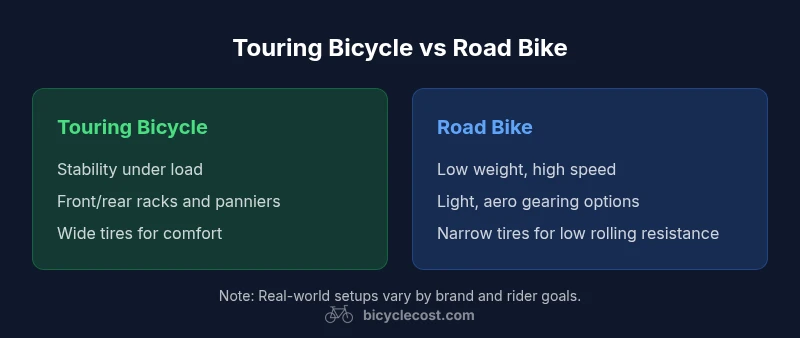
For touring bicycles, cargo capacity is a core feature rather than an afterthought. Most touring frames are designed to accept sturdy racks on the rear and sometimes the front, plus multiple bottle cages and generous fork and down-tube clearances. Pannier compatibility is not optional—it’s the backbone of a successful touring setup. Road bikes, conversely, minimize or even omit rack mounts to reduce weight and complexity, focusing on clean lines and reduced drag. If luggage handling is part of your typical ride, a touring platform is naturally forgiving, offering easy access to gear and a stable center of gravity under load.
Practical considerations include rack compatibility with your frame, the ability to run wider tires for comfort and puncture protection, and the availability of robust fenders for wet climates. The best touring bikes provide integrated mounts, resilient pannier eyelets, and reinforced stays that can handle several kilograms per side without compromising ride quality. Road bikes can be adapted with after-market racks, but the added weight and potential frame stress reduce efficiency and may negate some performance gains.
- Luggage strategy: panniers, rear racks, and front racks for balanced weight distribution.
- Tire clearance: wider tires improve comfort and stability with loads.
- Frame acceptance: look for proven rack mounts and reinforced dropouts.
For riders who regularly combine cycling with travel, touring configurations offer dependable load capacity and predictable handling, while road setups excel when the priority is speed and minimal weight. As you plan, consider how many days you expect to ride with gear and whether you want to maintain a purely road-oriented stance or an adaptable, adventure-ready platform.
sectionIdInDoc":null}
Comfort, Ride Quality, and Tire Choice
Ride comfort emerges as a major differentiator once you factor in weight and luggage. Touring bikes are typically equipped to ride with wider tires and often feature more compliant geometry, which smooths out vibrations and reduces fatigue over long distances. Wider tires also allow lower tire pressures, increasing impact absorption on rough pavement and gravel surfaces. Road bikes, aiming for efficiency, rely on narrower tires and higher pressures to minimize rolling resistance. The result is a brisk, responsive feel on smooth roads but a stiffer ride when surfaces deteriorate or you carry a load. Across 2026 models, tire width has become a more flexible choice on both platforms—there are road bikes that tolerate 28–32 mm tires and touring bikes that stay well within 35–40 mm for improved comfort on mixed surfaces.
Saddle design, contact point setup, and bar geometry contribute just as much to comfort as tire choice. Touring riders often favor a cockpit that reduces wrist and back strain, with more upright seating options. Road riders opt for a more aggressive posture when the road demands tempo and pace. If you anticipate extended days in the saddle, prioritize cockpit reach, bar height, and a seat with proven comfort for long hours.
- Comfort targets: stability under load vs. forward-leaning speed posture.
- Tires: wider for touring; narrower for road, with pressure tuned to terrain.
- Saddles and bars: fit matters as much as frame geometry.
The result is a trade-off: touring bikes provide all-day comfort and predictable handling; road bikes deliver sharper acceleration and efficiency on clean pavement. The right choice lies in your typical terrain, load, and comfort preferences.
According to BicycleCost, the comfort advantage of touring setups is most evident on longer routes when fatigue becomes a factor, reinforcing the case for a purpose-built platform when endurance is your goal.
sectionIdInDoc":null}
Components, Durability, and Maintenance Needs
Maintenance realities help many riders decide between touring and road machines. Touring bicycles often use components selected for durability and compatibility with a wide range of accessories. They tend to use dependable drivetrains and robust braking systems that tolerate heavier use and occasional mud or rain. The upside is easier, more affordable maintenance in the field and widely available replacement parts at local shops. Road bikes are designed to maximize efficiency and braking performance, frequently featuring lighter components and precision shifting. This can mean faster wear under heavy touring loads or in harsh conditions, but it also offers superior performance for riders prioritizing weight and speed.
Component choices influence service intervals and upgrade paths. Touring setups may lean toward more robust rims, thicker tires, and heavy-duty racks, which can be standardized across brands, reducing maintenance complexity. Road bikes often rely on high-precision components that reward careful tuning but can be pricier to replace. If you foresee a mix of commuting and weekend touring, you’ll benefit from a modular approach that lets you swap parts between the two setups with minimal downtime.
- Drivetrain: wide gear ranges and robust components on touring bikes; compact, high-precision groups on road bikes.
- Brakes: disc brakes are common on both platforms, but road bikes may use lighter, higher-friction options for performance gains.
- Field maintenance: touring gear emphasizes availability and ease of repair; road gear emphasizes efficiency and fine-tuning.
Maintenance strategy matters more than brand name. A touring bike that’s easy to service and compatible with common parts reduces downtime and increases ride confidence on longer trips. Road bikes reward you with performance upgrades, provided you’re prepared for the higher replacement cost and the need for careful setup. BicycleCost’s 2026 guidance highlights that practical maintenance planning often determines long-term satisfaction more than initial buy-in price.
sectionIdInDoc":null}
Weight, Efficiency, and Real-World Performance on Pavement
Weight is a frequent talking point in any touring vs road discussion, but the full story includes aerodynamics, rolling resistance, and gearing ranges. Touring bicycles tend to be heavier due to racks, reinforced stays, and broader tire clearance to handle luggage. The extra mass can reduce acceleration and efficiency in flat terrain, but the added momentum can help on long climbs where momentum carries you forward. Road bikes are lighter and designed to minimize energy loss, translating to quicker accelerations and more efficient climbs when unloaded. On smooth pavement, the weight difference is a measurable factor, yet riders often enjoy the advantage of a lower center of gravity and better stability on touring bikes when fully loaded. The key is to match your weight budget with your riding goals and the surfaces you expect to encounter most.
Rolling resistance drops with wider tires up to a point, but aerodynamics can flip the balance. A touring bike’s relaxed geometry can improve stability at lower speeds, which matters when you’re pedaling with loads. Road bikes benefit from high-speed efficiency, especially on long distances without heavy gear. In 2026, trends show that many riders zoom between both worlds with versatile frame geometries and wider-tire options that do not sacrifice too much performance. When evaluating weight and efficiency, consider how much load you’ll carry, the terrain, and your typical ride cadence.
- Heavier weight on touring bikes can be offset by better load management and longer hours spent in the saddle.
- Road bikes win on acceleration and sprinting when not loaded.
- Tire choice dramatically influences real-world efficiency for both platforms.
The end result is a nuanced picture: weight is important, but ride quality, load handling, and wheel/tire choices often dictate which bike truly performs best for you. As BicycleCost notes, performance is context-dependent, and the best choice is the bike that best fits your everyday routes and comfort thresholds.
sectionIdInDoc":null}
When to Choose Touring vs Road: Decision Factors and Scenarios
Choosing between a touring bicycle and a road bike hinges on scenario-based reasoning. If you plan extended trips with luggage, you’ll want a platform that prioritizes stability, cargo capacity, and comfort for many hours in the saddle. Touring bikes excel in this role, with racks, multiple bottle mounts, and geometry that tolerates heavier payloads. If your rides center on speed, efficiency, and weekend group rides on paved roads, a road bike is generally the better starting point. They’re lighter, with geometry optimized for quick accelerations, precise handling at speed, and compatibility with efficient tire and gear configurations.
Consider eight practical questions to guide your decision:
- How often will you carry luggage or panniers? 2) What surfaces will you ride most—highway, gravel, or mixed? 3) How important is weight versus comfort? 4) Do you want a frame that’s easy to upgrade with racks and fenders? 5) What’s your budget for both initial purchase and future upgrades? 6) Do you ride in wet climates that demand fenders and rugged tires? 7) How important are ride feel and fatigue management after long days? 8) Will you use the bike for multi-day tours or mainly daily commutes?
BicycleCost’s 2026 analysis suggests you can often find a “best of both” approach by choosing a touring-inspired platform with options to shed weight or add aero-attributes, or by selecting a road-oriented frame with robust rack mounts and broader tires. The decision should reflect your typical route profile, packing needs, and long-term goals. Finally, a test ride that includes luggage—real-world weight—will reveal how each platform handles, brakes, and stabilizes under load.
- Best for touring with gear: Touring bicycle with racks and wide tires.
- Best for speed on paved roads: Road bike with light components and aerodynamic positioning.
- Hybrid pathways exist: gravel bikes or “adventure” bikes offer compromises for mixed terrains.
The bottom line: pick the one that optimizes reliability and comfort on your regular routes; you’ll ride more and enjoy it more. In 2026, choosing with a clear plan remains the most reliable route to satisfaction.
sectionIdInDoc":null}
Sizing, Fit, and Practical Setup for Long-Term Comfort
Fit is non-negotiable when comparing touring and road bikes. A proper fit reduces fatigue, prevents injury, and ensures efficient power transfer. Because touring riders often carry extra weight, seat height, saddle choice, and handlebar reach should account for the added load. Touring frames typically provide generous standover clearance and a slightly taller head-tube for a more upright posture, which can reduce wrist and back strain during long days. Road bikes, on the other hand, emphasize a more compact, forward-leaning position that improves pedaling efficiency and aero performance. Sizing both types starts with careful measurements of inseam, reach, stack, and torso length, then confirming that the chosen model supports comfortable saddle and grip positions under your anticipated load.
- Front-end: ensure bar height and stem length give you a stable front end under load.
- Saddle: choose a model known for long-distance comfort, with cushioning or contour that fits your sit bones.
- Load testing: test with pannier weight and typical luggage to check for clearances and ride feel.
Practical tips to test fit include bringing a realistic setup to a shop test ride, wearing your usual riding gear, and evaluating hand numbness or lower-back fatigue after 20–30 minutes of pedal work. If you plan serious touring, consider a bike fit session to optimize geometry for your unique biomechanics and payload. In 2026, fit services are widely available and often crucial for riders shifting between platforms.
- Take measurements at the shop with actual gear mounted.
- Ensure adequate clearance for racks, fenders, and tires.
- Prioritize comfort over vanity geometry when long rides are the goal.
The right fit makes an enormous difference in long-term enjoyment, especially when traveling with gear. Brand-backed guidance from BicycleCost emphasizes testing setups under load to avoid surprises on day one of a multi-day trip.
sectionIdInDoc":null}
Budgeting, Long-Term Value and Total Cost of Ownership
Bicycle budgeting for touring vs road riding involves more than sticker price. Touring bikes typically cost more upfront due to heavier frames, robust racks, wider tires, and durable components designed for extended use. However, the total cost of ownership can be favorable over the long term if you value modular upgrades, reliable parts availability, and better payload handling. Road bikes often start with a lower initial price but can incur higher upgrade costs if you want to approach touring practicality, including racks, wider tires, and compatible components. The practical takeaway is to estimate initial purchase price, anticipated upgrade costs, and the frequency of maintenance when you plan to ride with gear regularly.
To make a sound financial choice, map your typical annual mileage, the kinds of routes you’ll ride, and the probability of needing luggage. If you foresee frequent travel or multi-day trips, invest in a touring setup with durable racks and wide tire options. If most miles are fast-paced and on smooth roads, a road bike with lightweight components and a sensible wheelset can be a wise choice. In 2026, many riders find a balanced path by selecting a capable road bike with touring-ready accessories rather than a full touring build. This approach preserves performance while maintaining versatility as your riding goals evolve.
- Upfront cost vs. upgrade trajectory: touring bikes tend to cost more at purchase but can save on future upgrades.
- Maintenance signals: expect more frequent checks on cables, rims, and disc brakes for touring setups.
- Resale value: well-maintained touring or road bikes hold value well if you document maintenance and keep original components.
The budgeting framework from BicycleCost emphasizes a realistic plan that aligns a bike with your most common trips and anticipated gear needs, rather than chasing the latest feature set. A thoughtful, staged investment yields the best long-term payoff for most riders.
sectionIdInDoc":null
Comparison
| Feature | Touring bicycle | Road bike |
|---|---|---|
| Geometry and Riding Style | Longer wheelbase, relaxed geometry for stability under load | Shorter wheelbase, steeper angles for quick handling and speed |
| Weight | Heavier due to racks, wider tires, and reinforced stays | Lighter frames and components optimized for efficiency |
| Load Carrying Capacity | Rack mounts and pannier compatibility for multi-day trips | Limited luggage support; optimized for weight reduction |
| Tire Clearance | Wide tires (likely 28–40 mm) with puncture protection | Narrower tires (23–28 mm) for reduced rolling resistance |
| Gearing | Wide range with low gears suitable for heavy loads | Compact gearing oriented to maintain high speeds on flats/climbs |
| Durability and Maintenance | Built for durability with broad compatibility; easier field repairs | Lightweight parts with high precision; maintenance focused on performance |
| Best For | Bikepacking, long tours, mixed surfaces, and camping gear | Speed-focused riding on paved roads, group rides, and events |
| Price Range | $1200-$4000+ (complete touring setup) | $800-$2500 (road builds; varies by components) |
Pros
- Enhanced load carrying and luggage options for touring
- Improved comfort and stability on long rides with gear
- Versatility to handle mixed surfaces with appropriate tires
- Road bikes offer superior speed and efficiency when unloaded
Downsides
- Touring setups are generally heavier and slower to accelerate when loaded
- Road bikes can struggle with heavy payloads and long days in the saddle
- Upfront costs can be higher for versatile touring gear and racks
Touring bike is best for regular luggage and long-distance comfort; road bike excels in speed and efficiency on paved roads.
Choose touring if you plan to travel with gear and prioritize stability. Choose road if your priority is fast, efficient riding with minimal weight. The best choice depends on your typical routes and gear needs; in 2026, many riders opt for a capable road bike with touring-ready accessories to balance both worlds.
People Also Ask
What is the main difference between a touring bicycle and a road bike?
The primary difference is purpose: touring bikes are built for stability, load-carrying, and comfort on long trips, while road bikes optimize weight, aerodynamics, and speed on paved surfaces. Differences in geometry and accessories reflect these goals.
Touring bikes focus on stability and carrying capacity; road bikes focus on speed and efficiency.
Can I convert a road bike into a touring bike?
Yes, you can convert a road bike to be more touring-friendly by adding racks, wider tires, and compatible fender mounts. Some frame choices also influence weight distribution and load handling, so it’s wise to verify frame compatibility before purchasing.
You can add racks and wider tires to a road bike, but check frame compatibility first.
Are touring bikes slower than road bikes in real-world riding?
In most cases, touring bikes are slower when ridden unloaded because of weight and aerodynamics. When carrying luggage, the stability and comfort of a touring bike can translate into more efficient long-distance riding, depending on terrain and rider fitness.
Touring bikes are usually slower when unloaded but can be more efficient over long distances with gear.
What tires and gearing should I look for on touring vs road bikes?
Touring bikes typically use wider tires (28–40 mm) for comfort and stability with lower gears to handle heavy loads. Road bikes favor narrower tires (23–28 mm) with higher gearing for speed and efficiency on flat to rolling terrain.
Touring needs wide tires and low gears; road bikes use narrow tires and higher gears for speed.
What safety considerations matter when carrying loads?
Key considerations include weight distribution, secure rack attachment, proper pannier mounting, and maintaining braking performance under load. Regularly inspect racks and frame mounts, and avoid overloading beyond manufacturer limits.
Balance the load and ensure racks are secure; check brakes when carrying heavy gear.
Quick Summary
- Define your typical routes and luggage needs
- Prioritize frame geometry that matches riding goals
- Factor weight, durability, and maintenance into budgeting
- Consider future upgrades and resale value
- Test ride with real luggage loads to validate comfort and handling