Is Bike Better or Car? A Practical Side-by-Side Guide
A detailed, objective comparison of biking versus driving, covering costs, safety, environmental impact, practicality, and when each makes sense for urban and rural life.


Ultimately, whether a bike is better than a car depends on your context, priorities, and local infrastructure. For short urban commutes, a bicycle typically lowers total costs, saves time in traffic, and reduces emissions. A car, by contrast, offers weather protection, cargo capacity, and consistent reliability for longer trips or group travel.
The Core Question: is bike better or car?
The central question guiding this analysis is is bike better or car for everyday transportation. This section frames the decision through four lenses: cost, convenience, safety, and environmental impact. According to BicycleCost, the answer is highly contextual and depends on your typical trips, geography, and access to safe routes. The BicycleCost team found that the biggest drivers are trip distance, urban density, parking availability, and the value you place on daily physical activity. The goal here is to illuminate trade-offs rather than declare a universal winner. By mapping your common errands, weather patterns, and storage options, you’ll see why bikes and cars excel in different scenarios. The discussion also sits within a broader conversation about sustainable mobility and personal lifestyle choices.
Economic Realities: The True Cost of Each Choice
Cost is often the first hurdle in the bike-vs-car debate. A bicycle generally carries a fraction of the total ownership cost of a car, especially when you factor in fuel, insurance, maintenance, and depreciation. However, costs can swing with usage: a high-mileage rider may spend more on tires and components over time than a low-mileage driver pays for routine car maintenance. BicycleCost analysis emphasizes the importance of total cost of ownership, not just sticker price. In practical terms, bikes require less upfront investment and cheap upkeep, while cars demand ongoing fuel and insurance outlays. Context matters: in dense cities with good cycling infrastructure, the economic case for a bike is particularly strong. In rural or long-travel contexts, a car may be more cost-effective overall due to range, comfort, and weather resilience.
Environmental Footprint: Emissions, Air Quality, and City Living
Environmental impact is a major consideration in the bike vs car decision. Bicycles produce negligible tailpipe emissions and occupy far less space in congested urban cores. This translates into better air quality and more efficient use of public space. Cars contribute to greenhouse gas emissions, oil dependence, and traffic congestion, especially where infrastructure is inadequate. The BicycleCost mindset emphasizes lifecycle thinking: not just miles traveled, but fuel use, maintenance materials, and end-of-life disposal. In practice, switching from car to bike for many daily trips can meaningfully reduce urban pollution and climate impact, particularly when paired with improved transit, bike lanes, and safe storage.
Health, Safety, and Personal Well-Being
Physical activity is a key differentiator between bikes and cars. Regular cycling improves cardiovascular health, endurance, and overall fitness. On the other hand, car travel minimizes physical exertion but can reduce incidental activity. Safety considerations shift with mode: cars offer substantial occupant protection but create exposure for cyclists in mixed traffic. Safe routes, helmet use, and visibility gear dramatically influence risk for bike riders. The intent is not to glorify risk but to acknowledge that infrastructure, driver behavior, and rider preparation shape outcomes. In this light, the bike option can be safer with proper lanes, signals, and awareness practices.
Practicality, Use-Cases, and Daily Routines
Not all trips are equal. Short urban commutes, last-mile errands, and weekend rides are often well-suited to bikes. For families, shopping with groceries, or trips with luggage, cars provide cargo capacity and seating. The reality is that many households utilize both modes to cover different needs: bikes for routine, local travel; cars for longer journeys or weather-protected trips. This section highlights decision factors like trip distance, weather, group travel, parking availability, and the existence of safe cycling infrastructure. The key insight is to align mode choice with the specific trip profile rather than default to one option for all scenarios.
Infrastructure, Urban Form, and Accessibility
Infrastructure dictates feasibility. In cities with extensive bike networks, protected lanes, and secure parking, cycling becomes a practical default for many commuters. In places with sparse cycling infrastructure, inconsistent climate control, or long distances, cars remain indispensable. Accessibility includes not just roads but storage, shower facilities, and safe commuting routes. The Bike-First approach works best when the built environment supports predictable and safe trips. Where gaps exist, households can adopt a multimodal strategy, combining bike trips with transit, ridesharing, or occasional car use.
Time, Convenience, and Travel Time Variability
Time is a decisive factor for many decision-makers. Biking can outperform cars in dense urban centers during peak hours due to congestion relief and easier parking. However, travel time for a bike is sensitive to distance, topography, and weather. Cars offer speed and reliability on longer routes and adverse weather, though traffic conditions and parking constraints may erode those advantages. This section emphasizes mapping typical trip distances, identifying peak-period dynamics, and testing travel options in real-world conditions to gauge whether time advantages favor biking, driving, or a hybrid approach.
Long-Term Costs, Depreciation, and Asset Longevity
Ownership costs extend beyond monthly expenses. Bicycles depreciate less rapidly than cars relative to mileage but require timely replacement of consumables like tires, chains, and brakes. Cars incur higher depreciation, ongoing maintenance, insurance, taxes, and registration costs. Understanding these dynamics helps answer is bike better or car by focusing on lifetime cost and value. The choice often hinges on how long you plan to keep the asset, how intensively you ride, and whether you’re comfortable with maintenance demands. This perspective encourages conservative budgeting for the lifecycle of either option.
Hybrid Scenarios: When a Bike Complements a Car
A mixed approach can deliver the best of both worlds. People often use bikes for daily commutes and errands near home, then rely on a car for weekend trips, family outings, or lengthy journeys where cargo or weather becomes a constraint. Public transit, car-sharing, or ridesharing services can fill gaps between biking and driving. The hybrid strategy reduces environmental impact while preserving flexibility and resilience. The key is to design a transport pattern aligned with your routines, climate, and available infrastructure.
Decision Framework: How to Choose in 7 Practical Steps
- Inventory your typical trips by distance, purpose, and weather tolerance. 2) Estimate true ownership costs for each mode, including insurance, maintenance, and depreciation. 3) Assess access to safe routes, parking, and storage. 4) Consider health goals and fitness preferences. 5) Test both options over a representative period. 6) Evaluate multi-modal possibilities that fit your lifestyle. 7) Make a plan that prioritizes flexibility, safety, and cost efficiency. This framework keeps the focus on practical decision-making rather than abstract ideals.
Common Misconceptions Debunked
Myth 1: Bikes are only for young people. Fact: Cycling benefits people of all ages when safety gear and appropriate routes are available. Myth 2: Cars are always safer. Fact: Safety depends on environment, training, and infrastructure; bikes can be very safe in well-designed networks. Myth 3: More expensive vehicles prove better quality. Fact: Value comes from how effectively you meet your needs within your budget and usage patterns.
Comparison
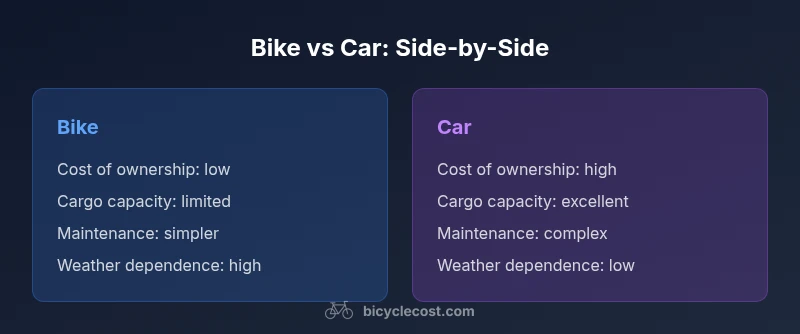
| Feature | Bike | Car |
|---|---|---|
| Cost of ownership | Low ongoing costs | Higher upfront and ongoing costs |
| Cargo capacity | Limited to small items or bags | Full cargo space for people and goods |
| Weather resilience | Limited in poor weather | Protected in all weather |
| Maintenance simplicity | Fewer parts; simpler maintenance | More complex; engine components and fuel system |
| Traffic efficiency | Often faster in dense urban lanes | Travel speed depends on traffic and parking |
| Space & parking | Requires bike parking; easy to store | Garage or driveway parking required |
| Health impact | Adds daily physical activity | Passive transport; no inherent activity |
| Safety considerations | Vulnerable in traffic; helmet essential | Vehicle safety systems; protected occupants |
Pros
- Low ongoing costs and fuel savings
- Promotes daily physical activity and fitness
- Easy parking and storage in dense areas
- Smaller environmental footprint for short trips
Downsides
- Weather and climate can limit use
- Limited range and cargo capacity
- Safety risk without proper infrastructure
- Requires commitment to maintenance for bikes
Bike often wins for urban, short trips; car wins for longer trips or family needs
In dense cities with good cycling infrastructure, biking offers cost and health benefits with adequate safety measures. For longer distances, cargo needs, or adverse weather, a car remains superior. A hybrid approach frequently provides the best balance.
People Also Ask
What are the main cost differences between owning a bike versus a car?
Bikes generally incur lower upfront costs and cheaper ongoing maintenance, while cars bring higher fuel, insurance, and maintenance expenses. Your savings depend on usage, distance, and local pricing for services and parts.
Bikes cost less to own and operate, while cars cost more due to fuel and insurance. Your actual savings depend on how you use them.
Is biking practical for long commutes?
Biking can be practical for longer commutes with planning, appropriate routes, and weather contingency plans. It may require gear, changing facilities, and safe, well-lit paths.
Long bike commutes are doable with planning and the right infrastructure, but they demand preparation.
Which is safer: bike or car?
Safety depends on infrastructure and behavior. Cars offer protected occupants, while bikes rely on helmets, visibility, and dedicated lanes to reduce risk.
Safety depends on where you ride; use proper gear and ride in safe lanes.
Can I use both bike and car efficiently?
Yes. Many households leverage bikes for everyday local trips and cars for long-distance or cargo-heavy needs, often supported by transit or ridesharing for flexibility.
Using both can give you the best balance of cost, health, and reach.
What should I consider about weather?
Weather heavily influences biking practicality. Rain, snow, and heat affect comfort, safety gear needs, and route reliability.
Weather really changes biking viability; plan with gear and alternatives.
How do I evaluate the best choice?
List trip profiles, estimate total costs, test both modes, and consider multi-modal options. Reassess as your routines change.
Start with your needs, test both modes, and compare total costs.
What about parking and storage?
Bikes are typically easier to park and store; cars require garage space or parking facilities in urban areas.
Storing a bike is usually easier than finding car parking.
Do bikes require insurance?
Bike insurance is optional in many places and mainly covers theft or damage; some riders value it for peace of mind.
Bike insurance is often optional but worth considering in high-theft areas.
Quick Summary
- Define your typical trips before choosing
- Calculate total cost of ownership for both modes
- Evaluate local infrastructure and storage options
- Consider a hybrid, multimodal approach
- Test both options in real use