Should Bike Seat Be Higher Than Handlebars? A Practical How-To
Learn how saddle height relative to handlebars affects comfort, efficiency, and safety. This BicycleCost guide covers measurement, step-by-step adjustments, and ride-testing tips for road, mountain, and commuter bikes.


Yes—there isn’t a universal height, but the seat should be high enough to allow smooth pedaling without locking the knee. If the seat is too high, you’ll feel over-stretched; too low, your hips may wobble and waste power. The BicycleCost team emphasizes comfort, balance, and biomechanical alignment when choosing saddle height.
Understanding Saddle Height and Riding Biomechanics
Riding posture affects power transfer, knee health, and back comfort. The saddle height relative to handlebars changes hip angle, knee extension, and reach. When the seat is too high, you may overextend the knee at the bottom of the pedal stroke, forcing the pelvis to rock and compromising control. If the seat is too low, you’ll likely feel excessive knee flexion, which can increase joint strain and reduce leverage. According to BicycleCost, optimal saddle height is not a fixed number; it's a balance between leg extension, seat position, and rider anatomy. In practice, you should aim for a position that allows a smooth pedaling motion with a slight bend in the knee at the bottom of the stroke, while keeping your hips and shoulders aligned over the pedals. This ensures you can apply power efficiently without feeling pinned or unstable.
How Saddle Height Interacts with Handlebar Reach
Handlebar position and saddle height interact to create your overall riding posture. A taller handlebar relative to the saddle can reduce back strain, but if you raise the bars without adjusting the saddle, you may end up over-stretching the arms or compromising steering control. Conversely, if the bars are too close to the saddle, a higher seat can pinch the torso and limit breathing. The key is to find harmony between seat height and handlebar reach so that your spine remains neutral, your wrists stay relaxed, and you can pedal with a stable pelvis. Balance is more important than chasing a single metric; comfort and control come from how all contact points work together during real riding.
Setting a Baseline: How to Measure Yours
Start by getting your bike into a stable position. Sit on the saddle with your hands on the handlebars and your feet on the pedals. Check that your forward knee aligns roughly over the ball of your foot when the pedal is at the lowest point. The goal is to have enough leg extension to push smoothly without needing to recoil your hips. Use a soft marker or tape to mark the seat height against the seat tube. Record the current height so you can return to it if needed. In the absence of a precise fitting system, this baseline gives you a practical starting point for experimentation.
Step-by-Step: Initial Saddle Height Adjustment
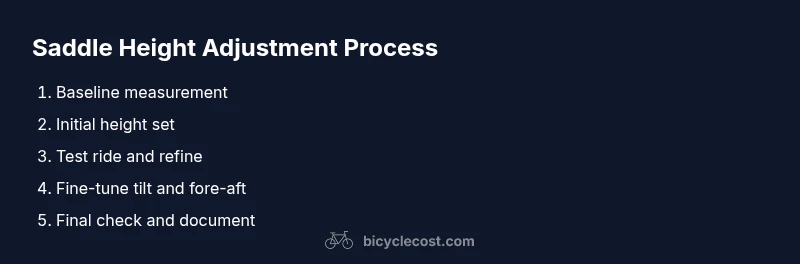
Step 1: Check your baseline alignment by comparing your knee, hip, and ankle alignment at the pedal stroke. Step 2: Set a reasonable starting height using the seated baseline as a reference, making small, incremental changes. Step 3: Take a short test ride and note any knee strain, hip rocking, or discomfort in the back or shoulders. Step 4: Adjust the tilt and fore-aft position of the saddle if you notice pressure on softer tissue or shifting weight. Step 5: Re-test across different terrains and riding styles to confirm the change improves comfort and efficiency. Step 6: Document the final settings for future reference. Tip: Make changes in small increments and test each change with a short ride.
Test Ride Feedback: What Your Body Tells You
During a test ride, pay attention to knee alignment, smoothness of pedal stroke, and how your hips feel over time. If you notice recurring knee pain behind the patella, consider lowering the height slightly or adjusting the cleat position to reduce knee valgus. If you feel upper-body tension, you might need to ease the saddle back or raise the bars. Remember, saddle height is part of a system—handlebar position, crank length, and pedal position all influence the outcome. The goal is a neutral spine, relaxed shoulders, and a comfortable, repeatable pedal stroke across your typical routes.
Fine-Tuning Fore-Aft Position and Tilt
The fore-aft saddle position determines how your weight sits over the crank. A forward position often reduces knee strain when climbing, but can increase pressure on the hands and wrists; a rearward position can improve stability but may compromise pedaling efficiency if too far back. Saddle tilt matters too: a slight nose-down tilt can relieve pressure on sensitive areas, but excessive tilt can cause sliding and instability. Start with a level saddle and adjust by small increments, testing each adjustment with gentle climbs and sprints to observe changes in balance and pedal efficiency.
Bike Type Considerations: Road, Mountain, and City Bikes
Different riding styles demand subtle changes to saddle height. Road bikes prioritize an efficient, streamlined position, often favoring a slightly higher saddle height relative to handlebars. Mountain bikes require a slightly more balanced position to absorb terrain and maintain control on rough surfaces, while city bikes may benefit from a modestly lower saddle to allow quick dismounts and comfortable riding in stop-and-go traffic. Always tailor height to your riding goals and anatomy, rather than relying on a single universal metric for all bikes.
Safety, Pain Signals, and When to Stop
If you experience sharp knee pain, numbness in the feet, or dizziness during rides, reassess saddle height and reach. Returning to a comfortable baseline is wise after any adjustment. If discomfort persists after multiple cautious changes over several rides, seek a professional bike fit. Prioritize gradual changes, especially if you have underlying conditions or a previous injury, and never push through pain during a ride.
Practical Next Steps and Maintenance
Keep a simple log of your settings and ride feedback. Re-check saddle height whenever you change pedals, crank length, or seat post geometry, or after major setup changes like swapping handlebars or wheels. Periodic re-evaluation ensures comfort and efficiency over time. Remember, your bike fit should evolve with you—seasonal changes in flexibility, strength, and riding goals deserve adjustments as needed.
Tools & Materials
- Tape measure(To measure seat height relative to pedal axis or clamp.)
- Allen keys (metric)(For seat post clamp and saddle rail bolts.)
- Bike stand or sturdy support(Optional but helpful for precise adjustments.)
- Notebook and pen(Record baseline and adjustments.)
- Marker or tape(Mark current height on the seat tube for reference.)
Steps
Estimated time: 45-60 minutes
- 1
Check baseline alignment
Sit on the saddle with hands on the bars and feet on pedals. Observe whether your knee, hip, and ankle form a smooth line through the pedal cycle. Ensure your hips don’t rock and your torso remains upright or slightly forward without strain.
Tip: Use a mirror or a riding buddy to verify symmetry during the stance. - 2
Set a starting height
Using the baseline measurement, set the saddle to a starting height. Make only small changes at a time, then sit and ride briefly to observe how your body responds.
Tip: If you feel you’re extending your knee too much, lower the saddle slightly; if your knee feels cramped, raise it a touch. - 3
Test ride and observe
Take a short loop that includes flats and gentle hills. Pay attention to knee comfort, hip stability, and back posture. Note if you slip forward on the saddle or feel heavy on the hands.
Tip: Avoid long rides during the initial adjustments; keep tests short to isolate effects. - 4
Adjust tilt and fore-aft position
If pressure points appear, adjust the saddle tilt by small amounts and shift the saddle forward or backward in the rails. Re-test to see how each change affects balance and pedaling efficiency.
Tip: Small changes yield clearer results; document each change in your notebook. - 5
Re-test across riding scenarios
Test on climbs, sprints, and steady flats to ensure the height supports varied forces. Your aim is consistent comfort and control, not a single perfect moment.
Tip: Try adjusting gear selection to see how height interacts with cadence under load. - 6
Record and review
Record your final height, tilt, and fore-aft position. Compare with prior baselines to confirm improvements. Schedule a re-check after a few weeks of training or route changes.
Tip: Keep a simple log to detect gradual drift due to fatigue or equipment changes.
People Also Ask
Should the saddle be higher or lower than the handlebars?
There isn’t a universal rule; aim for a balance that supports a comfortable knee bend, neutral spine, and relaxed shoulders. Your saddle height should feel stable and efficient across your typical routes.
There isn’t one fixed setting. Aim for a balanced fit that keeps your body comfortable and your pedaling efficient across your routes.
How do I know if my seat height is correct?
Check knee comfort, hip stability, and pedal stroke smoothness. If you experience knee or back pain, re-check the height and alignment and adjust in small increments.
Look for a smooth pedal stroke, neutral hips, and no pain. Adjust in small steps if you notice strain.
Can wrong saddle height cause injuries?
Yes, persistent incorrect height can contribute to knee, hip, or back discomfort. Make incremental changes and test over multiple rides before finalizing.
Yes, an improper height can lead to knee or back pain. Adjust gradually and test over several rides.
Should saddle tilt be adjusted often?
Tilt should be gentle and purposeful. A slight nose-down tilt can relieve pressure, but avoid extreme tilt which can cause sliding and discomfort.
Tilt should be subtle and based on comfort; avoid large tilts.
Does height change with different bike types?
Yes. Road bikes may benefit from a higher height for efficiency, while mountain and city bikes may require more balanced or slightly lower heights for control and accessibility.
Different bike types.”
When should I see a professional fit?
If pain persists despite careful adjustments, or if you’ve changed major components or anatomy, a professional bike fit can provide precise guidance.
If adjustments don’t help, consider a professional bike fit.
Watch Video
Quick Summary
- Start with a practical baseline using your current setup.
- Balance saddle height with handlebar reach for harmony across contact points.
- Test gradually and document changes for future reference.
- Re-check fit after bike changes or seasonal shifts.