How to Remove Rear Hub from Bicycle Wheel
Learn how to remove the rear hub from a bicycle wheel with a clear, step-by-step process. Covers hub types, tools, safety, and reassembly for durable, smooth operation.


This guide walks you through removing the rear hub from a bicycle wheel, with emphasis on hub type identification, the correct tools, and a safe, step-by-step process. It covers both cup-and-cone and cartridge bearings, plus quick-release and thru-axle configurations. You’ll also learn how to inspect bearings and reassemble for reliable performance.
Why removing the rear hub might be necessary
If you're maintaining a bicycle, there are times you need to access the rear hub to service bearings, replace worn cups, or inspect the axle. For readers asking how to remove rear hub from bicycle wheel, the process varies depending on hub type and axle design. According to BicycleCost, understanding your particular hub configuration before you twist anything is essential to avoid damage. In practice, you’ll remove the wheel, identify whether your bike uses a quick-release (QR) skewer or thru-axle, and then decide how to disassemble safely. A deliberate approach saves time and protects the wheel’s integrity, especially if you ride in tough conditions where grit can contaminate bearings. This section outlines why hub maintenance matters and what you’ll gain from a clean, well-lubricated hub, including smoother rotation, longer bearing life, and fewer creaks on long rides.
Hub types and preparation
Rear hubs come in two broad families: cup-and-cone and cartridge-bearing designs. Cup-and-cone hubs use adjustable cones and locknuts, so you’ll need cone wrenches to back off preload. Cartridge-bearing hubs use sealed bearings that often come out with the axle and end caps. Your wheel might be built around a quick-release skewer or a thru-axle, which changes how you access the hub. Before you begin, inspect the cassette or freewheel side to understand any retention parts you must remove. Having the right tools ready—cone wrenches, an adjustable wrench, hex keys, grease, and clean rags—will keep the procedure smooth. According to BicycleCost insights, planning for bearing type and axle design helps you avoid unnecessary disassembly and preserves wheel alignment during reassembly.
Safety and prep before disassembly
Disassembly carries minor risks if you hurry or force parts. Always work on a stable surface and secure the bike so there’s no wobble. Wear eye protection when removing springs, washers, or end caps, and keep small parts in labeled containers to prevent loss. Clean the exterior of the hub and surrounding components to avoid grit entering the bearings. If your ride is dirty, wipe down the cassette side first, then shift clean lubrication to any moving parts you will handle. BicycleCost recommends taking a few photos from multiple angles before you begin, so you can recall exact orientations during reassembly.
Common pitfalls and troubleshooting
Hubs can be stubborn if corroded, or if locknuts have seized from moisture. Don’t pry or slam parts; instead, apply penetrating oil and let it sit for a few minutes before retrying. If the cone or locknut spins together with the axle, you’ll need a second wrench or cone wrench to keep the inner part stationary. When bearings feel gritty or have visible pitting, plan to replace them rather than force-fit new seals. After resealing, re-grease the bearings generously but avoid over-lubricating, which can attract dirt.
Tools & Materials
- Cone wrenches (two sizes, e.g., 13mm and 15mm)(Used to loosen locknuts and adjust cones on cup-and-cone hubs.)
- Adjustable wrench(For non-standard end caps and to assist with stubborn locknuts.)
- Hex keys/Allen set (5mm, 6mm, 8mm)(Essential for removing bolts in thru-axle hubs or end caps.)
- Cassette lockring remover (optional)(Needed if you must separate the cassette side to access the hub.)
- Grease or bicycle lubricant(Lubricate bearings and seals during reassembly.)
- Degreaser and clean rags(Keep parts clean to prevent contamination of bearings.)
- Bearing puller or small pliers (optional)(Useful for stubborn cartridge bearings, not always required.)
- Torque wrench (optional)(Helps apply precise preload on certain thru-axle hubs.)
Steps
Estimated time: 60-90 minutes
- 1
Identify hub type
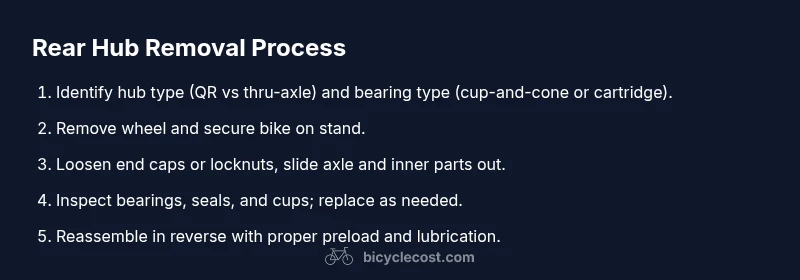
Visually inspect the rear hub to determine if it uses a quick-release skewer or a thru-axle, and check whether the bearings are cup-and-cone or cartridge. This foundation will dictate tool choice and disassembly order.
Tip: Take a photo of the hub from multiple angles to reference orientation during reassembly. - 2
Remove the rear wheel and loosen the drivetrain
If you plan to keep the cassette in place, shift to the smallest cog and back off the derailleur to reduce tension. Remove the wheel from the frame by freeing the QR lever or unscrewing the thru-axle, depending on your setup.
Tip: Secure the chain and derailleur with a strap or bungee to avoid bending or misalignment. - 3
Loosen end caps or locknuts
Using the appropriate wrenches, back off the end caps or locknuts to relieve preload on the bearings. Keep track of any spacers, washers, or cones as you remove them.
Tip: Place small parts in labeled containers to avoid losing orientation during reassembly. - 4
Extract the axle and inner parts
Carefully slide the axle out of the hub shell while supporting the bearings. For cartridge bearings, remove the inner race with minimal disturbance of the bearing race.
Tip: If parts resist, apply a little penetrating oil and pause to prevent damage. - 5
Inspect bearings and seals
Check for roughness, pitting, rust, or excessive play. Clean seals and races; replace any worn components before reassembly.
Tip: If you see shiny grooves or rust, replacement is more reliable than cleaning and reusing. - 6
Clean, lubricate, and prep for reassembly
Wipe all parts clean, apply a light film of grease to bearings and contact surfaces, and prepare end caps or cones for reinstall. Avoid over-lubrication that can attract dirt.
Tip: Use fresh grease on bearing races and seals to maintain performance. - 7
Reassemble with correct preload
Reinsert the axle, reinstall spacers, cones, and locknuts, and then restore preload to a snug, smooth feel without binding. If using cartridge bearings, ensure proper alignment of the inner race.
Tip: Keep removing and reinstalling until there is no side-to-side play in the hub while turning smoothly. - 8
Reinstall wheel and test
Place the wheel back in the frame, secure the QR or thru-axle, and spin the wheel to verify smooth rotation. Pedal lightly to ensure the cassette engages correctly and there’s no rubbing.
Tip: Take a short test ride to confirm alignment and feel of the drivetrain.
People Also Ask
What tools do I typically need to remove a rear hub?
Most hub removals require cone wrenches, an adjustable wrench, hex keys, grease, and degreaser. A bearing puller is optional for stubborn cartridges. Always have labeled containers for small parts.
You’ll typically need cone wrenches, an adjustable wrench, hex keys, grease, and degreaser. A bearing puller is optional for tough cartridges.
Can I remove the rear hub without removing the cassette or sprockets?
Often you can access the hub without fully removing the cassette, but on many hubs you’ll need to detach the cassette to reach the locknuts or end caps. Plan for a cassette tool if required.
Usually you’ll need to detach the cassette to access the locknuts or end caps, depending on the hub design.
How do I know when to replace bearings?
If bearings feel gritty, show visible pitting, or there is excessive lateral play, replacement is recommended. Clean and inspect races for damage before deciding.
Replace bearings if they’re gritty, pitted, or show excessive play after cleaning.
Is it safe to service a thru-axle hub myself?
Yes, with care. Follow torque specs, keep threads clean, and avoid overtightening. If unsure, consult the manufacturer’s guidance for your exact model.
Yes, but mind the torque specs and threads—don’t overtighten.
What should I do after removing the hub?
Clean all parts, inspect for wear, re-lubricate, and reassemble in reverse order. Verify bearing preload and wheel alignment before riding.
Clean, inspect, lubricate, and reassemble with correct preload, then test the wheel.
Do I need special tools for cartridge bearings?
Cartridge bearings often come out with the axle; you may need pliers or a puller for stubborn parts, but many hubs do not require special tools beyond basic wrenches.
Often not—most cartridge hubs come apart with basic tools, but some stubborn parts may need a puller.
Watch Video
Quick Summary
- Identify hub type before disassembly.
- Use the correct tools to prevent damage.
- Inspect and replace bearings as needed.
- Test rotation and alignment after reassembly.