How to Make a Bicycle with Paper: A Step-by-Step Craft Guide
Learn how to make a bicycle with paper through a detailed, kid-friendly craft. Gather simple supplies and follow safe folding techniques to create a decorative paper bike you can display with pride.


You’ll learn how to make a bicycle with paper using simple supplies and careful folding. The goal is a sturdy, decorative model—not a rideable bike. Gather paper, glue, scissors, tape, markers, and a ruler. Follow the steps to design a lightweight frame, wheels, and handlebars that hold together with basic adhesives.
Why this project matters
Making a bicycle with paper is a engaging, educational craft that helps learners explore geometry, symmetry, and spatial thinking. In this project, you’ll translate a three-dimensional idea into layered, foldable components. According to BicycleCost, hands-on paper constructions like this bolster planning, sequencing, and fine motor skills while offering a safe, reusable model for classroom demonstrations or family projects. If you’re exploring how to make a bicycle with paper, this guide walks you through planning, folding, and assembly step by step. You’ll practice measuring, scoring, and layering to build a lightweight representation of a bike—without the hazards of metal or wheel impact. The goal is clarity of form, balance, and a sense of achievement as you see a flat sheet become a recognizable bicycle silhouette. This project is accessible to beginners and adaptable for more detailed variations as skills grow.
Materials and design considerations
Before you start, gather everyday craft supplies and a plan. The core materials are inexpensive and commonly available: paper (multiples: printer-weight for sturdiness, construction-weight for folds), plain white glue or craft glue, scissors, a ruler, a pencil, and markers or colored pens for accents. Optional items include a thin cardboard backing for stiffness, a craft knife for clean edges, and double-sided tape for extra hold. When choosing paper, aim for sheets around 60-100 gsm for lightweight pieces and 120-180 gsm for structural parts; lighter paper is easier to fold, heavier stock holds shapes better. The BicycleCost team also suggests designing templates on grid paper to ensure symmetry; printing templates from your computer can improve accuracy. Safety-conscious builders should keep blades away from fingers and work on a stable surface. For color, consider a small palette of two or three hues to differentiate frame, wheels, and accents. Finally, plan your assembly order to minimize rework: start with the frame, then wheels, then handlebars, and finally decorations.
Planning the build: structure, folds, and aesthetics
Develop a simple blueprint before you cut. Start by sketching a rough bicycle silhouette and identify core components: frame, wheels, handlebars, and seat. Create lightweight templates for each piece on scrap paper, then transfer to your final sheets with light pencil lines. Use folds to simulate depth: longer, straighter frame segments and round rims can suggest different bike types. To keep your model sturdy, consider layering each component with two or three sheets glued together, then reinforcing joints with small tabs. For aesthetics, decide which parts will be flat versus dimensional; the front wheel can be represented with two discs and a small spacer to imply a tire, while the frame can be built from connected trapezoids to mimic tubes. Incorporating color bands or stripes can help convey branding or style while using a minimal color palette improves readability. The planning stage saves materials and makes assembly smoother.
Finishing touches and display ideas
After assembling, allow glue to dry completely before handling. Add final details with markers or colored pencils: spokes, hub centers, or decals can simulate metal or wood. A light spray of acrylic sealer can protect the finished piece and reduce smudging; test on a scrap sheet first. Mounting the model on a small base or stand can showcase it without tipping; consider a simple cardboard stand or clear acrylic rod held with a dab of glue. If you want to display multiple bikes, arrange them in a row or diorama to demonstrate design variations. For presentation, photograph your model against a neutral background and crop to emphasize the bicycle silhouette. The result is a charming, decorative piece that communicates the concept of a bicycle using only paper and glue.
Safety, limitations, and learning outcomes
Remember this is a craft project, not a functional vehicle. Paper cannot withstand real riding stresses, so avoid attempting to ride or apply weight beyond a few ounces. Scissors and craft knives require careful handling; cut away from your body and keep blades protected when not in use. Work in a well-ventilated area when applying glue or sealant. As a learning activity, this project reinforces following instructions, planning steps, and testing fit before assembly. It also provides a tangible way to discuss geometry, symmetry, and reinforcement strategies with students or family members.
Tools & Materials
- Printer-weight or construction-weight paper(Multiple sheets; light colors help contrasting parts)
- Scissors(Sharp enough for clean edges)
- Ruler(At least 12 inches)
- Pencil(For tracing templates)
- Glue (white glue or craft glue)(Apply thin layer; avoid soggy sheets)
- Markers or colored pens(For details and accents)
- Double-sided tape (optional)(Extra hold for joins)
- Thin cardboard backing (optional)(Adds stiffness)
- Craft knife (adult supervision)(For clean edge trimming)
Steps
Estimated time: 60-90 minutes
- 1
Prepare templates and workspace
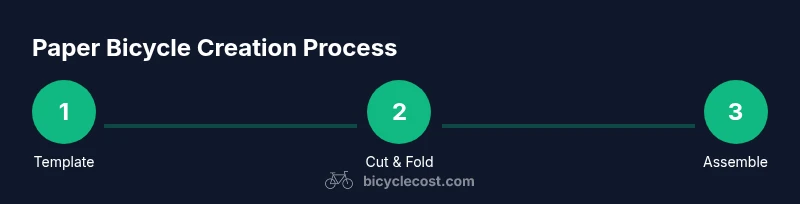
Set up a clean, flat workspace. Trace or print lightweight templates for the frame, wheels, and handlebars on scrap paper first, then transfer them to your final sheets with light pencil lines. This helps ensure symmetry before you cut. Cut out only the sheets you’ll need, leaving extra for testing fits.
Tip: Test-fit pieces dry before gluing any edges to avoid misalignment. - 2
Cut out the frame pieces
Carefully cut the frame and main components from your chosen paper. Use a ruler to keep straight edges and a craft knife for precise cuts if needed. Label each piece lightly with a pencil so you can identify them during assembly.
Tip: Keep cut edges neat; rough edges can weaken joints and affect alignment. - 3
Assemble the frame skeleton
Lay out the main frame pieces and glue them with thin, even layers. Use tabs where possible to create natural joints. Allow the glue to set momentarily so pieces don’t shift during subsequent steps.
Tip: Work in small sections to prevent warping from excess moisture. - 4
Create and attach wheels
Cut wheel circles from sturdy paper, then glue or tape a thin inner disc to simulate a hub. Attach wheels to the frame using small tabs or a shared strip of paper to mimic axles. Ensure wheels are aligned and free to rotate visually in the display model.
Tip: Use a spacer or tiny ring to suggest tire depth without bulky edges. - 5
Add handlebars and seat
Shape separate pieces for handlebars and the seat, then secure them to the frame using glue or tape. Angle the bars slightly to convey steering geometry and attach a small neck piece if needed to connect to the frame. You can color-code these parts for clarity.
Tip: Keep the angles consistent with the intended bike style (road vs. cruiser). - 6
Reinforce joints and decorate
Reinforce critical joints with extra layers or a small paper strip as a reinforcement. Add decorative elements like stripes, decals, or spokes by drawing or layering thin paper slips. Check for wobble and adjust with additional glue if necessary.
Tip: Let each layer dry before adding the next to prevent shifting. - 7
Display and dry time
Set the completed model on a stable surface and allow a full drying period before handling or displaying. If you plan to seal the piece, apply a light coat after drying and wait for it to cure. Then, display on a neutral background for best impact.
Tip: Use a small base or stand to stabilize the sculpture and prevent accidental tipping.
People Also Ask
Is a paper bicycle durable enough for display?
A paper bicycle is a decorative model designed for display. With layered construction and careful gluing, it can hold up to light handling and photography but should not be treated as a functional object. Store it away from moisture to preserve shape.
It's a display piece, not a toy; handle gently and avoid bending the structure.
What papers work best for a paper bicycle?
Lighter printer-weight papers are easier to fold and shape, while heavier stock provides more stiffness. A mix of 60-100 gsm for flexible parts and 120-180 gsm for structural elements often yields a balanced result.
Use a mix of lighter and slightly heavier papers for strength and foldability.
Can I scale this design to a larger size?
Yes, but scaling up increases weight and fragility. Use layered backings and reinforce joints more aggressively. Plan for larger wheel rims and a sturdier frame if you enlarge the model.
You can make a bigger version, just reinforce joints more and be mindful of weight.
How long does it take to complete the project?
Typical completion ranges from 60 to 90 minutes, depending on prep time, drying time between steps, and the level of detail you add during decoration.
Most people finish in about an hour.
Are there safety tips I should follow with scissors and knives?
Always cut away from your body, use a cutting mat, and supervise younger crafters when using blades. Keep blades sheathed or stored safely when not in use.
Be careful with blades and always cut away from your body.
How can I customize my paper bicycle design?
Experiment with color schemes, patterns, and textures. Try different wheel designs or add logos and decals. Keep the overall silhouette recognizable while letting creativity show.
Try different colors and a simple decal to make it unique.
Watch Video
Quick Summary
- Plan before folding to ensure symmetry
- Use layered pieces for sturdiness
- Dry each joint thoroughly for durability
- Display as decorative, not functional, model