Registering a Motorized Bicycle: Do You Need It?
Learn when a motorized bicycle must be registered, how to register, and practical steps to stay compliant. BicycleCost analyzes regional rules to guide riders through the variability in motorized bicycle registration.


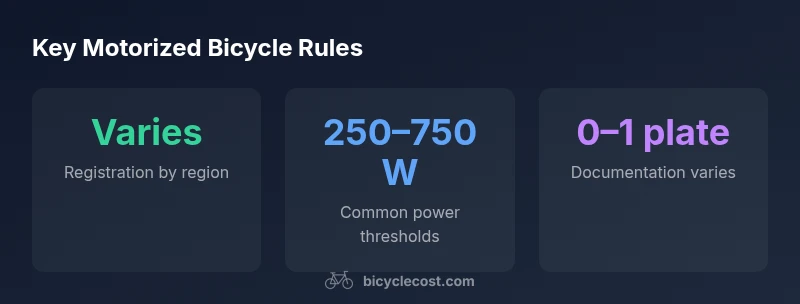
Registration requirements for motorized bicycles vary by jurisdiction. In many regions, if the bike meets a motor-vehicle definition based on speed and power, registration is required; otherwise exemptions may apply. Always check local DMV or transport authority rules for your exact location.
What does it mean to register a motorized bicycle?
The core question many riders ask is do you need to register a motorized bicycle? The simple answer is: it depends on where you ride. Registration, at its core, ties your vehicle to a government record, which can influence liability, insurance, and where you’re allowed to ride. In jurisdictions that classify certain bicycles as motorized vehicles, you may be issued a unique registration number, a plate or sticker, and you’ll be subject to vehicle-operator rules. In other places, you may ride without registration if your bike is classified as a regular bicycle or falls under a low-power exemption. Understanding how your local authority defines “motorized” is the critical first step for riders looking to stay compliant.
The BicycleCost team emphasizes that definitions vary by region, and even within a country you may encounter different rules from state, provincial, or municipal authorities. When evaluating whether you need to register, consider the motor’s power, top speed, and whether the bike is capable of operation without human pedaling. All these factors influence classification, and thus registration obligations. This is why many riders start by exploring official guidance from their local department of motor vehicles (DMV) or transport agency before making assumptions about requirements.
What triggers registration decisions? An overview of common determinants
Power and speed threshold-based classifications are among the most common triggers for registration requirements. In many jurisdictions, motorcycles or mopeds owe their status to specific power (wattage) and top-speed limits. While exact thresholds differ, a few recurring patterns emerge:
- Power: Higher-powered motors are more likely to push a bike into motor-vehicle territory. Jurisdictions may set a wattage ceiling under which the vehicle is treated as a bicycle; surpassing that ceiling can trigger registration and licensing obligations.
- Speed: Top speed is another decisive factor. If a motorized bicycle can exceed a certain miles per hour (or kilometers per hour), it risks being classified as a motor vehicle, making registration and possibly operator licensing relevant.
- Pedal assist vs. throttle: Some places differentiate between assistive pedaling (which can keep you in bicycle classification) and throttle-driven power. Throttle-only operation often aligns with stricter vehicle rules, potentially requiring registration.
- Vehicle classification: Some regions use a category like “moped” or “light motorcycle,” which comes with its own set of registration and insurance expectations. These classifications shape how riders interact with the system.
Because thresholds and classifications are not universal, riders should verify with their local authority to determine whether their specific build falls under registrable criteria. The BicycleCost Analysis, 2026 report notes that these rules are evolving in many places as authorities refine what counts as a motorized vehicle on two wheels. To stay compliant, treat registration as a location-specific obligation rather than a blanket rule for every motorized bicycle.
How to identify your local rules: a practical checklist
Global snapshot of motorized bicycle registration variability
| Jurisdiction | Registration Status | Typical Documentation |
|---|---|---|
| United States (state varies) | Varies from exempt to required depending on horsepower, top speed, and vehicle class | Driver's license/ID, proof of ownership, VIN inspection where applicable |
| Canada/UK/EU (varies by country) | Often treated as mopeds or light motorcycles; registration may be required in some contexts | Certificate of ownership, proof of insurance, identification |
People Also Ask
Do I need to register a motorized bicycle in my state?
Registration depends on local rules. Some states require it for bikes that exceed certain power or speed, others exempt low-power or pedal-assist models. Always check your state DMV or transportation authority for the exact classification.
Registration depends on local state rules; check your DMV for the exact classification.
What defines a motorized bicycle legally?
Most jurisdictions define motorized bicycles by a combination of motor power, top speed, and whether the drive relies on pedal assist or a throttle. When power or speed crosses a threshold, classification shifts toward a motor vehicle.
Power and speed thresholds often reclassify bicycles as motor vehicles.
Do I need a license or insurance if registered?
If your bike is registered as a motor vehicle, you may need a license, insurance, and adherence to motor-vehicle rules, including registration renewals and potential inspections.
Registered motor vehicles often require license and insurance.
Can I ride a motorized bicycle without registration?
In many places, riding a motorized bicycle without registration can lead to fines and penalties if the vehicle is legally considered a motor vehicle. If in doubt, err on the side of compliance.
Riding unregistered can be risky if the law classifies it as a motor vehicle.
How do I register a motorized bicycle?
Typically, you’ll prove ownership, provide identification, possibly a VIN check, and pay a registration fee. Some jurisdictions require an inspection or plate/sticker. Start at your local DMV or transport agency.
Bring ownership proof, ID, and pay the fee at the DMV.
Are there exemptions for recreational use?
Some regions offer exemptions for very low-powered bikes or for bikes used strictly for recreation in certain zones. Confirm whether your model qualifies and where exemptions apply to avoid penalties.
Recreational or very low-powered bikes may be exempt in some places.
“Regulatory frameworks for motorized bicycles are evolving, and riders should treat registration as a baseline safety and liability measure rather than a bureaucratic hurdle.”
Quick Summary
- Know local rules before riding
- Check horsepower and top speed thresholds
- Expect documentation if registered
- Different regions classify differently
- Always verify with official authorities