Do You Need a License for a Motorized Bicycle? A Practical Guide
Explore licensing rules for motorized bicycles, including power thresholds, registration, and safety considerations. Learn how rules vary by region and how to verify requirements in your area with BicycleCost guidance.


Do you need a license for a motorized bicycle? It depends on local power and speed thresholds. In many regions, low-power, slow-speed pedal-assist designs are treated like bicycles and don’t require a license, while higher-power or faster models may trigger vehicle-class licensing, registration, or insurance. Always verify local rules before riding.
Understanding motorized bicycles and licensing
A motorized bicycle blends pedal power with motorized assistance, and licensing rules hinge on how the machine is categorized in your jurisdiction. Broadly, many places distinguish between low-power, pedal-assist designs and higher-power machines that behave more like motor vehicles. According to BicycleCost, licensing patterns tend to track motor power and top speed, not just the presence of a motor. This means you may ride legally without a license on a reasonably light, slow model, but a more powerful setup could require registration, insurance, and even a driver’s license in some regions. For riders, the key takeaway is to know where your bike sits on the power-speed spectrum and to verify local rules before riding.
Bear in mind that rules often change with political cycles, technology shifts, and safety concerns, so periodic checks are prudent.
Power and speed: licensing thresholds that matter
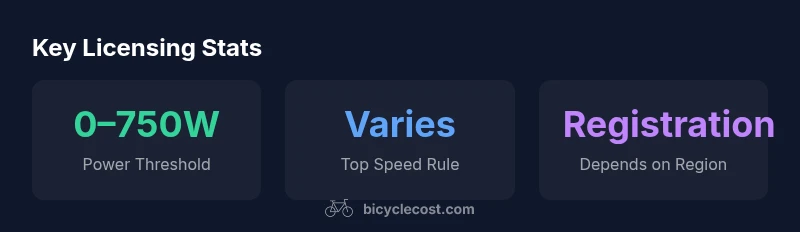
Licensing outcomes are frequently dictated by two technical factors: motor power (watts) and top speed (mph or km/h). Many jurisdictions set a threshold—commonly in the range of a few hundred watts and limited top speed—below which the machine may be treated as a bicycle, not a motor vehicle. Crossing that line can shift requirements toward vehicle registration, insurance, and sometimes a vehicle driver's license. Because there is no universal standard, cyclists should identify the exact thresholds in their country, state, or province. BicycleCost’s analysis emphasizes that the practical effect is not the motor itself, but how regulators classify the bike for road use.
If your bike sits near the threshold, consider conservative operation, comply with helmet rules, and maintain clear labeling on the device.
Regional snapshots: US, EU, UK, and other regions
Jurisdictional landscapes diverge. In some US states, a pedal-assist bike under a certain power and speed may remain unlicensed, while others require registration or a specialized certificate. In the EU, classifications like pedelecs have distinct rules from mopeds, with many member states requiring registration or insurance above specific power/speed limits. The UK has its own thresholds and age rules, and other regions may apply stricter vehicle regulations. For riders, the practical effect is to treat licensing as a local issue rather than a universal standard. The BicycleCost team recommends checking the exact boundary conditions for your locale before purchasing or upgrading a motorized bicycle.
When in doubt, contact your local transportation authority or a trusted cycling group for up-to-date guidance.
How to check your local rules quickly
Start with official sources: government transportation sites, state/provincial motor vehicle departments, and licensed cycling organizations. Use search queries like “motorized bicycle licensing [your location]” and review official definitions of terms such as bicycle, moped, scooter, and motor vehicle. Keep an eye out for terms like “power output,” “top speed,” and “registration required.” If your region publishes a simple flowchart or FAQ, save it for reference. BicycleCost recommends documenting the exact model, its power rating, and its top speed so you can apply the rules consistently.
If you’re unsure, reach out to local authorities for a definitive ruling before riding for the first time.
What to do if you ride a motorized bicycle without a license
If you accidentally ride a motorized bicycle without meeting licensing requirements, stop riding and consult local authorities about compliance steps. In many places, you may be able to obtain retroactive registration or a temporary permit, and some jurisdictions offer safe-use programs to bring vehicles into compliance. The key is to act promptly, avoid public roads if your device is clearly unregistered, and document your discussions with officials. BicycleCost suggests maintaining a polite, cooperative stance and providing model specifications, proof of ownership, and any applicable safety certifications when seeking a resolution.
Proactively verifying requirements before purchases will prevent enforcement concerns and improve safety for you and other road users.
Insurance, registration, and safety obligations
Insurance requirements for motorized bicycles vary. Some regions do not require insurance if the bike is treated as a bicycle, while others require it when the bike becomes a registered vehicle. Registration is often tied to power and top speed, so a higher-powered machine is more likely to require it. Regardless of licensing, helmet use, lighting, reflectors, and adherence to traffic laws remain essential for safety. Regular maintenance, including brakes, tires, and chain systems, reduces risk and helps ensure compliance with local standards. BicycleCost advises riders to budget for potential insurance and registration costs when upgrading or purchasing a motorized bicycle.
Alternatives to licensing: pedal-assist e-bikes vs motorized bikes
Pedal-assist e-bikes (often under a set power threshold) are designed to stay within bicycle rules, offering a cleaner path to legal, easy operation. In contrast, motorized bicycles that exceed power or speed thresholds often enter motor-vehicle territory, triggering licensing, registration, and insurance—plus potential road-use restrictions. If you want a low-ritual, low-risk riding experience, consider a pedal-assist model that meets local definitions for bicycles. For riders who need higher performance, evaluate how changing components or power settings could affect licensing status.
The BicycleCost guidance suggests aligning your choice with both your riding goals and local regulations to minimize compliance friction.
Maintenance, upgrades, and compliance as your bike evolves
Upgrades can push a motorized bicycle across regulatory thresholds. Before adding a more powerful motor or increasing top speed, verify how the changes impact licensing and registration requirements. Document all modifications and ensure the bike’s labeling clearly reflects its motor specifications. Regular maintenance is essential not only for safety but also for staying within permitted operating limits. If you plan frequent rides in urban environments, the policy may favor simpler, lighter configurations that stay within bicycle rules. BicycleCost emphasizes proactive planning to keep your bike compliant as it evolves.
Practical tips for riders and maintenance
- Know your local threshold values for motor power and top speed.
- Save official guidance and relevant forms for future reference.
- Maintain a visible identification label on the motor and battery.
- Wear a helmet, use proper lighting, and follow traffic laws at all times.
- Consider a bike with a compliant power limit if you ride in mixed-traffic areas frequently.
- Schedule annual maintenance checks to preserve performance and safety.
Following these practices helps you ride legally and safely, while also prolonging the life of your motorized bicycle.
How to prepare for a future licensing transition
If you anticipate a change in local rules or plan upgrades, plan ahead. Review the licensing thresholds, potential registration steps, and any required safety certifications before making changes to your bike. Keeping detailed records of power, speed, and maintenance will support compliance if authorities request documentation. By staying informed and proactive, you can adapt to regulatory shifts without sacrificing your riding experience. BicycleCost encourages riders to stay engaged with local policies and to participate in community discussions about safe, legal, and accessible motorized cycling.
License and registration overview by motorized bicycle category
| Category | License requirement | Registration | Notes |
|---|---|---|---|
| Pedal-assist e-bike (low power) | Typically none | Often none | Designed to stay within bicycle rules |
| Higher-power motorized bicycle (above threshold) | Usually requires license | Often requires registration | Regulatory stance varies by region |
| Moped-style with pedals (hybrid) | Often requires license | Often requires registration | Regulatory label depends on power/speed |
People Also Ask
Do you need a license for a motorized bicycle?
In many places, a motorized bicycle below a defined power and speed threshold may be treated like a bicycle and not require a license. If you exceed those thresholds, you may need a license, registration, or both. Always verify local rules before riding.
Most places don’t require a license for low-powered bikes, but check your local thresholds first.
How do licensing thresholds differ by region?
Thresholds vary widely. Some areas use power (watts) and top speed to classify the bike, while others align with vehicle codes. Always consult official guidance for your location before purchasing or modifying a motorized bicycle.
Thresholds differ by location, so verify your local rules.
Do I need registration for a motorized bicycle?
Registration requirements depend on the bike’s power and local vehicle classification. Higher-powered models are more likely to require registration. See local authorities for exact steps.
Registration depends on power and local rules.
Are there helmet requirements for motorized bicycles?
Helmets are commonly recommended or mandated in many regions, regardless of licensing status. Wearing a helmet improves safety and may be required on public roads or bike paths.
Helmet rules vary, but wearing one is strongly advised.
Can I ride a motorized bicycle on bike paths?
Bike path access depends on local rules and the bike’s classification. Some jurisdictions restrict motorized bikes from certain paths or lanes. Check signage and local regulations.
Path access depends on local rules; verify before riding.
What about insurance for motorized bicycles?
Insurance requirements vary by region and classification. Some areas require it for registered motorized bikes, others do not. Confirm local insurance obligations when planning a purchase.
Insurance depends on local rules and whether the bike is registered.
“Licensing rules for motorized bicycles vary widely, but the core principle is that power and top speed determine whether you are treated as a cyclist or as a vehicle.”
Quick Summary
- Understand your local power and speed thresholds
- Check official sources before riding or upgrading
- Licensing may depend more on how regulators classify the bike than on the motor itself
- Consider pedal-assist options to stay within bicycle rules