How to Buy an E-Bicycle: A Practical Guide for 2026
Learn how to choose the right e-bike with a practical, step-by-step approach. From classes and motors to sizing, batteries, and budgeting, this BicycleCost guide helps you buy smarter in 2026.


This quick guide helps you complete an informed e bicycle buy by outlining key criteria: define riding goals and budget, compare motor types and battery range, check fit and safety features, and plan for charging and maintenance. You’ll leave with a shortlist and a clear purchase plan tailored to your terrain, commute, and lifestyle.
Why the right e-bike choice matters for your daily riding
When you start your e bicycle buy, you’re selecting more than a bike—you’re choosing a tool that shapes your daily routines, fitness, and confidence on varied terrain. An appropriately chosen electric bike enhances comfort on long commutes, supports climbing hills, and broadens your riding options without sacrificing control. According to BicycleCost, the most satisfied new e-bike buyers begin with concrete goals: where you ride, how far you ride, and how much power you actually need. Keep your priority list in mind as you evaluate frame geometry, weight, and the feel of the motor during a test ride. The right match reduces fatigue, increases reliability, and makes regular maintenance more straightforward. With a clear plan, your e bicycle buy becomes an investment in safer, more enjoyable riding.
Understanding your goals sets the foundation for a smart e-bike purchase
Before browsing models, write down a short list: typical trip length, terrain (flat, hilly, mixed), weather and climate, cargo needs, and whether you’ll rely on assisted power for steep climbs. Consider who will ride most often, how much exposure you have to traffic, and the kinds of accessories you’ll want (racks, fenders, lights). A well-scoped brief keeps you from overpaying for features you won’t use and helps you compare like-for-like when you test ride. BicycleCost’s approach emphasizes balancing power, weight, and battery life to meet your daily rhythm, while keeping maintenance practical and affordable.
What you’ll gain from a thoughtful e-bike selection
A properly chosen e-bike aligns with your riding style, reduces fatigue on longer trips, and can extend your season into shoulder months. It also sets you up for safer interactions with traffic through better braking performance and stable handling. As you narrow down options, focus on fit, braking, and motor response across common speeds. This ensures predictable behavior under real-world conditions, which is essential for new riders and seasoned cyclists alike. By framing the purchase around your actual use, you’ll maximize satisfaction and minimize post-purchase regrets.
Tools & Materials
- Tape measure or frame sizing guide(Used to confirm frame size and reach.)
- Helmet and basic protective gear(Required for safe test rides.)
- Credit card or budgeting app(Track your spend and payment options.)
- Water bottle and small tools(Stay hydrated; bring compact multitool for adjustments.)
- Test-ride checklist(Document fit, comfort, and motor responsiveness.)
Steps
Estimated time: 3–6 weeks
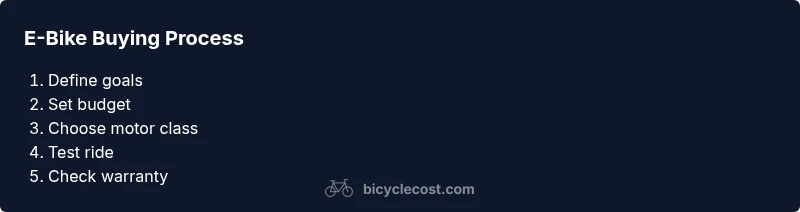
- 1
Define riding goals
Clarify typical trip length, terrain, cargo needs, and climate. This frames all other decisions and prevents buying more power than you require.
Tip: Document your top three daily routes and note the hills you climb most often. - 2
Set a realistic budget
Determine how much you’re willing to spend and consider total cost of ownership: maintenance, battery replacement, insurance, and accessories.
Tip: Divide your budget into base bike price, protection plan, and essential add-ons. - 3
Choose motor class and type
Decide between pedal-assist levels and motor placement (hub vs mid-drive). Each type affects feel, efficiency, and maintenance needs.
Tip: If you climb frequently, prioritize mid-drive with smooth torque. - 4
Assess battery capacity and range
Understand watt-hours (Wh) and approximate range under typical conditions. Higher Wh usually extends range but adds weight and cost.
Tip: Aim for at least 400–600 Wh for mixed commuting and hills. - 5
Check fit and geometry
Test ride bikes with similar frame sizes and adjust saddle height and handlebar position for comfortable reach.
Tip: Stand over the bike; you should have a slight bend in the knee when pedaling with the ball of foot on the pedal. - 6
Test ride and compare feel
Take at least two models on similar routes; note torque response, shifting smoothness, braking power, and overall stability.
Tip: Bring your own gloves and a light bag to mimic real-use weight. - 7
Evaluate service and warranty
Ask about local service options, battery warranty, and what maintenance is covered under pricing.
Tip: Prefer brands with a nearby authorized service network. - 8
Decide on accessories and insurance
Consider racks, fenders, lighting, a lock, and possible insurance or theft protection options.
Tip: Bundle disclosures and warranties when negotiating with the seller.
People Also Ask
What is the difference between pedal-assist classes?
Pedal-assist class 1 provides aid up to 20 mph with minimal regulatory restrictions, class 2 adds a throttle, and class 3 limits assistance to higher speeds with more stringent usage rules. Your choice depends on local laws and how you ride.
Pedal-assist classes differ mainly in speed and throttle options; check local laws before buying.
How much should I budget for a new e-bike?
Entry-level models start lower, while mid-range and premium bikes offer larger batteries and lighter frames. Plan for the bike price plus accessories, maintenance, and potential battery replacement over time.
Budget includes the bike, accessories, and ongoing maintenance.
What should I look for in a battery?
Look for watt-hours (Wh) for range, a reputable battery chemistry, and a warranty. Higher Wh generally means more range but adds weight and cost.
Battery capacity affects distance; choose a reputable battery with a solid warranty.
Are there safety considerations or licenses?
Wear a proper helmet, check local helmet and bike laws, and ensure the bike has reliable brakes and lights for night riding. Most places don’t require a license for e-bikes, but rules vary by class and region.
Helmet and lights are essential; check local rules for class-specific restrictions.
Can I convert my regular bike to an e-bike?
Conversion kits exist, but they can add weight and sometimes compromise safety or reliability. A purpose-built e-bike usually provides better integration and warranty coverage.
Conversion kits exist, but factory-built e-bikes are generally more reliable.
How long does a battery last and how do you charge?
Battery lifespan depends on usage, charging practices, and storage. Charge regularly, avoid deep discharges, and follow manufacturer guidelines for optimal longevity.
Charge regularly and follow the manufacturer guidelines to extend battery life.
Watch Video
Quick Summary
- Define goals before shopping to narrow options.
- Budget for total cost, not just the bike price.
- Test ride multiple models to compare motor feel and fit.
- Prioritize fit, safety features, and after-sales support.
- Plan for charging, maintenance, and future battery life.