How to Bicycle in Spanish: A Practical Guide for Cyclists
Learn essential Spanish biking vocabulary, safety phrases, and practical dialogues to ride confidently in Spanish-speaking environments. A BicycleCost guide for cyclists and language learners.


In this guide you'll learn practical steps to bicycle in Spanish, including essential vocabulary, safety phrases, and realistic dialogues to use on rides, shops, and routes. You'll practice pronunciation, common questions, and authentic responses. The guide also offers context-based practice, idioms, and cultural tips to help you communicate confidently while cycling.
Why learning how to bicycle in Spanish matters
For many cyclists, speaking Spanish expands access to routes, people, and safety communication in diverse regions. The BicycleCost team found that bilingual practice about cycling can reduce misunderstandings on the road and improve traveler confidence in Spanish-speaking environments. This is especially useful when navigating busy streets, asking for directions, or seeking help at a repair shop. By learning the core vocabulary, phrases for traffic scenarios, and culturally appropriate etiquette, you’ll feel more at ease whether you’re touring a city, commuting, or exploring mountains where Spanish is spoken. This article uses practical examples, real-life dialogues, and clear explanations to help you start speaking about biking in Spanish today.
Key idea: learning to bicycle in Spanish is not just about words; it’s about building situational fluency that makes rides safer and more enjoyable. BicycleCost’s guidance emphasizes context-first practice: learn a phrase, then rehearse it in realistic scenarios you’ll encounter on the road. By combining vocabulary with quick mental drills and daily micro-practices, you’ll gain momentum fast.
Core Spanish biking vocabulary you must know
Learning a small-but-strong vocabulary set gives you immediate leverage when you’re on the road or at a shop. Start with nouns for the bike itself, parts, and common objects, then add verbs to describe actions and adjectives to discuss condition. Practice these terms in short, 5-minute sessions each day to build recall. Below are essential terms with simple examples:
- la bicicleta (bicycle) — Voy a limpiar la bicicleta.
- el manillar (handlebar) — Ajusta el manillar para una conducción más estable.
- la cadena (chain) — La cadena necesita lubricación.
- los frenos (brakes) — Revisa los frenos antes de la ruta.
- la llanta (tire) / la rueda (wheel) — La llanta está desinflada.
- el pedales (pedals) — No te cortes los pedales; usa calzado adecuado.
- el casco (helmet) — Siempre usa casco al rodar.
- el candado (lock) — Deja la bicicleta con un candado doble.
- parar (to stop) / avanzar (to go) / girar (to turn) — Parar en la señal roja.
Tips de pronunciación: Spanish vowels are typically consistent, so practice these simple sounds: a, e, i, o, u. Repite en voz alta, con énfasis claro, para mejorar claridad al comunicarte con otros ciclistas o en tiendas.
Phrases for safety and rules on the road
Safety and traffic phrases help you communicate quickly during rides, especially in unfamiliar areas. Memorize these short phrases and drill them in context:
- ¡Alto! — Stop now. (used by pedestrians and car drivers)
- ¡Ceda el paso! — Yield. (use when crossing or merging)
- ¿Qué dirección toma? — Which direction are you taking?
- Mantén la distancia — Keep a safe distance.
- Límite de velocidad — Speed limit.
- Señales de tráfico — Traffic signals/signs.
- Estoy deshidratado, necesito agua — I’m thirsty, I need water. (useful for long rides and speaking with locals or guides)
Extra tip: practice these phrases while riding a quiet street or with a friend as a checker. Use them in real situations to build natural timing and tone. Even if your grammar isn’t perfect yet, clear intent and respectful language matter most for safety on the road.
Dialogues: practical conversations you’ll encounter
Dialogue A – At a bike shop:
- Customer: ¿Tiene una cadena compatible con mi bicicleta?
- Empleado: Sí, ¿qué marca tiene?
- Customer: Una cadena de 11 velocidades, por favor.
- Empleado: Tenemos varias; ¿prefiere reforzada o ligera?
Dialogue B – Asking for directions on a route:
- Rider: Disculpe, ¿cómo llego al parque central?
- Local: Siga recto dos cuadras, gira a la derecha y verá el parque a la izquierda.
- Rider: Gracias. ¿Es seguro para bicicletas?
- Local: Sí, hay carril bici y semáforos en la avenida.
Dialogue C – Emergency/assistance:
- Rider: ¡Ayuda! mi candado no funciona y necesito que la bici esté asegurada.
- Pedestrian: Llama a la policía si hay peligro y llama a un cerrajero de bicicletas.
These dialogues illustrate common needs: parts, directions, and safety. Practice them aloud, focusing on clarity, tone, and tempo. Real-life practice with a partner who bikes also increases your confidence and helps you remember vocabulary more naturally.
Practice strategies and resources for learning
Adopt a practical, ongoing routine that fits your biking schedule. Aim for small daily bites rather than long, exhausting study sessions. Use a mix of passive and active learning:
- Short daily vocab drills (5–10 minutes) using flashcards or an app.
- 2–3 weekly dialogue practice sessions with a language partner who rides or with a tutor.
- After rides, journal in Spanish about what you did, what you saw, and what you would say next time.
- Listen to cycling podcasts or YouTube videos in Spanish, focusing on listening for familiar terms.
- Label real-world items on your bike in Spanish to reinforce memory.
As you progress, switch to context-rich phrases tied to tasks you perform, such as repairing the bike, planning routes, or discussing safety with a friend. BicycleCost’s approach emphasizes authentic practice in real-world contexts rather than rote memorization alone.
Recommended resources: drills in Anki or Quizlet for vocabulary, bilingual cycling forums for practical language usage, and local clubs that frequent bilingual exchanges. Track your comfort level in different scenarios and adjust your study plan every week.
Cultural context and etiquette for cycling in Spanish-speaking regions
Cultural norms around cycling can vary. In some cities, cyclists share lanes with cars more than in others, and etiquette around signaling and yielding may differ. Learn to read local cues: when riders point to a right shoulder or when pedestrians step aside for passing bikes. When discussing routes or road conditions, a polite tone goes a long way. In many areas, asking for a quick local tip is appreciated and can open doors to riding partnerships or guided tours. Remember to be patient and adapt your language to the local context; showing interest in local customs will boost your safety and enjoyment. Bike shops and repair hubs in Spanish-speaking regions often welcome bilingual talkers, so using even basic phrases shows respect and can lead to better service and guidance.
Quick-start 7-day practice plan to begin speaking while cycling
- Day 1–2: Learn 20 essential biking terms in Spanish and practice short, verb-based commands.
- Day 3–4: Practice 5 safety phrases in various tones (urgent, calm).
- Day 5: Role-play two short dialogues: asking directions and requesting a part at a shop.
- Day 6–7: Go on a short ride with a partner and narrate what you’re doing in Spanish; review and adjust phrases as needed.
Tools & Materials
- Notebook or flashcards(For vocabulary and phrases you repeat daily)
- Spanish-English cycling dictionary or app(Keep a quick reference handy during rides or shop visits)
- Smartphone or computer(For apps, audio practice, and online dialogues)
- Headphones(Useful for listening practice and pronunciation drills)
- Notebook or recording app(Record yourself speaking to improve pronunciation)
- Conversation partner or tutor(Real-time practice with feedback)
Steps
Estimated time: Total time: 2-4 weeks
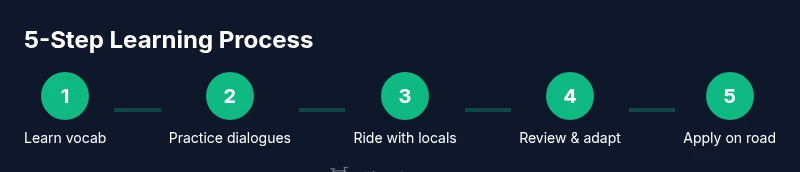
- 1
Set learning goals
Define what you want to achieve in 2–4 weeks: basic traffic phrases, bike parts names, and two short dialogues you can use when shopping or asking directions. Write these goals down and review them every day to stay motivated.
Tip: Make goals specific and measurable, e.g., 'I will say 5 safety phrases aloud on a 20-minute ride.' - 2
Build core vocabulary
Create a focused vocabulary list of 40–60 cycling-related words and phrases. Group them by category (bike parts, actions, safety, shop dialogue). Drill daily using flashcards and quick quizzes.
Tip: Use spaced repetition to reinforce memory; revisit tricky terms at the end of each day. - 3
Practice essential dialogues
Script and role-play common conversations you’ll have at shops, on routes, or with local cyclists. Start with 2–3 short dialogues and gradually add variations.
Tip: Record yourself and compare pronunciation to native samples; adjust intonation and pace. - 4
Apply in real-world contexts
Practice phrases during actual rides or pre-ride planning sessions. Narrate what you’re doing in Spanish and ask simple questions to locals or shop staff.
Tip: Keep a pocket list of phrases for on-the-spot use; don’t worry about perfect grammar at first. - 5
Review and adjust
Weekly, review your progress, note gaps, and adjust your plan. Add new terms you encountered during the week and remove ones you’ve mastered.
Tip: Set a weekly reflection time to track progress and plan the next week’s practice.
People Also Ask
What is the fastest way to learn vocabulary for cycling in Spanish?
Use daily flashcards and short drills focused on cycling terms. Pair new words with short practice sentences in context.
Use flashcards daily and practice cycling terms in short, real-life sentences.
Which phrases are most important for safety while riding?
Memorize key commands and safety signals like '¡Alto!', 'Ceda el paso', and 'Mantén la distancia'. Practice them in calm scenarios before trying on busy streets.
Important safety phrases include '¡Alto!' and 'Ceda el paso'; practice in safe settings first.
Can I learn while cycling, or should I wait?
For safety, practice language drills off-bike or during short breaks. On-bike practice should be limited to the basics and non-distracting phrases.
Practice language on breaks or off the bike to stay safe while riding.
Are there cultural differences in riding etiquette I should know?
Yes. Etiquette varies by region; show polite asking for directions, yield to pedestrians, and use clear signaling. Adapt language to local norms.
Etiquette varies by country; follow local cues and be courteous when asking directions.
What if I travel to a Spanish-speaking country with limited time?
Focus on 10–15 phrases for directions, safety, and basic needs; use your dictionary app and practice with a partner before departure.
Learn 10–15 essential phrases for quick travel and practice them beforehand.
Do I need perfect grammar to start using Spanish on rides?
No. Start with simple sentences and key phrases; focus on clarity and intent. Grammar improves with regular practice.
Begin with simple phrases; grammar improves as you practice.
Watch Video
Quick Summary
- Identify clear learning goals first.
- Master core vocabulary before advanced phrases.
- Practice dialogues in realistic contexts.
- Apply Spanish on actual rides and at shops.
- Review weekly and adjust your plan.