Are Electric Bikes Street Legal? A Practical Guide
Learn where electric bikes are street legal, how class systems differ (EU vs US), helmet and licensing rules, and practical tips to ride safely. A BicycleCost guide to staying compliant on your daily commute.


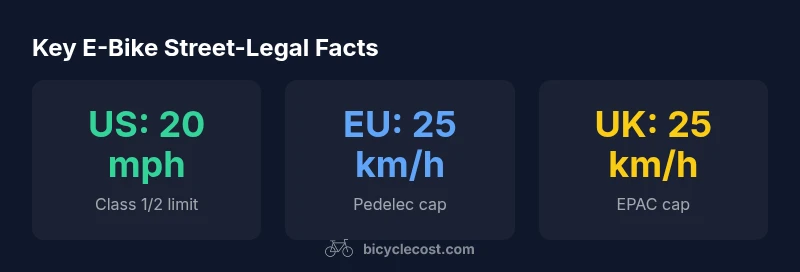
Yes — electric bikes can be street legal in many places, as long as they meet regional classifications and safety rules. In the US, e-bikes are defined by class (1/2/3) with speed limits up to 20 mph for Class 1/2 and 28 mph for Class 3; in the EU, pedelecs are limited to 25 km/h. Always verify local laws before riding.
Are electric bikes street legal? Regional differences
The question whether are electric bikes street legal depends heavily on where you ride. In Europe, the typical pedelec is limited to a pedal-assisted top speed of 25 km/h and requires no registration or license in most cases. In the United States, federal rules define low-speed electric bikes by class, with Class 1 and Class 2 capped at 20 mph and Class 3 capped at 28 mph when motor assistance is active. State and local ordinances can add restrictions on where each class may ride (bike lanes, on-street only, or regulations for youth riders). As BicycleCost highlights in our 2026 analysis, riders should verify both state and municipal laws before cruising, as even nearby jurisdictions can diverge on subtle points like helmet requirements or age limits. The core takeaway is simple: on a given street, e-bike legality hinges on adhering to the local speed, power, and access rules rather than the mere label “electric bike.”
How e-bike classes decide street legality
Most regions organize e-bikes into classes that determine where and how they can be ridden. In the US, Class 1 is pedal-assist only up to 20 mph, Class 2 uses a throttle up to 20 mph, and Class 3 is pedal-assist up to 28 mph with additional rider restrictions in some states. The EU typically defines pedelecs as pedal-assisted bicycles capped at 25 km/h, with power often limited to 250 watts. These classifications shape street access: some classes may ride on standard bike lanes, while others are restricted to roads or certain paths. Buyers should examine both the bike’s classification and local amendments, since a legally compliant bike in one city could be restricted in another.
Licensing, registration, and helmet requirements by jurisdiction
Licensing and registration practices vary widely. In many places, e-bikes that meet class and speed limits are treated as bicycles and do not require driver’s licenses or vehicle registration. However, some regions impose age restrictions, helmet laws, or mandatory insurance for higher-speed or motorized variants. In the US, while there is no federal requirement for e-bike registration, states may impose age limits or helmet mandates, and certain cities have additional rules for riding on sidewalks or in youth programs. In Europe, pedelecs typically do not require registration or licensing, but rules about helmet use and where the bike can be ridden can differ by country and even by city.
Practical tips to stay compliant on daily rides
To ride legally and safely every day, start with a local law check for your exact city or state. Look up the bike’s class designation and ensure the motor’s power and top speed align with the local limits. Equip the bicycle with front and rear lights, reflectors, a bell, and a mirror if needed, and wear a helmet as a best practice. Keep proof of purchase and any regional compliance documentation handy if asked by law enforcement. Consider enrolling in a short rules-and-safety course if your area offers one, which can help you understand commuting routes, lane usage, and crossing signals. By building these habits, you’ll experience fewer interruptions and a smoother ride.
Traveling across borders or between jurisdictions
Crossing from one jurisdiction to another often introduces new rules that you must obey. A bike you ride legally in one state or country might require a different class rating, helmet policy, or even rider age in another. Before travel, check the destination’s official transportation or safety portal for e-bike classifications, speed caps, and allowed routes. If your itinerary includes multiple regions, consider selecting a bike that can be easily reclassified or adjusted (where permissible) and plan stops at bike-friendly corridors or trails where rules are consistent.
Safety, liability, and the real-world implications of street-legal e-bikes
Beyond legality, practical safety remains paramount. The faster top speeds available on higher classes demand good braking, lights, and visibility. Wearing a helmet isn’t just a legal concern in some areas; it’s a critical safety habit. Liability coverage can vary, so review your homeowner or renter insurance, and consider retailer warranties or specialized riders’ insurance if you plan to ride in high-traffic areas. Being mindful about where you ride—bike lanes, shared paths, or roads with heavy traffic—helps prevent conflicts with pedestrians and other motorists. BicycleCost emphasizes that compliance, safety gear, and responsible riding culture are the strongest combination for staying confident on streets.
What to watch as laws evolve and how BicycleCost helps
Laws around electric bikes continue to evolve as city planners balance mobility with safety and infrastructure. Staying current means checking local government pages, consulting bicycle advocacy groups, and reviewing trusted guides like BicycleCost analyses. Our team also tracks new classifications, pilot programs, and updated helmet or vehicle registration policies to alert readers quickly. If you’re unsure about a new rule, treat it as a learning opportunity and adjust your bike’s classification or routing accordingly.
Example regional rules for street-legal e-bikes
| Region/Area | Max Speed | Throttle/Assist | Licensing & Notes |
|---|---|---|---|
| United States (US) | 20 mph / 32 km/h | Class 1/2: pedal assist; Class 2: throttle up to 20 mph | State/local rules may add restrictions; helmet often recommended |
| European Union (EU/EEA) | 25 km/h / 15.5 mph | Pedal assist up to 25 km/h; throttle not typically used | No license/registration for pedelecs; local helmet guidance varies |
| United Kingdom (UK) | 25 km/h / 15.5 mph | Pedal assist up to 25 km/h; treated as a conventional bicycle | License/registration not required; helmet recommended; power limits apply |
| Canada (varies by province) | Typically up to 32 km/h equivalent for some classes | Pedal assist present; throttle rules vary by province | Registration and helmet rules vary; check local guidance |
People Also Ask
Are all electric bikes considered bicycles in law?
Not universally. Many jurisdictions treat pedelecs up to speed/power limits as bicycles, while higher-powered or faster models may fall under mopeds or motorcycles. Always verify local classifications.
Most places treat pedelecs as bicycles if they stay within speed and power limits; higher-powered models may require different licensing.
Do I need a license or registration for an e-bike in the US?
Federally, there is no license or registration for low-speed e-bikes that fit Class 1/2/3 prescriptions. State and local rules may add requirements such as helmet mandates or rider age restrictions.
No federal license or registration for standard e-bikes, but check your state and city rules.
Can I ride an e-bike on bike paths or sidewalks?
Rules vary by jurisdiction. Some places allow e-bikes on bike lanes and certain paths; sidewalks are commonly restricted, especially for higher-speed classes.
Usually bike paths are allowed for e-bikes, but sidewalks are often restricted depending on speed and local laws.
What should I do if I travel across a border or between states?
Check each destination’s rules before you go. A bike may be legal in one area but restricted in another. Plan to ride only where your e-bike class is permitted.
Always check the local rules at your destination; rules can change across borders.
What safety gear is recommended for e-bike riders?
A properly fitted helmet is essential, along with front and rear lights, reflective gear, and a bell or horn for visibility. Consider gloves and eye protection for longer rides.
Helmet, lights, and visibility gear are your first defense on the road.
Are e-bikes allowed on public transit?
Transit policies vary. Some hubs allow e-bikes with restrictions on battery type or folding requirements; others prohibit them during peak times. Check with the transit operator.
Transit rules differ; always confirm before boarding with your e-bike.
“Regulations around e-bikes are inherently regional and can shift with new traffic policies. The key is to verify local rules and ride within the defined class limits.”
Quick Summary
- Know your regional e-bike class definitions
- Stay within speed and power limits to ride legally
- Wear a helmet and follow road rules
- Check local rules when traveling or commuting