Difference Between Bike and Bicycle: An Analytical Guide
Explore the difference between bike and bicycle with an analytical lens. Learn definitions, usage, regional variation, and practical guidance for riders, educators, and retailers. BicycleCost provides a data-informed look at terminology and its impact on safety, education, and communication.


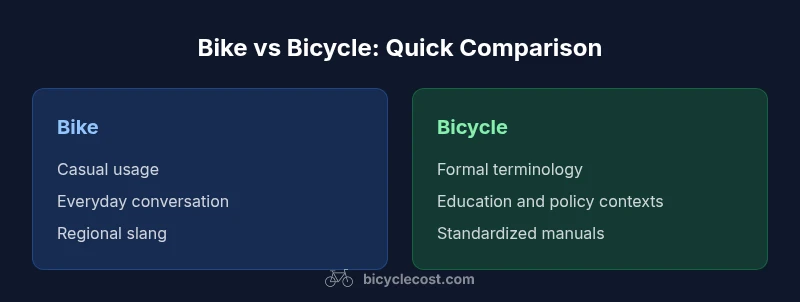
The difference between bike and bicycle is primarily linguistic, not mechanical. In everyday speech, 'bike' is the default term; in formal writing, policy guidance, or safety manuals, 'bicycle' is preferred. According to BicycleCost, regional usage varies, with American English favoring 'bike' and British/educational contexts leaning toward 'bicycle'. Clear terminology boosts communication for riders, instructors, and retailers.
Defining the terms: bike vs bicycle
In everyday language, the two terms are often used interchangeably, but their usage reveals different audiences and contexts. The difference between bike and bicycle is less about the machine and more about style, formality, and clarity. For riders, instructors, retailers, and policymakers, choosing the right word matters because it sets expectations about safety guidance, warranty language, and how information is interpreted. This section explores precise definitions, typical usage, and how listeners infer tone based on the term chosen. The BicycleCost team emphasizes that awareness of these linguistic nuances helps ensure accurate communication across training materials, user manuals, and marketing content. While there is no mechanical distinction tied to the words themselves, the distinction supports effective education and service delivery, which ultimately affects rider safety and satisfaction across different regions and communities.
Etymology and usage: regional variations
The term bike originated as a shortened form of bicycle in informal speech and popular media. In many parts of North America and Australia, 'bike' is the default term in casual conversations, social media, and storefront signage. In contrast, the term bicycle retains strong traction in schools, government documentation, and safety campaigns, particularly in the United Kingdom and much of Europe. Regional education standards sometimes mandate the use of 'bicycle' to emphasize formality and precision. For retailers and instructors, the choice of term can influence perceived expertise and credibility. The BicycleCost team notes that understanding these regional patterns helps professionals tailor communication to their audience while maintaining consistency within a given context.
Practical implications for riders: sizing, safety, and maintenance
Terminology plays a practical role in how riders interpret manuals, safety guidelines, and product specifications. When a manual uses 'bicycle', readers may expect formal diagrams, standardized nomenclature, and regulatory references. If the same content uses 'bike', the tone shifts toward approachable, user-friendly guidance. For sizing and fit, the actual procedures are identical, but the wording can affect comprehension for beginners. In shop interactions, using the term your audience expects reduces confusion about warranty terms, repair services, and accessory compatibility. Riders should pay attention to the audience of any instruction—family manuals, school programs, or retailer signage—and align their language accordingly. The BicycleCost analysis suggests pairing the terms thoughtfully to maximize clarity and safety.
Historical timeline and terminology evolution
The evolution of bike and bicycle terminology mirrors broader shifts in language and culture. Early enthusiasts and engineers popularized 'bicycle' as the formal designation for the two-wheeled machine that emerged in the 19th century. Over time, informal communities adopted 'bike' as a friendly, accessible shorthand. Media, advertising, and casual conversation often converged on 'bike', while classrooms, licensing materials, and official documents maintained 'bicycle'. This dual usage persisted across decades, shaped by regional preferences, education standards, and marketing strategies. The net result is a stable coexistence: 'bicycle' signals precision and formality, while 'bike' signals approachability and everyday practicality.
Design differences: frame geometry, components, nomenclature
There are no intrinsic design differences tied to the words themselves. A bicycle and a bike are the same class of vehicle: a two-wheeled, human-powered machine with a frame, drivetrain, and braking system. The distinction in terminology often appears in accompanying language rather than hardware. When technicians reference parts—such as frame geometry, drivetrain types, or brake systems—they may adopt the standardized vocabulary associated with formal writing (e.g., 'crankset', 'derailleur') regardless of whether the audience is reading 'bike' or 'bicycle'. In practice, the mechanical features and maintenance steps are identical; terminology changes reflect context, not construction.
Contextual examples: conversation, education, and policy
In casual conversation, a rider might say, 'I bought a new bike.' In a classroom or policy briefing, instructors will use 'bicycle' to maintain formality and align with legal language. When reading warranties or insurance documents, the term may be chosen for legal precision. Journalists and educators often calibrate tone by switching between terms depending on the audience—families, professional cyclists, or policymakers. The key is consistency: once you choose a term for a document, follow it throughout to avoid mixed signals. The BicycleCost team emphasizes that establishing a clear rule for your setting—whether 'bike' in casual contexts or 'bicycle' in formal ones—reduces ambiguity for readers and listeners alike.
Common myths debunked: debunking language myths
Myth: 'Bike' and 'bicycle' refer to different machines. Reality: They refer to the same vehicle; the distinction lies in usage rather than function. Myth: 'Bike' is only American slang. Reality: While common in the United States, 'bike' is widely understood in many English-speaking regions, though formal contexts may favor 'bicycle'. Myth: Using 'bike' is always acceptable. Reality: For manuals, laws, and safety guidance, 'bicycle' is typically preferred to ensure professionalism and legal clarity. Understanding these myths helps writers and instructors choose language that enhances comprehension and safety.
Communication in education and policy: framing the message
Public-facing materials, safety campaigns, and educational curricula benefit from consistent terminology. When designing a course or policy document, starting with a policy on terminology—whether to use 'bike' or 'bicycle'—helps avoid mixed messaging. Teachers and instructors should consider audience literacy and prior exposure to cycling concepts. For multilingual audiences, offering both terms with a glossary can reduce confusion. The BicycleCost approach emphasizes clarity, alignment with legal standards, and an emphasis on rider safety when selecting terminology. This consistency supports better understanding and safer riding practices across diverse communities.
Shopping and consumer guidance: how terminology affects buying decisions
Shopper education often leverages familiar terms to support decision-making. If product manuals, compatibility guides, or warranty terms use 'bicycle', customers may anticipate more formal documentation. Conversely, 'bike' can invite broader, more approachable conversation about value, accessories, and casual riding. Retailers should tailor their messaging to the expected audience while maintaining technical accuracy. The distinction between 'bike' and 'bicycle' should inform packaging, customer support scripts, and warranty language to avoid misinterpretation and ensure a smooth purchasing experience.
Brand and media usage guidelines: language in marketing and media
Brand voice plays a critical role in how audiences perceive cycling content. In marketing, 'bike' conveys warmth, accessibility, and community, while 'bicycle' signals expertise, safety, and formal credibility. Media outlets, training programs, and safety campaigns should document a preferred term and apply it consistently. When brands feature both terms, a simple glossary helps readers understand that they refer to the same vehicle. The BicycleCost guidance recommends establishing clear brand rules and providing examples to maintain consistency across articles, manuals, and social media.
Comparison
| Feature | Bike | Bicycle |
|---|---|---|
| Definition | Casual term for a two-wheeled vehicle used in informal contexts | Formal term for the same vehicle used in official or technical contexts |
| Common usage | Predominantly 'bike' in everyday speech and media | Predominantly 'bicycle' in classrooms, manuals, and legal texts |
| Geographic prevalence | High use of 'bike' in North America and Australia | Stronger presence of 'bicycle' in UK, Europe, and international standards |
| Formality level | Low to medium formality | Medium to high formality |
| Communication risk | Lower risk of confusion in casual talk | Higher risk of misinterpretation in formal contexts if used incorrectly |
| Regulatory/educational examples | Advertising, casual signage, social media | Policy documents, safety certifications, training curricula |
| Pronunciation/colloquial variations | Simply pronounced as /ˈbaɪk/ | Same pronunciation, different formality |
Pros
- Clarifies language across audiences
- Supports standardized teaching and documentation
- Helps retailers tailor messaging for different markets
- Reduces risk of misinterpretation in formal settings
Downsides
- Regional slang differences can still confuse new riders
- Some contexts require synonyms, causing mixed signals
Use bicycle in formal contexts and bike in casual speech for maximum clarity
Terminology matters more for education and policy than for the machine itself. Bicycle conveys precision in official docs, while bike keeps conversations approachable. The BicycleCost team endorses consistency within each context to improve rider safety and understanding.
People Also Ask
What is the practical difference between 'bike' and 'bicycle'?
There is no mechanical difference. The distinction is linguistic and contextual—'bike' for casual use, 'bicycle' for formal documentation and education.
There’s no mechanical difference; use bicycle in formal contexts and bike in casual talk.
Is there regional usage that favors one term over the other?
Yes. In North America, 'bike' is more common in everyday speech, while in the UK and many European settings, 'bicycle' appears more in formal contexts.
Regional trends vary; check your audience and choose accordingly.
Should formal documentation use 'bicycle'?
For legal clarity and safety guidance, 'bicycle' is usually preferred in official materials, manuals, and standards.
Yes—use bicycle in formal documents to ensure precision.
Did the term 'bike' originate as a short form of 'bicycle'?
Yes, 'bike' emerged as a more casual shortening of 'bicycle' over time and became commonplace in everyday speech.
Yes—it's a casual shortened form that became widely used.
Are there contexts where 'bike' might confuse readers?
In highly formal contexts, mixing terms can confuse readers about policy or warranty scope, so consistency is recommended.
Yes, keep it consistent to avoid confusion.
Can 'bike' refer to motorcycles as well as bicycles?
In everyday language, 'bike' can refer to motorcycles, but in cycling contexts, it typically means bicycles. Context matters.
Usually means bicycle in cycling contexts, but watch the audience.
Quick Summary
- Use bicycle in formal documentation and safety materials
- Prefer bike for casual conversation and marketing content
- Maintain consistency of terminology within a document
- Be mindful of regional usage when communicating with diverse audiences
- When uncertain, default to bicycle in official contexts