Bicycle vs Car ICD-10: A Practical Comparison
Compare bicycle injuries vs car crashes in ICD-10-CM, with practical guidance on external cause codes, diagnosis coding, and accurate documentation for clinicians, coders, and safety professionals.


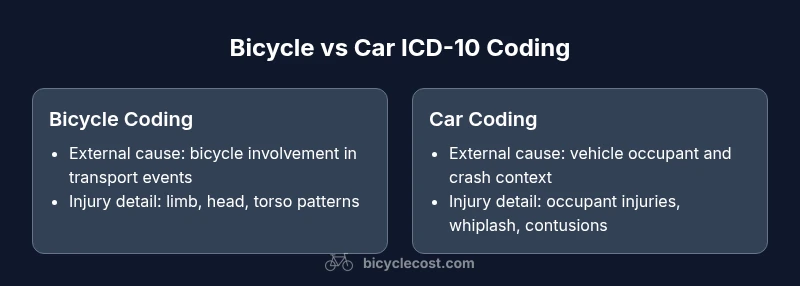
When coding bicycle injuries vs car crashes in ICD-10-CM, the key difference is in the external cause codes and the injury codes used to document transport events. This comparison explains how bicycle-related incidents are coded differently from car-related crashes, with practical tips for clinicians, coders, and safety professionals. The BicycleCost team provides guidance to reduce ambiguity and improve records.
Defining the Scope: Bicycle vs Car ICD-10 Context
Bicycle-related incidents and car crashes are both transport events, but their documentation in ICD-10-CM differs in purpose and nuance. For cyclists, the coding often emphasizes rider status and collision type, while for car occupants the emphasis can shift to vehicle type and occupant outcome. According to BicycleCost analysis, accurate coding hinges on distinguishing the injury pattern from the external cause. This section outlines the scope and why it matters for clinicians and coders. The aim is to establish a clear framing for how ICD-10-CM distinguishes bicycle versus car incidents, which supports safer road practices and clearer reimbursement trails. In practice, clinicians should capture the activity (riding vs. driving), the crash partner (vehicle, pedestrian, other), and the resulting injuries to yield precise documentation. The BicycleCost team emphasizes that consistent terminology and following official guidelines reduces ambiguity and improves data quality for research, prevention, and policy planning.
This framing helps professionals understand that the coding narrative should separate what happened from what injuries occurred. It also highlights the need to reflect the cyclist’s role and the collision partner during data capture, which improves road-safety analytics and resource planning. The discussion also sets the stage for how external cause codes interact with diagnosis codes, ultimately shaping patient care, reimbursement, and public health surveillance.
How ICD-10-CM Handles Bicycle-Related Injuries
In ICD-10-CM, transport-related events—such as bicycle crashes—use external cause codes to describe the crash context, while the diagnosis codes explain the actual injuries. For cyclists and pedestrians, external cause codes typically indicate the involvement of a bicycle in a motor vehicle crash. The injury codes (S, T) provide details about the body region, severity, and type of injury. Documentation should reflect the cyclist’s position (rider, pedestrian) and the nature of the collision (with motor vehicle, with fixed object). Although the external cause framework is shared across transport events, bicycle incidents often demand careful attention to activity status, speed context, and collision partner. The goal is to separate the event description from the clinical injury, enabling clearer surveillance and reimbursement pathways. The BicycleCost perspective stresses consistent use of laterality, multiple injury codes when applicable, and alignment with the ICD-10-CM guidelines so that the medical record accurately tells the story of the crash. Clinicians and coders should consult official references for updates, especially when new cycling technologies or urban designs change risk patterns.
From a coding perspective, the bicycle scenario often requires documenting whether the rider was actively cycling at the time of impact and who the other party was. This clarity reduces disputes in billing and improves data quality for evidence-based safety programs. Regular training and adherence to the latest ICD-10-CM guidelines help prevent common discrepancies, such as using generic terms instead of precise activity codes or misclassifying the collision type.
How ICD-10-CM Handles Car-Related Injuries
Car crashes involve vehicle occupants and, in some cases, pedestrians or bicyclists. The diagnostic codes (injury codes) document anatomical injuries, while external cause codes describe who was involved and under what circumstances. For occupants, codes emphasize seat position, airbag deployment, speed context, and crash type when documented; for pedestrians or riders, external cause codes capture the vehicle involved and the event context. The relationship between diagnosis and external cause codes is critical to produce a complete clinical picture for treatment, research, and reimbursement. The coding process benefits from careful notes about seat belt use, airbag status, and casualty status. The BicycleCost team notes that maintaining up-to-date knowledge of the coding guidelines reduces delays in patient care and insurance processing. In all cases, accuracy hinges on pairing the correct injury diagnosis with the appropriate external cause code and the activity of the person involved in the crash.
Practical Coding Scenarios and Examples
Example 1: A cyclist collides with a motor vehicle while riding in an urban corridor. The coder documents the injury location with the corresponding S/t code and pairs it with an external cause code indicating a bicycle collision with a motor vehicle. The emphasis is on the injury pattern and the crash context, not on speculative outcomes. Example 2: A car occupant sustains whiplash and contusions after a rear-end collision. The documentation should include the vehicle occupant’s seating position and the crash dynamics, with external cause codes aligned to motor vehicle crashes. Example 3: A pedestrian struck by a bicycle while crossing at an intersection. The coding approach treats the bicycle as the external cause and captures the pedestrian injuries with standard diagnosis codes while noting the collision context. The coding strategy aims to create a clean, reconstructible medical record for treatment, billing, and prevention analysis. The BicycleCost guidance highlights the need to document chain of events, mechanism, and injuries while avoiding ambiguous terms.
These scenarios illustrate the practical pairing of external cause codes with precise injury diagnoses. In each case, documentation should capture the activity, collision partner, injury patterns, and consequences to support coordination of care, insurance adjudication, and public health reporting. The emphasis on accuracy helps reduce claim denials and improves the reliability of injury surveillance data.
Safety, Prevention, and Documentation Considerations
From a safety and prevention perspective, clear ICD-10-CM documentation supports injury surveillance and resource allocation. Clinicians should record activity (riding a bicycle vs driving a car), crash type (collision, fall, struck by), and injury details. For prevention, data helps identify high-risk intersections and equipment usage patterns, including helmets and lights. Documentation should also note protective measures, such as helmet use, visibility aids, and speed context, as these influence treatment considerations and outcome statistics. The BicycleCost team reiterates that high-quality records enable better public health decisions and a stronger case for safety investments. Additionally, clinicians should document post-crash evaluations, concussion screening when relevant, and any long-term impairment notes to aid both clinical care and follow-up planning. When possible, include timelines and involvement of emergency services, which improves continuity of care and data traceability.
Effective documentation also supports insurance and worker-compensation processes by providing a precise narrative of the crash, injuries, and the occupational or recreational context. For researchers and policymakers, standardized, precise coding yields more reliable trend analyses and safety policy assessments. In short, precise documentation is just as important as the codes themselves, because the data tells a story that informs prevention strategies and resource allocation for cyclists and drivers alike.
Comparison
| Feature | Bicycle injuries (ICD-10-CM) | Car crashes (ICD-10-CM) |
|---|---|---|
| External cause coding approach | Transport-related external cause codes for bicycle involvement | Transport-related external cause codes for vehicle occupants |
| Injury code detail | Often granular by limb, head, or torso injuries (S/T codes) | Often centered on occupant injuries with complementary injury codes |
| Documentation focus | Context of crash and rider status | Vehicle occupant status and crash dynamics |
| Best for | Public safety surveillance and cyclist-focused prevention | Clinical care for vehicle occupants and roadway injuries |
| Documentation complexity | Moderate to high, depending on scenario | Moderate to high, depending on scenario |
Pros
- Clarifies risk differences for clinicians and insurers
- Supports accurate reimbursement and surveillance
- Helps track public safety trends and infrastructure needs
- Improves documentation clarity and data quality
- Aids research and policy development
Downsides
- Requires ongoing training due to guideline updates
- Can be complex for mixed-incident scenarios
- Risk of coding ambiguity without complete notes
- Demand for precise activity status can be challenging in busy settings
Bicycle injuries require distinct external cause coding and detailed injury documentation; car injuries often center on occupant status and crash dynamics.
Both coding tracks rely on pairing external cause codes with accurate injury diagnoses. The bicycle versus car ICD-10 comparison highlights the importance of documenting activity, collision partner, and injury patterns to ensure precise records, appropriate reimbursement, and meaningful safety insights.
People Also Ask
What is the difference between external cause codes for bicycle incidents versus car crashes?
External cause codes describe the crash context (bike involved, vehicle type, etc.), while injury codes document the actual injuries. For bicycles, external causes often indicate bicycle involvement with a motor vehicle, whereas car crashes focus more on vehicle occupancies and crash dynamics. Clinicians should ensure the event narrative aligns with official guidelines to support accurate coding.
External cause codes describe the crash context, and injury codes describe injuries. For bikes, show bicycle involvement; for cars, note occupant details and crash dynamics.
Are there specific ICD-10-CM codes for helmet use in bike incidents?
ICD-10-CM does not have a universal helmet-use code as a standalone diagnosis; helmet use is usually documented in the clinical notes and linked to injury documentation where relevant. The emphasis is on the injuries sustained and the crash context, with helmet use contributing to the overall safety narrative.
There isn’t a separate helmet code; use the injury codes and document helmet use in notes.
How can clinicians ensure accurate ICD-10 coding for mixed transport injuries (bicycle and car)?
For mixed incidents, document the precise activity, collision partner, and injuries, then select the most specific external cause code that reflects the scenario. Cross-check the notes to ensure the context aligns with the patient’s care pathway and insurance requirements.
Detail the activity, partner, and injuries, then choose the closest accurate external cause code and verify against notes.
Where can I find official ICD-10-CM guidelines?
Official ICD-10-CM guidelines are published by government and health agencies. Key sources include the CDC’s ICD-10-CM resources and the CMS ICD-10-CM guidelines page. Regularly review updates to stay compliant with coding practices.
Check the CDC and CMS ICD-10-CM guideline pages for the latest rules and examples.
Do ICD-10-CM codes distinguish rider vs pedestrian in bicycle crashes?
Yes, ICD-10-CM distinguishes whether a person is riding a bicycle, a pedestrian, or an occupant in a vehicle. The external cause code and the injury codes together reflect the person’s role and the crash context.
The codes separate riders, pedestrians, and vehicle occupants based on their role in the crash.
What coding practices improve accuracy for post-crash care and prevention data?
Maintain detailed notes on activity, collision partner, injuries, protective gear, and crash context. Use the most specific injury codes and ensure external cause codes reflect the event to support valid treatment plans, insurance adjudication, and prevention research.
Keep thorough notes on activity, partner, injuries, and context to ensure precise codes and better prevention data.
Quick Summary
- Code the context first: activity and collision partner
- Pair external cause codes with detailed injury diagnoses
- Document helmet use and protective gear when relevant
- Maintain up-to-date knowledge of ICD-10-CM guidelines
- Use consistent terminology to improve surveillance and billing