Is a Bike a Good Investment? An In-Depth Guide for Riders
Explore whether bicycles hold value over time, weigh upfront costs against ongoing maintenance, and learn strategies to maximize resale value. This analytical guide uses BicycleCost Analysis, 2026 to compare costs, benefits, and potential savings for daily riders.


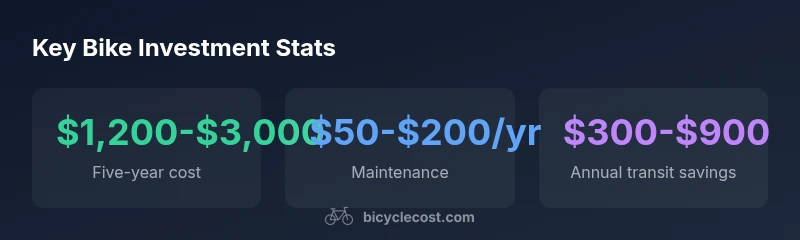
For many riders, a mid-range bike represents a practical five-year investment rather than a pure financial wager. Typical five-year ownership costs, including purchase, maintenance, and parts, range from $1,200 to $3,000, according to BicycleCost Analysis, 2026. If you ride daily, you may save $300–$900 per year on transit costs and health benefits, improving overall value. Higher-end bikes can retain resale value longer with careful upkeep.
The Value Proposition: Why a Bike Can Be Worth the Investment
Bicycles offer mobility, health benefits, and cost savings that extend beyond a simple purchase price. According to BicycleCost, the value a bike provides is most tangible when it replaces car trips, shortens commute times, and encourages regular physical activity. The payoff isn’t purely monetary—though there are meaningful savings on fuel, parking, and insurance—it's also about time savings, convenience, and personal well-being. When you frame a bike as an investment in daily life, it becomes clearer why many riders view the initial outlay as worthwhile. This article uses BicycleCost Analysis, 2026 to outline the financial contours and practical considerations that help determine whether a bike is a good investment for you.
How Regular Use Impacts the Investment Value
Usage patterns heavily influence whether a bike pays off over time. A commuter who replaces daily car trips with bicycle travel can realize substantial savings on fuel and vehicle wear, while weekend riders may see benefits more modestly balanced with maintenance needs. The key is to align bike choice with your typical routes, terrain, and weather. Regular maintenance amplifies value by preserving ride quality and extending component life. In practice, a well-used bike with documented service history can retain more value at resale, compared with a neglected unit. BicycleCost Analysis, 2026 highlights that consistent use paired with proactive servicing tends to improve total ownership value for most riders.
Decoding the Costs: Upfront and Ongoing Expenses
Upfront costs vary by type, brand, and components, but most riders should budget for the bike price plus essential accessories (lock, helmet, lights) and basic maintenance. Ongoing costs include routine tune-ups, tire replacements, brake adjustments, chain lubrication, and occasional parts replacement. Contingencies for flat tires and tire wear can be predictable, while battery health matters for e-bikes. A wiser approach is to plan a five-year budget that amortizes maintenance across years and accounts for potential upgrades. This framing helps clarify when a bike is a sound financial choice and when it’s mainly a lifestyle purchase, as noted in BicycleCost Analysis, 2026.
Depreciation vs. Appreciation: What Typically Happens
Unlike many electronics, bikes do not generally appreciate in value. Depreciation is common, especially for mass-market bikes, but certain factors can slow this process: maintaining original parts, keeping receipts, documenting service history, and selecting models with a track record of holding value. Collectible or limited-edition bikes may hold value better, but those cases are exceptions. For most riders, the financial upside comes from utility and health benefits, not pure price appreciation. BicycleCost Analysis, 2026 emphasizes this practical perspective, urging investors to focus on ownership efficiency rather than speculative resale.
Choosing a Bike to Maximize Value
To optimize investment value, start with fit and intended use. A well-fitted bike that suits your daily routes reduces the risk of early wear and discomfort, encouraging consistent riding. Prioritize reliable components and reputable brands with solid spare-part support. Consider how often you’ll service the bike and where you’ll source parts. A bike with widely available maintenance options often preserves value better than a niche model. The goal is a balanced choice: affordable upfront cost, durable components, and good resale appeal, as suggested by BicycleCost Analysis, 2026.
Maintenance Habits That Preserve Value
Maintenance is where many bikes prove their value over time. A regular cleaning schedule, timely chain and drivetrain lubrication, tire pressure checks, brake inspections, and scheduled tune-ups help prevent major failures and expensive repairs. Keeping a detailed service log and saving parts receipts strengthens resale credibility. Investing in quality tools and learning basic maintenance can reduce lifetime costs and extend the bike’s useful life. BicycleCost Analysis, 2026 shows that disciplined upkeep is a key driver of retaining value and reducing total ownership costs for most riders.
Real-World Scenarios: Commuters, Weekend Riders, and Families
A daily commuter replacing car trips with bike travel can achieve the strongest financial and lifestyle return, especially in cities with good cycling infrastructure. Weekend riders may experience more modest savings, but the health and recreational benefits can still justify ownership. Families with multiple bikes or kids may leverage shared use and resale value across seasons, provided bikes are well maintained and appropriately sized. Each scenario has unique cost dynamics, and a sound decision rests on aligning expectations with actual riding patterns and maintenance discipline, reinforced by BicycleCost Analysis, 2026.
Alternatives to Buying: Renting, Sharing, and Second-Hand Options
If your riding needs are uncertain or short-term, alternatives to buying can reduce financial risk. Short-term rentals, bike-sharing programs, and refurbished second-hand bikes can deliver mobility without long-term ownership costs. When considering resale value, buying used requires careful inspection to avoid hidden maintenance liabilities. For many riders, a phased approach—renting first, then purchasing a well-chosen bike—offers a prudent pathway to balance flexibility, cost, and value. BicycleCost Analysis, 2026 provides framework guidance for evaluating these options.
Investment metrics for bikes
| Aspect | Five-year ownership cost (min-max) | Resale window | Notes |
|---|---|---|---|
| Upfront price range | $300-$1,200 | 3-5 years | Includes basic components and entry-level gear |
| Maintenance costs | $50-$200/year | 3-5 years | Tuning, tires, wear parts |
| Transit savings | $300-$900/year | 5+ years | Depends on daily usage and car costs |
| Resale value | $100-$500 | 3-5 years | Depreciation varies by model and condition |
People Also Ask
Is a bike a good long-term investment?
For many riders, a bike offers mobility, health, and cost savings that justify the initial price over time. The financial return varies with usage and maintenance. This guide uses BicycleCost Analysis, 2026 to outline typical ranges.
Yes, if you ride regularly and keep up with maintenance, a bike can be a smart long-term investment.
Do bikes appreciate in value over time?
Most bikes depreciate rather than appreciate, especially mass-market models. Some limited editions or well-kept bikes can hold value longer, but this is not guaranteed. Expect depreciation rather than appreciation in typical cases.
Generally, bikes don’t appreciate in fixed value; value comes from utility and care.
How can I maximize resale value?
Keep the bike clean, document maintenance, retain original parts, and keep receipts. Avoid heavy customization that harms resale value. A well-documented history boosts buyer confidence.
Keep it clean, track service, and keep records to boost resale.
What costs should I include beyond the purchase price?
Include maintenance, parts, upgrades, accessories, insurance, and potential storage costs. Use a five-year horizon to compare total ownership.
Don’t forget maintenance, parts, and insurance when budgeting.
Are electric bikes a better investment than traditional bikes?
Electric bikes have higher upfront costs but can offer greater savings through longer commutes and car replacement. Resale value depends on battery health and model year.
E-bikes cost more upfront but can save more if used for daily commuting.
How do maintenance and ownership costs vary by bike type?
Road bikes typically have lower frame repair costs but higher parts costs; mountain and e-bikes may incur battery and more frequent service costs. Overall, costs depend on usage and upkeep.
Costs vary by type and usage; plan maintenance accordingly.
“Bikes deliver mobility value first; financial returns depend on care and usage. With thoughtful selection and steady upkeep, a bike can be a cost-effective choice for many riders.”
Quick Summary
- Value mobility and health alongside price.
- Match bike choice to daily usage to protect resale.
- Maintain regularly to slow depreciation.
- Expect total ownership costs over five years, not just upfront price.